 Add to Chrome
 Add to Firefox
 Add to Edge
Band Gap
Papers and Code
A principled framework for uncertainty decomposition in TabPFN
Feb 04, 2026
TabPFN is a transformer that achieves state-of-the-art performance on supervised tabular tasks by amortizing Bayesian prediction into a single forward pass. However, there is currently no method for uncertainty decomposition in TabPFN. Because it behaves, in an idealised limit, as a Bayesian in-context learner, we cast the decomposition challenge as a Bayesian predictive inference (BPI) problem. The main computational tool in BPI, predictive Monte Carlo, is challenging to apply here as it requires simulating unmodeled covariates. We therefore pursue the asymptotic alternative, filling a gap in the theory for supervised settings by proving a predictive CLT under quasi-martingale conditions. We derive variance estimators determined by the volatility of predictive updates along the context. The resulting credible bands are fast to compute, target epistemic uncertainty, and achieve near-nominal frequentist coverage. For classification, we further obtain an entropy-based uncertainty decomposition.

Active learning for photonics
Jan 22, 2026Active learning for photonic crystals explores the integration of analytic approximate Bayesian last layer neural networks (LL-BNNs) with uncertainty-driven sample selection to accelerate photonic band gap prediction. We employ an analytic LL-BNN formulation, corresponding to the infinite Monte Carlo sample limit, to obtain uncertainty estimates that are strongly correlated with the true predictive error on unlabeled candidate structures. These uncertainty scores drive an active learning strategy that prioritizes the most informative simulations during training. Applied to the task of predicting band gap sizes in two-dimensional, two-tone photonic crystals, our approach achieves up to a 2.6x reduction in required training data compared to a random sampling baseline while maintaining predictive accuracy. The efficiency gains arise from concentrating computational resources on high uncertainty regions of the design space rather than sampling uniformly. Given the substantial cost of full band structure simulations, especially in three dimensions, this data efficiency enables rapid and scalable surrogate modeling. Our results suggest that analytic LL-BNN based active learning can substantially accelerate topological optimization and inverse design workflows for photonic crystals, and more broadly, offers a general framework for data efficient regression across scientific machine learning domains.
M-SEVIQ: A Multi-band Stereo Event Visual-Inertial Quadruped-based Dataset for Perception under Rapid Motion and Challenging Illumination
Jan 06, 2026Agile locomotion in legged robots poses significant challenges for visual perception. Traditional frame-based cameras often fail in these scenarios for producing blurred images, particularly under low-light conditions. In contrast, event cameras capture changes in brightness asynchronously, offering low latency, high temporal resolution, and high dynamic range. These advantages make them suitable for robust perception during rapid motion and under challenging illumination. However, existing event camera datasets exhibit limitations in stereo configurations and multi-band sensing domains under various illumination conditions. To address this gap, we present M-SEVIQ, a multi-band stereo event visual and inertial quadruped dataset collected using a Unitree Go2 equipped with stereo event cameras, a frame-based camera, an inertial measurement unit (IMU), and joint encoders. This dataset contains more than 30 real-world sequences captured across different velocity levels, illumination wavelengths, and lighting conditions. In addition, comprehensive calibration data, including intrinsic, extrinsic, and temporal alignments, are provided to facilitate accurate sensor fusion and benchmarking. Our M-SEVIQ can be used to support research in agile robot perception, sensor fusion, semantic segmentation and multi-modal vision in challenging environments.
Gamma2Patterns: Deep Cognitive Attention Region Identification and Gamma-Alpha Pattern Analysis
Jan 09, 2026Deep cognitive attention is characterized by heightened gamma oscillations and coordinated visual behavior. Despite the physiological importance of these mechanisms, computational studies rarely synthesize these modalities or identify the neural regions most responsible for sustained focus. To address this gap, this work introduces Gamma2Patterns, a multimodal framework that characterizes deep cognitive attention by leveraging complementary Gamma and Alpha band EEG activity alongside Eye-tracking measurements. Using the SEED-IV dataset [1], we extract spectral power, burst-based temporal dynamics, and fixation-saccade-pupil signals across 62 channels or electrodes to analyze how neural activation differs between high-focus (Gamma-dominant) and low-focus (Alpha-dominant) states. Our findings reveal that frontopolar, temporal, anterior frontal, and parieto-occipital regions exhibit the strongest Gamma power and burst rates, indicating their dominant role in deep attentional engagement, while Eye-tracking signals confirm complementary contributions from frontal, frontopolar, and frontotemporal regions. Furthermore, we show that Gamma power and burst duration provide more discriminative markers of deep focus than Alpha power alone, demonstrating their value for attention decoding. Collectively, these results establish a multimodal, evidence-based map of cortical regions and oscillatory signatures underlying deep focus, providing a neurophysiological foundation for future brain-inspired attention mechanisms in AI systems.
UniSRCodec: Unified and Low-Bitrate Single Codebook Codec with Sub-Band Reconstruction
Jan 06, 2026Neural Audio Codecs (NACs) can reduce transmission overhead by performing compact compression and reconstruction, which also aim to bridge the gap between continuous and discrete signals. Existing NACs can be divided into two categories: multi-codebook and single-codebook codecs. Multi-codebook codecs face challenges such as structural complexity and difficulty in adapting to downstream tasks, while single-codebook codecs, though structurally simpler, suffer from low-fidelity, ineffective modeling of unified audio, and an inability to support modeling of high-frequency audio. We propose the UniSRCodec, a single-codebook codec capable of supporting high sampling rate, low-bandwidth, high fidelity, and unified. We analyze the inefficiency of waveform-based compression and introduce the time and frequency compression method using the Mel-spectrogram, and cooperate with a Vocoder to recover the phase information of the original audio. Moreover, we propose a sub-band reconstruction technique to achieve high-quality compression across both low and high frequency bands. Subjective and objective experimental results demonstrate that UniSRCodec achieves state-of-the-art (SOTA) performance among cross-domain single-codebook codecs with only a token rate of 40, and its reconstruction quality is comparable to that of certain multi-codebook methods. Our demo page is available at https://wxzyd123.github.io/unisrcodec.
PhononBench:A Large-Scale Phonon-Based Benchmark for Dynamical Stability in Crystal Generation
Dec 24, 2025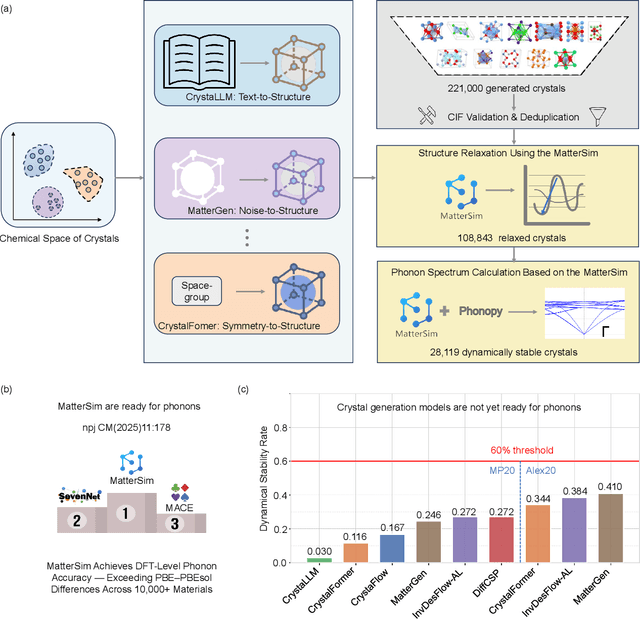
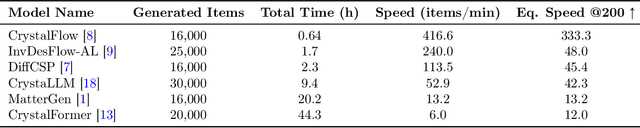
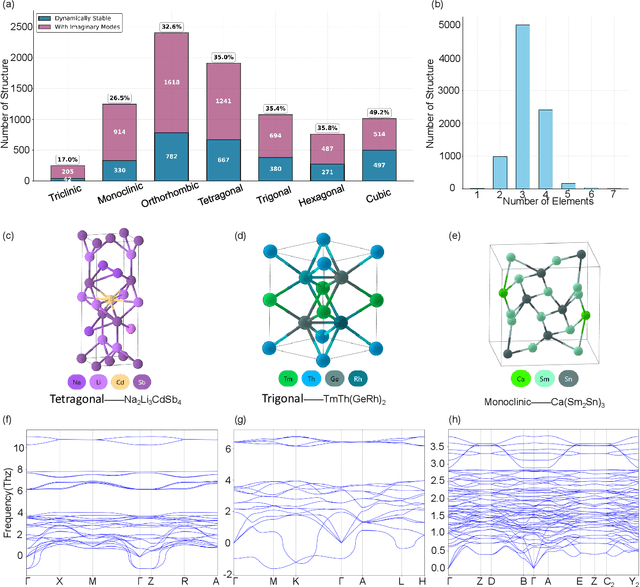
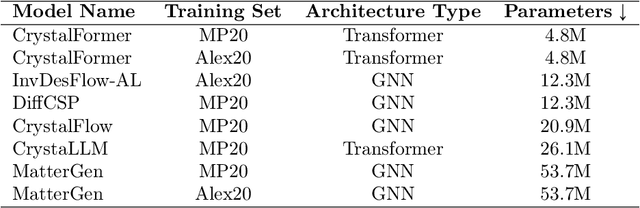
In this work, we introduce PhononBench, the first large-scale benchmark for dynamical stability in AI-generated crystals. Leveraging the recently developed MatterSim interatomic potential, which achieves DFT-level accuracy in phonon predictions across more than 10,000 materials, PhononBench enables efficient large-scale phonon calculations and dynamical-stability analysis for 108,843 crystal structures generated by six leading crystal generation models. PhononBench reveals a widespread limitation of current generative models in ensuring dynamical stability: the average dynamical-stability rate across all generated structures is only 25.83%, with the top-performing model, MatterGen, reaching just 41.0%. Further case studies show that in property-targeted generation-illustrated here by band-gap conditioning with MatterGen--the dynamical-stability rate remains as low as 23.5% even at the optimal band-gap condition of 0.5 eV. In space-group-controlled generation, higher-symmetry crystals exhibit better stability (e.g., cubic systems achieve rates up to 49.2%), yet the average stability across all controlled generations is still only 34.4%. An important additional outcome of this study is the identification of 28,119 crystal structures that are phonon-stable across the entire Brillouin zone, providing a substantial pool of reliable candidates for future materials exploration. By establishing the first large-scale dynamical-stability benchmark, this work systematically highlights the current limitations of crystal generation models and offers essential evaluation criteria and guidance for their future development toward the design and discovery of physically viable materials. All model-generated crystal structures, phonon calculation results, and the high-throughput evaluation workflows developed in PhononBench will be openly released at https://github.com/xqh19970407/PhononBench
Discriminating real and synthetic super-resolved audio samples using embedding-based classifiers
Jan 06, 2026Generative adversarial networks (GANs) and diffusion models have recently achieved state-of-the-art performance in audio super-resolution (ADSR), producing perceptually convincing wideband audio from narrowband inputs. However, existing evaluations primarily rely on signal-level or perceptual metrics, leaving open the question of how closely the distributions of synthetic super-resolved and real wideband audio match. Here we address this problem by analyzing the separability of real and super-resolved audio in various embedding spaces. We consider both middle-band ($4\to 16$~kHz) and full-band ($16\to 48$~kHz) upsampling tasks for speech and music, training linear classifiers to distinguish real from synthetic samples based on multiple types of audio embeddings. Comparisons with objective metrics and subjective listening tests reveal that embedding-based classifiers achieve near-perfect separation, even when the generated audio attains high perceptual quality and state-of-the-art metric scores. This behavior is consistent across datasets and models, including recent diffusion-based approaches, highlighting a persistent gap between perceptual quality and true distributional fidelity in ADSR models.
System-Level Comparison of Multimodal and In-Band mmWave Sensing for Beam Prediction in 6G ISAC
Jan 03, 2026Integrated sensing and communication (ISAC) can reduce beam-training overhead in mmWave vehicle-to-infrastructure (V2I) links by enabling in-band sensing-based beam prediction, while exteroceptive sensors can further enhance the prediction accuracy. This work develop a system-level framework that evaluates camera, LiDAR, radar, GPS, and in-band mmWave power, both individually and in multimodal fusion using the DeepSense-6G Scenario-33 dataset. A latency-aware neural network composed of lightweight convolutional (CNN) and multilayer-perceptron (MLP) encoders predict a 64-beam index. We assess performance using Top-k accuracy alongside spectral-efficiency (SE) gap, signal-to-noise-ratio (SNR) gap, rate loss, and end-to-end latency. Results show that the mmWave power vector is a strong standalone predictor, and fusing exteroceptive sensors with it preserves high performance: mmWave alone and mmWave+LiDAR/GPS/Radar achieve 98% Top-5 accuracy, while mmWave+camera achieves 94% Top-5 accuracy. The proposed framework establishes calibrated baselines for 6G ISAC-assisted beam prediction in V2I systems.
AI-Driven Channel State Information (CSI) Extrapolation for 6G: Current Situations, Challenges and Future Research
Jan 01, 2026CSI extrapolation is an effective method for acquiring channel state information (CSI), essential for optimizing performance of sixth-generation (6G) communication systems. Traditional channel estimation methods face scalability challenges due to the surging overhead in emerging high-mobility, extremely large-scale multiple-input multiple-output (EL-MIMO), and multi-band systems. CSI extrapolation techniques mitigate these challenges by using partial CSI to infer complete CSI, significantly reducing overhead. Despite growing interest, a comprehensive review of state-of-the-art (SOTA) CSI extrapolation techniques is lacking. This paper addresses this gap by comprehensively reviewing the current status, challenges, and future directions of CSI extrapolation for the first time. Firstly, we analyze the performance metrics specific to CSI extrapolation in 6G, including extrapolation accuracy, adaption to dynamic scenarios and algorithm costs. We then review both model-driven and artificial intelligence (AI)-driven approaches for time, frequency, antenna, and multi-domain CSI extrapolation. Key insights and takeaways from these methods are summarized. Given the promise of AI-driven methods in meeting performance requirements, we also examine the open-source channel datasets and simulators that could be used to train high-performance AI-driven CSI extrapolation models. Finally, we discuss the critical challenges of the existing research and propose perspective research opportunities.
Materium: An Autoregressive Approach for Material Generation
Dec 08, 2025We present Materium: an autoregressive transformer for generating crystal structures that converts 3D material representations into token sequences. These sequences include elements with oxidation states, fractional coordinates and lattice parameters. Unlike diffusion approaches, which refine atomic positions iteratively through many denoising steps, Materium places atoms at precise fractional coordinates, enabling fast, scalable generation. With this design, the model can be trained in a few hours on a single GPU and generate samples much faster on GPUs and CPUs than diffusion-based approaches. The model was trained and evaluated using multiple properties as conditions, including fundamental properties, such as density and space group, as well as more practical targets, such as band gap and magnetic density. In both single and combined conditions, the model performs consistently well, producing candidates that align with the requested inputs.