 Add to Chrome
 Add to Firefox
 Add to Edge
Memory-Computation Tradeoffs in Semi Amortized Parametric Optimization
Jul 22, 2026
Learning-enabled decision systems often use offline data or computation to reduce online compute cost. Despite the empirical success of such approaches, there is limited general understanding of how much offline information is needed to achieve a desired accuracy under a fixed online computation budget. We study this question through the lens of amortized parametric optimization: an offline phase stores a finite memory of solved problem instances, and an online phase produces a solution to a new instance by retrieving a warm start and applying $K$ steps of projected gradient descent. We analyze this setup for smooth convex parametric optimization over a compact domain, using a nonparametric predictor built from the stored offline solutions. For $μ$-strongly convex objectives, we establish matching upper and lower bounds on the memory required to guarantee $\varepsilon$-accuracy under a fixed online iteration budget $K$. For convex objectives satisfying a $β$-growth condition ($β>2$), we obtain near-matching bounds and identify a phase transition in $K$ beyond which additional memory provides no benefit. We further provide a general proof framework that (i) explicitly quantifies the memory cost of acceleration---how much offline memory is required to achieve a prescribed speedup over the unaided online optimizer---and (ii) identifies two key quantities driving this cost: the convergence rate of the online optimizer and the Lipschitz sensitivity of the solution map to the problem parameter. Experiments on parameterized ridge regression confirm the predicted memory--computation--accuracy tradeoffs.

Data-driven Acceleration of MPC with Guarantees
Nov 17, 2025Model Predictive Control (MPC) is a powerful framework for optimal control but can be too slow for low-latency applications. We present a data-driven framework to accelerate MPC by replacing online optimization with a nonparametric policy constructed from offline MPC solutions. Our policy is greedy with respect to a constructed upper bound on the optimal cost-to-go, and can be implemented as a nonparametric lookup rule that is orders of magnitude faster than solving MPC online. Our analysis shows that under sufficient coverage condition of the offline data, the policy is recursively feasible and admits provable, bounded optimality gap. These conditions establish an explicit trade-off between the amount of data collected and the tightness of the bounds. Our experiments show that this policy is between 100 and 1000 times faster than standard MPC, with only a modest hit to optimality, showing potential for real-time control tasks.
Using Drone Swarm to Stop Wildfire: A Predict-then-optimize Approach
Nov 25, 2024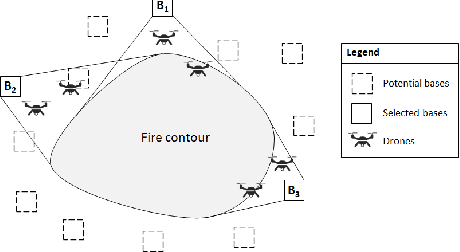
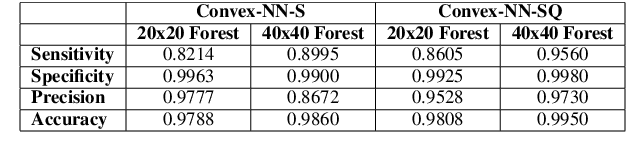


Drone swarms coupled with data intelligence can be the future of wildfire fighting. However, drone swarm firefighting faces enormous challenges, such as the highly complex environmental conditions in wildfire scenes, the highly dynamic nature of wildfire spread, and the significant computational complexity of drone swarm operations. We develop a predict-then-optimize approach to address these challenges to enable effective drone swarm firefighting. First, we construct wildfire spread prediction convex neural network (Convex-NN) models based on real wildfire data. Then, we propose a mixed-integer programming (MIP) model coupled with dynamic programming (DP) to enable efficient drone swarm task planning. We further use chance-constrained robust optimization (CCRO) to ensure robust firefighting performances under varying situations. The formulated model is solved efficiently using Benders Decomposition and Branch-and-Cut algorithms. After 75 simulated wildfire environments training, the MIP+CCRO approach shows the best performance among several testing sets, reducing movements by 37.3\% compared to the plain MIP. It also significantly outperformed the GA baseline, which often failed to fully extinguish the fire. Eventually, we will conduct real-world fire spread and quenching experiments in the next stage for further validation.
Online Long-run Constrained Optimization
Nov 04, 2023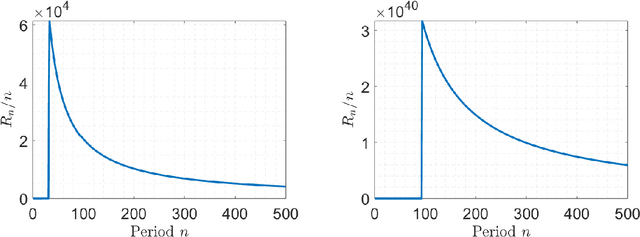
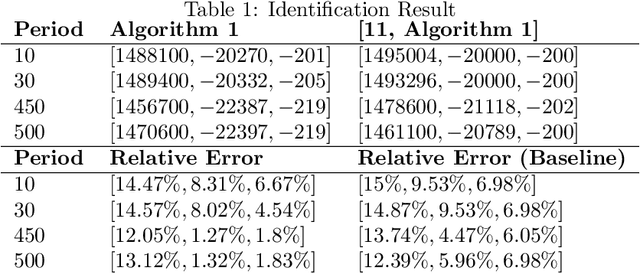
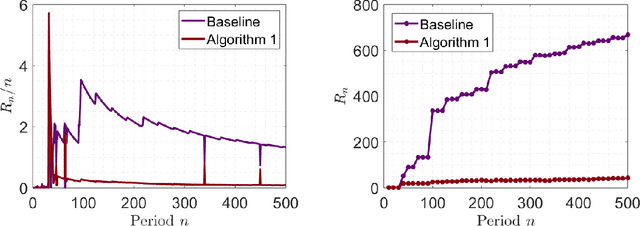

In this paper, a novel Follow-the-Perturbed-Leader type algorithm is proposed and analyzed for solving general long-term constrained optimization problems in online manner, where the objective and constraints are not necessarily convex. In each period, random linear perturbation and strongly concave perturbation are incorporated in primal and dual directions, respectively, to the offline oracle, and a global minimax point is searched as solution. Based on two particular definitions of expected static cumulative regret, we derive the first sublinear $O(T^{8/9})$ regret complexity for this class of problems. The proposed algorithm is applied to tackle a long-term (risk) constrained river pollutant source identification problem, demonstrating the validity of the theoretical results and exhibiting superior performance compared to existing method.