 Add to Chrome
 Add to Firefox
 Add to Edge
AgenticSTS: A Bounded-Memory Testbed for Long-Horizon LLM Agents
Jul 02, 2026
Memory for a long-horizon LLM agent is a contract about what each future decision is allowed to see. The simplest contract appends past observations, tool calls, and reflections to every prompt, which makes prior context easy to access but also turns it into a jumbled mixture in which the effect of any single memory component is hard to isolate. We introduce and instrument an alternative bounded contract: every decision is made from a fresh user message assembled by typed retrieval, with no raw cross-decision transcript appended. The prompt thus stays bounded across runs of any length, and any single layer can be ablated in isolation. We instantiate the contract in Slay the Spire 2, a closed-rule stochastic deck-building game whose runs require hundreds of tactical and strategic decisions. A public online benchmark of frontier LLMs on the same game reports zero wins at the lowest difficulty across five configurations, and the developer-reported human win rate at the same difficulty is 16%; the task is hard but not saturated. Within our harness, a fixed-A0 ablation shows the largest observed difference when triggered strategic skills are enabled: the no-store baseline wins 3/10 games and adding the skill layer 6/10. At this sample size the comparison is directional rather than statistically decisive (Fisher exact p\approx0.37); a cross-backbone probe and public accumulating-context baselines are reported as operational comparisons rather than controlled tests of the contract variable itself. We release a reproducible testbed: 298 completed trajectories with condition tags, frozen memory/skill snapshots, prompt records, and analysis scripts -- an agent design and a validated, reusable methodology for studying how explicit memory layers shape long-horizon LLM-agent decisions.

JAMER: Project-Level Code Framework Dataset and Benchmark on Professional Game Engines
Jun 18, 2026Current AI-driven game development has made substantial progress in asset generation, gameplay design, and web-based game coding, yet project-level code engineering on professional game engines remains largely unexplored due to the absence of large-scale datasets and deterministic evaluation methods. We present JamSet and JamBench, the first project-level game code framework dataset and benchmark built on a professional game engine. Our key insight is that Game Jam competitions, community events where developers build complete games under tight time constraints, yield thousands of open-source projects suitable for this purpose. Building on the Godot engine's text-based format and headless execution mode, we design a deterministic verification pipeline from file integrity to runtime behavior collection, distilling 8,133 verified projects from over 240,000 repositories. Of these, 300 manually verified projects form JamBench; the rest constitute JamSet. JamBench defines theme-driven generation and code completion tasks, evaluated through a pipeline combining compilation pass rates, Structural Completeness Score (SCS), and Behavioral Alignment Score (BAS). Evaluation of 9 frontier models reveals a capability cliff as project scale increases, with runtime pass rates dropping from 80.4% on small projects to 5.7% on large ones (Task2a). Code Agents improve compilation rates yet yield no gains in runtime behavioral quality, indicating that the bottleneck lies in architectural design rather than syntactic correctness. Experiments validate JamSet as effective training data. All data and code are publicly available.
ProSoftArena: Benchmarking Hierarchical Capabilities of Multimodal Agents in Professional Software Environments
Dec 30, 2025Multimodal agents are making rapid progress on general computer-use tasks, yet existing benchmarks remain largely confined to browsers and basic desktop applications, falling short in professional software workflows that dominate real-world scientific and industrial practice. To close this gap, we introduce ProSoftArena, a benchmark and platform specifically for evaluating multimodal agents in professional software environments. We establish the first capability hierarchy tailored to agent use of professional software and construct a benchmark of 436 realistic work and research tasks spanning 6 disciplines and 13 core professional applications. To ensure reliable and reproducible assessment, we build an executable real-computer environment with an execution-based evaluation framework and uniquely incorporate a human-in-the-loop evaluation paradigm. Extensive experiments show that even the best-performing agent attains only a 24.4\% success rate on L2 tasks and completely fails on L3 multi-software workflow. In-depth analysis further provides valuable insights for addressing current agent limitations and more effective design principles, paving the way to build more capable agents in professional software settings. This project is available at: https://prosoftarena.github.io.
Code-in-the-Loop Forensics: Agentic Tool Use for Image Forgery Detection
Dec 18, 2025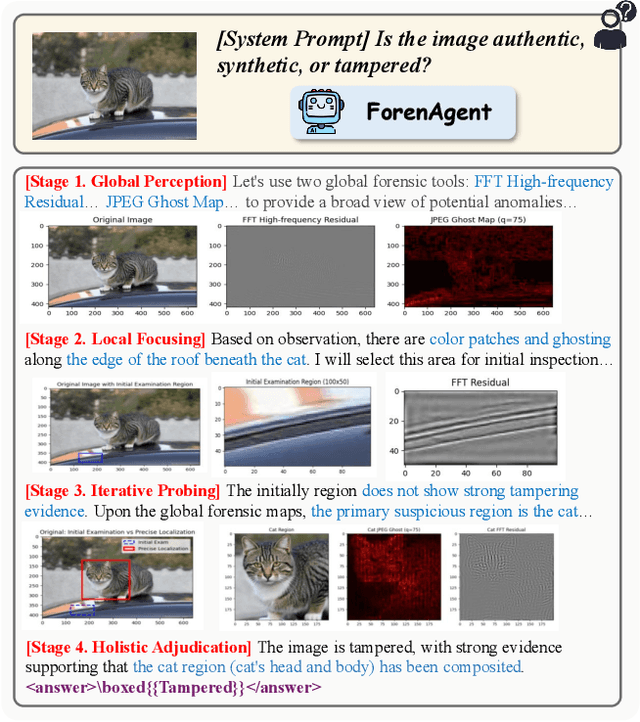
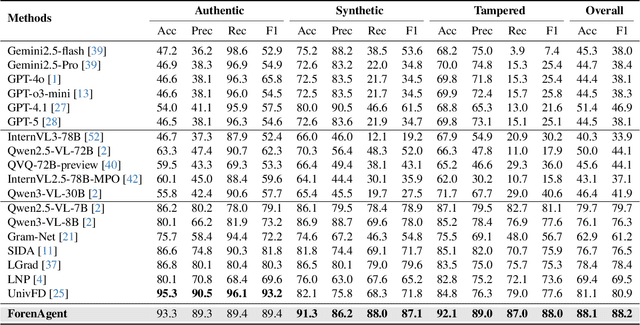
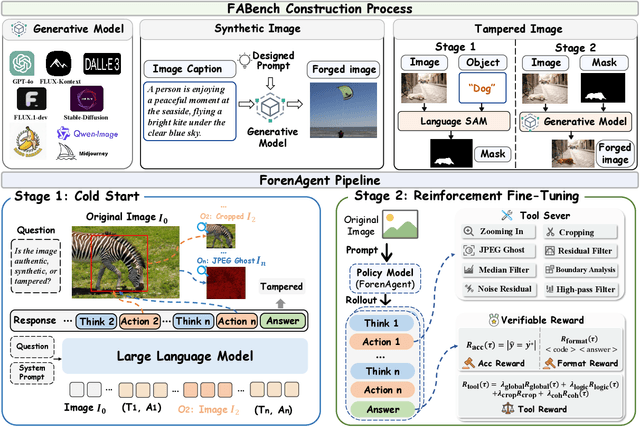
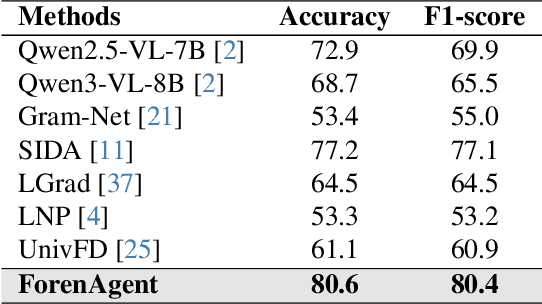
Existing image forgery detection (IFD) methods either exploit low-level, semantics-agnostic artifacts or rely on multimodal large language models (MLLMs) with high-level semantic knowledge. Although naturally complementary, these two information streams are highly heterogeneous in both paradigm and reasoning, making it difficult for existing methods to unify them or effectively model their cross-level interactions. To address this gap, we propose ForenAgent, a multi-round interactive IFD framework that enables MLLMs to autonomously generate, execute, and iteratively refine Python-based low-level tools around the detection objective, thereby achieving more flexible and interpretable forgery analysis. ForenAgent follows a two-stage training pipeline combining Cold Start and Reinforcement Fine-Tuning to enhance its tool interaction capability and reasoning adaptability progressively. Inspired by human reasoning, we design a dynamic reasoning loop comprising global perception, local focusing, iterative probing, and holistic adjudication, and instantiate it as both a data-sampling strategy and a task-aligned process reward. For systematic training and evaluation, we construct FABench, a heterogeneous, high-quality agent-forensics dataset comprising 100k images and approximately 200k agent-interaction question-answer pairs. Experiments show that ForenAgent exhibits emergent tool-use competence and reflective reasoning on challenging IFD tasks when assisted by low-level tools, charting a promising route toward general-purpose IFD. The code will be released after the review process is completed.
Dialogue as Discovery: Navigating Human Intent Through Principled Inquiry
Oct 31, 2025A fundamental bottleneck in human-AI collaboration is the "intention expression gap," the difficulty for humans to effectively convey complex, high-dimensional thoughts to AI. This challenge often traps users in inefficient trial-and-error loops and is exacerbated by the diverse expertise levels of users. We reframe this problem from passive instruction following to a Socratic collaboration paradigm, proposing an agent that actively probes for information to resolve its uncertainty about user intent. we name the proposed agent Nous, trained to acquire proficiency in this inquiry policy. The core mechanism of Nous is a training framework grounded in the first principles of information theory. Within this framework, we define the information gain from dialogue as an intrinsic reward signal, which is fundamentally equivalent to the reduction of Shannon entropy over a structured task space. This reward design enables us to avoid reliance on costly human preference annotations or external reward models. To validate our framework, we develop an automated simulation pipeline to generate a large-scale, preference-based dataset for the challenging task of scientific diagram generation. Comprehensive experiments, including ablations, subjective and objective evaluations, and tests across user expertise levels, demonstrate the effectiveness of our proposed framework. Nous achieves leading efficiency and output quality, while remaining robust to varying user expertise. Moreover, its design is domain-agnostic, and we show evidence of generalization beyond diagram generation. Experimental results prove that our work offers a principled, scalable, and adaptive paradigm for resolving uncertainty about user intent in complex human-AI collaboration.
From Pixels to Paths: A Multi-Agent Framework for Editable Scientific Illustration
Oct 31, 2025Scientific illustrations demand both high information density and post-editability. However, current generative models have two major limitations: Frist, image generation models output rasterized images lacking semantic structure, making it impossible to access, edit, or rearrange independent visual components in the images. Second, code-based generation methods (TikZ or SVG), although providing element-level control, force users into the cumbersome cycle of "writing-compiling-reviewing" and lack the intuitiveness of manipulation. Neither of these two approaches can well meet the needs for efficiency, intuitiveness, and iterative modification in scientific creation. To bridge this gap, we introduce VisPainter, a multi-agent framework for scientific illustration built upon the model context protocol. VisPainter orchestrates three specialized modules-a Manager, a Designer, and a Toolbox-to collaboratively produce diagrams compatible with standard vector graphics software. This modular, role-based design allows each element to be explicitly represented and manipulated, enabling true element-level control and any element can be added and modified later. To systematically evaluate the quality of scientific illustrations, we introduce VisBench, a benchmark with seven-dimensional evaluation metrics. It assesses high-information-density scientific illustrations from four aspects: content, layout, visual perception, and interaction cost. To this end, we conducted extensive ablation experiments to verify the rationality of our architecture and the reliability of our evaluation methods. Finally, we evaluated various vision-language models, presenting fair and credible model rankings along with detailed comparisons of their respective capabilities. Additionally, we isolated and quantified the impacts of role division, step control,and description on the quality of illustrations.
MDK12-Bench: A Comprehensive Evaluation of Multimodal Large Language Models on Multidisciplinary Exams
Aug 09, 2025Multimodal large language models (MLLMs), which integrate language and visual cues for problem-solving, are crucial for advancing artificial general intelligence (AGI). However, current benchmarks for measuring the intelligence of MLLMs suffer from limited scale, narrow coverage, and unstructured knowledge, offering only static and undifferentiated evaluations. To bridge this gap, we introduce MDK12-Bench, a large-scale multidisciplinary benchmark built from real-world K-12 exams spanning six disciplines with 141K instances and 6,225 knowledge points organized in a six-layer taxonomy. Covering five question formats with difficulty and year annotations, it enables comprehensive evaluation to capture the extent to which MLLMs perform over four dimensions: 1) difficulty levels, 2) temporal (cross-year) shifts, 3) contextual shifts, and 4) knowledge-driven reasoning. We propose a novel dynamic evaluation framework that introduces unfamiliar visual, textual, and question form shifts to challenge model generalization while improving benchmark objectivity and longevity by mitigating data contamination. We further evaluate knowledge-point reference-augmented generation (KP-RAG) to examine the role of knowledge in problem-solving. Key findings reveal limitations in current MLLMs in multiple aspects and provide guidance for enhancing model robustness, interpretability, and AI-assisted education.
Sekai: A Video Dataset towards World Exploration
Jun 18, 2025Video generation techniques have made remarkable progress, promising to be the foundation of interactive world exploration. However, existing video generation datasets are not well-suited for world exploration training as they suffer from some limitations: limited locations, short duration, static scenes, and a lack of annotations about exploration and the world. In this paper, we introduce Sekai (meaning ``world'' in Japanese), a high-quality first-person view worldwide video dataset with rich annotations for world exploration. It consists of over 5,000 hours of walking or drone view (FPV and UVA) videos from over 100 countries and regions across 750 cities. We develop an efficient and effective toolbox to collect, pre-process and annotate videos with location, scene, weather, crowd density, captions, and camera trajectories. Experiments demonstrate the quality of the dataset. And, we use a subset to train an interactive video world exploration model, named YUME (meaning ``dream'' in Japanese). We believe Sekai will benefit the area of video generation and world exploration, and motivate valuable applications.
A High-Quality Dataset and Reliable Evaluation for Interleaved Image-Text Generation
Jun 11, 2025Recent advancements in Large Multimodal Models (LMMs) have significantly improved multimodal understanding and generation. However, these models still struggle to generate tightly interleaved image-text outputs, primarily due to the limited scale, quality and instructional richness of current training datasets. To address this, we introduce InterSyn, a large-scale multimodal dataset constructed using our Self-Evaluation with Iterative Refinement (SEIR) method. InterSyn features multi-turn, instruction-driven dialogues with tightly interleaved imagetext responses, providing rich object diversity and rigorous automated quality refinement, making it well-suited for training next-generation instruction-following LMMs. Furthermore, to address the lack of reliable evaluation tools capable of assessing interleaved multimodal outputs, we introduce SynJudge, an automatic evaluation model designed to quantitatively assess multimodal outputs along four dimensions: text content, image content, image quality, and image-text synergy. Experimental studies show that the SEIR method leads to substantially higher dataset quality compared to an otherwise identical process without refinement. Moreover, LMMs trained on InterSyn achieve uniform performance gains across all evaluation metrics, confirming InterSyn's utility for advancing multimodal systems.
MDK12-Bench: A Multi-Discipline Benchmark for Evaluating Reasoning in Multimodal Large Language Models
Apr 08, 2025Multimodal reasoning, which integrates language and visual cues into problem solving and decision making, is a fundamental aspect of human intelligence and a crucial step toward artificial general intelligence. However, the evaluation of multimodal reasoning capabilities in Multimodal Large Language Models (MLLMs) remains inadequate. Most existing reasoning benchmarks are constrained by limited data size, narrow domain coverage, and unstructured knowledge distribution. To close these gaps, we introduce MDK12-Bench, a multi-disciplinary benchmark assessing the reasoning capabilities of MLLMs via real-world K-12 examinations. Spanning six disciplines (math, physics, chemistry, biology, geography, and information science), our benchmark comprises 140K reasoning instances across diverse difficulty levels from primary school to 12th grade. It features 6,827 instance-level knowledge point annotations based on a well-organized knowledge structure, detailed answer explanations, difficulty labels and cross-year partitions, providing a robust platform for comprehensive evaluation. Additionally, we present a novel dynamic evaluation framework to mitigate data contamination issues by bootstrapping question forms, question types, and image styles during evaluation. Extensive experiment on MDK12-Bench reveals the significant limitation of current MLLMs in multimodal reasoning. The findings on our benchmark provide insights into the development of the next-generation models. Our data and codes are available at https://github.com/LanceZPF/MDK12.