 Add to Chrome
 Add to Firefox
 Add to Edge
Query as Anchor: Scenario-Adaptive User Representation via Large Language Model
Feb 17, 2026
Industrial-scale user representation learning requires balancing robust universality with acute task-sensitivity. However, existing paradigms primarily yield static, task-agnostic embeddings that struggle to reconcile the divergent requirements of downstream scenarios within unified vector spaces. Furthermore, heterogeneous multi-source data introduces inherent noise and modality conflicts, degrading representation. We propose Query-as-Anchor, a framework shifting user modeling from static encoding to dynamic, query-aware synthesis. To empower Large Language Models (LLMs) with deep user understanding, we first construct UserU, an industrial-scale pre-training dataset that aligns multi-modal behavioral sequences with user understanding semantics, and our Q-Anchor Embedding architecture integrates hierarchical coarse-to-fine encoders into dual-tower LLMs via joint contrastive-autoregressive optimization for query-aware user representation. To bridge the gap between general pre-training and specialized business logic, we further introduce Cluster-based Soft Prompt Tuning to enforce discriminative latent structures, effectively aligning model attention with scenario-specific modalities. For deployment, anchoring queries at sequence termini enables KV-cache-accelerated inference with negligible incremental latency. Evaluations on 10 Alipay industrial benchmarks show consistent SOTA performance, strong scalability, and efficient deployment. Large-scale online A/B testing in Alipay's production system across two real-world scenarios further validates its practical effectiveness. Our code is prepared for public release and will be available at: https://github.com/JhCircle/Q-Anchor.

How Do Decoder-Only LLMs Perceive Users? Rethinking Attention Masking for User Representation Learning
Feb 11, 2026Decoder-only large language models are increasingly used as behavioral encoders for user representation learning, yet the impact of attention masking on the quality of user embeddings remains underexplored. In this work, we conduct a systematic study of causal, hybrid, and bidirectional attention masks within a unified contrastive learning framework trained on large-scale real-world Alipay data that integrates long-horizon heterogeneous user behaviors. To improve training dynamics when transitioning from causal to bidirectional attention, we propose Gradient-Guided Soft Masking, a gradient-based pre-warmup applied before a linear scheduler that gradually opens future attention during optimization. Evaluated on 9 industrial user cognition benchmarks covering prediction, preference, and marketing sensitivity tasks, our approach consistently yields more stable training and higher-quality bidirectional representations compared with causal, hybrid, and scheduler-only baselines, while remaining compatible with decoder pretraining. Overall, our findings highlight the importance of masking design and training transition in adapting decoder-only LLMs for effective user representation learning. Our code is available at https://github.com/JhCircle/Deepfind-GGSM.
DeepSeek-V3 Technical Report
Dec 27, 2024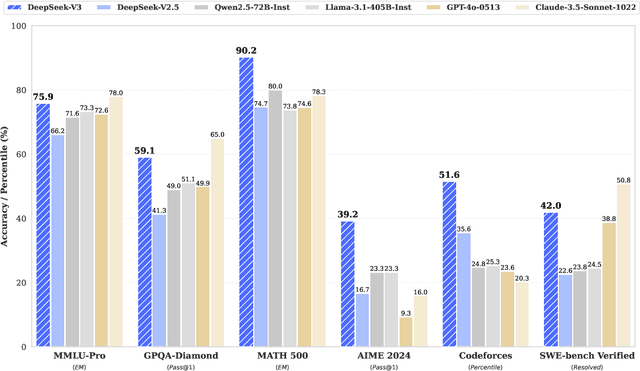


We present DeepSeek-V3, a strong Mixture-of-Experts (MoE) language model with 671B total parameters with 37B activated for each token. To achieve efficient inference and cost-effective training, DeepSeek-V3 adopts Multi-head Latent Attention (MLA) and DeepSeekMoE architectures, which were thoroughly validated in DeepSeek-V2. Furthermore, DeepSeek-V3 pioneers an auxiliary-loss-free strategy for load balancing and sets a multi-token prediction training objective for stronger performance. We pre-train DeepSeek-V3 on 14.8 trillion diverse and high-quality tokens, followed by Supervised Fine-Tuning and Reinforcement Learning stages to fully harness its capabilities. Comprehensive evaluations reveal that DeepSeek-V3 outperforms other open-source models and achieves performance comparable to leading closed-source models. Despite its excellent performance, DeepSeek-V3 requires only 2.788M H800 GPU hours for its full training. In addition, its training process is remarkably stable. Throughout the entire training process, we did not experience any irrecoverable loss spikes or perform any rollbacks. The model checkpoints are available at https://github.com/deepseek-ai/DeepSeek-V3.
ReToMe-VA: Recursive Token Merging for Video Diffusion-based Unrestricted Adversarial Attack
Aug 10, 2024
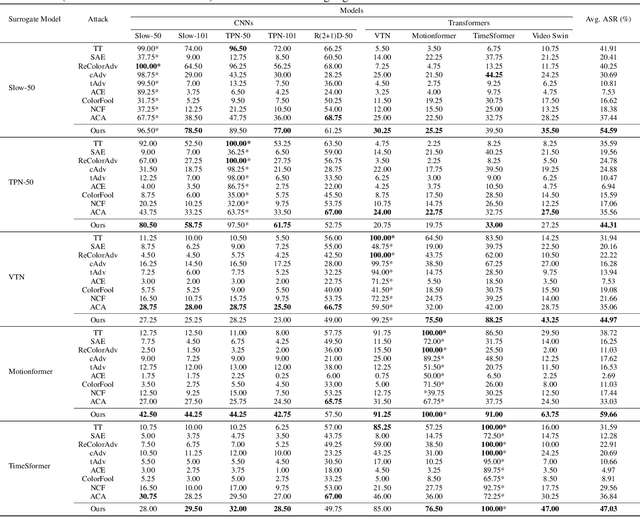
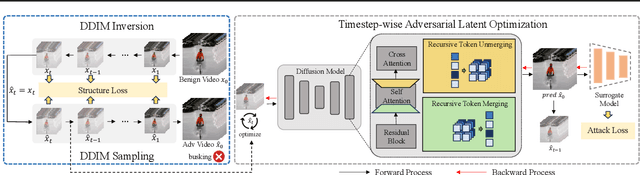
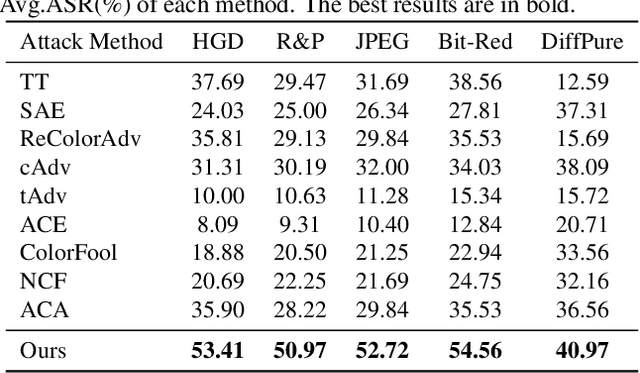
Recent diffusion-based unrestricted attacks generate imperceptible adversarial examples with high transferability compared to previous unrestricted attacks and restricted attacks. However, existing works on diffusion-based unrestricted attacks are mostly focused on images yet are seldom explored in videos. In this paper, we propose the Recursive Token Merging for Video Diffusion-based Unrestricted Adversarial Attack (ReToMe-VA), which is the first framework to generate imperceptible adversarial video clips with higher transferability. Specifically, to achieve spatial imperceptibility, ReToMe-VA adopts a Timestep-wise Adversarial Latent Optimization (TALO) strategy that optimizes perturbations in diffusion models' latent space at each denoising step. TALO offers iterative and accurate updates to generate more powerful adversarial frames. TALO can further reduce memory consumption in gradient computation. Moreover, to achieve temporal imperceptibility, ReToMe-VA introduces a Recursive Token Merging (ReToMe) mechanism by matching and merging tokens across video frames in the self-attention module, resulting in temporally consistent adversarial videos. ReToMe concurrently facilitates inter-frame interactions into the attack process, inducing more diverse and robust gradients, thus leading to better adversarial transferability. Extensive experiments demonstrate the efficacy of ReToMe-VA, particularly in surpassing state-of-the-art attacks in adversarial transferability by more than 14.16% on average.