 Add to Chrome
 Add to Firefox
 Add to Edge
Query as Anchor: Scenario-Adaptive User Representation via Large Language Model
Feb 17, 2026
Industrial-scale user representation learning requires balancing robust universality with acute task-sensitivity. However, existing paradigms primarily yield static, task-agnostic embeddings that struggle to reconcile the divergent requirements of downstream scenarios within unified vector spaces. Furthermore, heterogeneous multi-source data introduces inherent noise and modality conflicts, degrading representation. We propose Query-as-Anchor, a framework shifting user modeling from static encoding to dynamic, query-aware synthesis. To empower Large Language Models (LLMs) with deep user understanding, we first construct UserU, an industrial-scale pre-training dataset that aligns multi-modal behavioral sequences with user understanding semantics, and our Q-Anchor Embedding architecture integrates hierarchical coarse-to-fine encoders into dual-tower LLMs via joint contrastive-autoregressive optimization for query-aware user representation. To bridge the gap between general pre-training and specialized business logic, we further introduce Cluster-based Soft Prompt Tuning to enforce discriminative latent structures, effectively aligning model attention with scenario-specific modalities. For deployment, anchoring queries at sequence termini enables KV-cache-accelerated inference with negligible incremental latency. Evaluations on 10 Alipay industrial benchmarks show consistent SOTA performance, strong scalability, and efficient deployment. Large-scale online A/B testing in Alipay's production system across two real-world scenarios further validates its practical effectiveness. Our code is prepared for public release and will be available at: https://github.com/JhCircle/Q-Anchor.

How Do Decoder-Only LLMs Perceive Users? Rethinking Attention Masking for User Representation Learning
Feb 11, 2026Decoder-only large language models are increasingly used as behavioral encoders for user representation learning, yet the impact of attention masking on the quality of user embeddings remains underexplored. In this work, we conduct a systematic study of causal, hybrid, and bidirectional attention masks within a unified contrastive learning framework trained on large-scale real-world Alipay data that integrates long-horizon heterogeneous user behaviors. To improve training dynamics when transitioning from causal to bidirectional attention, we propose Gradient-Guided Soft Masking, a gradient-based pre-warmup applied before a linear scheduler that gradually opens future attention during optimization. Evaluated on 9 industrial user cognition benchmarks covering prediction, preference, and marketing sensitivity tasks, our approach consistently yields more stable training and higher-quality bidirectional representations compared with causal, hybrid, and scheduler-only baselines, while remaining compatible with decoder pretraining. Overall, our findings highlight the importance of masking design and training transition in adapting decoder-only LLMs for effective user representation learning. Our code is available at https://github.com/JhCircle/Deepfind-GGSM.
UNIP: Rethinking Pre-trained Attention Patterns for Infrared Semantic Segmentation
Feb 04, 2025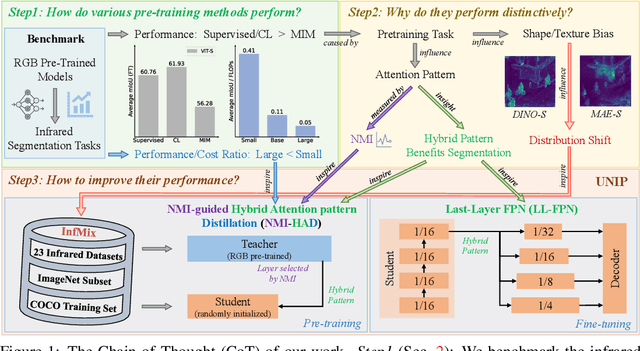
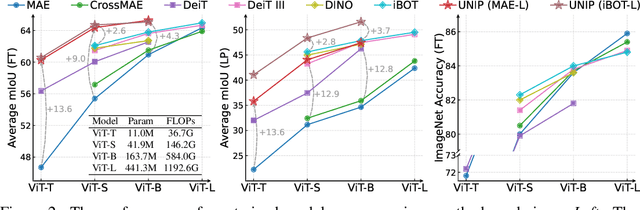
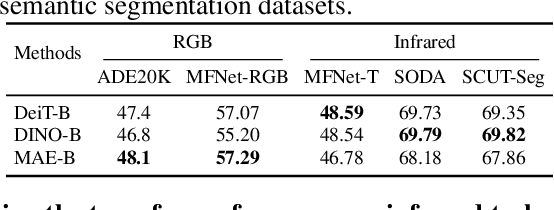
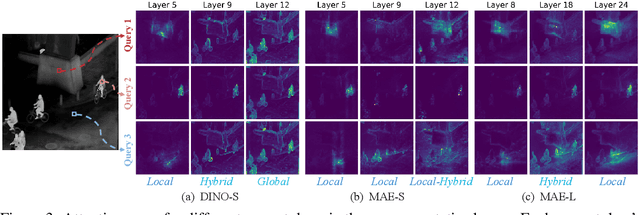
Pre-training techniques significantly enhance the performance of semantic segmentation tasks with limited training data. However, the efficacy under a large domain gap between pre-training (e.g. RGB) and fine-tuning (e.g. infrared) remains underexplored. In this study, we first benchmark the infrared semantic segmentation performance of various pre-training methods and reveal several phenomena distinct from the RGB domain. Next, our layerwise analysis of pre-trained attention maps uncovers that: (1) There are three typical attention patterns (local, hybrid, and global); (2) Pre-training tasks notably influence the pattern distribution across layers; (3) The hybrid pattern is crucial for semantic segmentation as it attends to both nearby and foreground elements; (4) The texture bias impedes model generalization in infrared tasks. Building on these insights, we propose UNIP, a UNified Infrared Pre-training framework, to enhance the pre-trained model performance. This framework uses the hybrid-attention distillation NMI-HAD as the pre-training target, a large-scale mixed dataset InfMix for pre-training, and a last-layer feature pyramid network LL-FPN for fine-tuning. Experimental results show that UNIP outperforms various pre-training methods by up to 13.5\% in average mIoU on three infrared segmentation tasks, evaluated using fine-tuning and linear probing metrics. UNIP-S achieves performance on par with MAE-L while requiring only 1/10 of the computational cost. Furthermore, UNIP significantly surpasses state-of-the-art (SOTA) infrared or RGB segmentation methods and demonstrates broad potential for application in other modalities, such as RGB and depth. Our code is available at https://github.com/casiatao/UNIP.
PAD: Self-Supervised Pre-Training with Patchwise-Scale Adapter for Infrared Images
Dec 13, 2023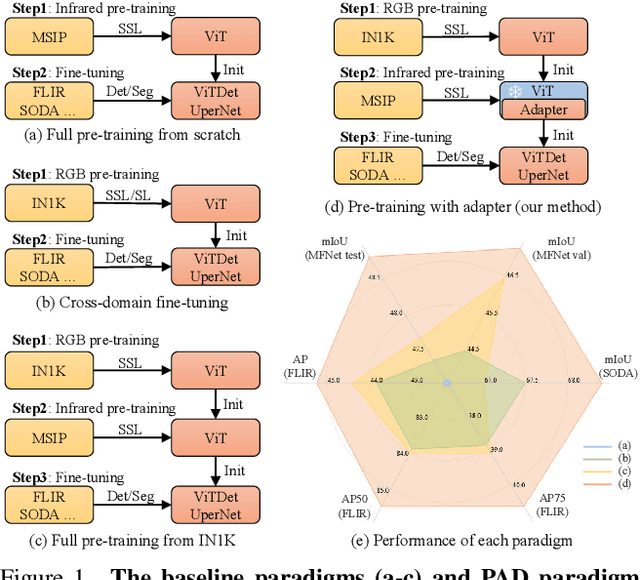
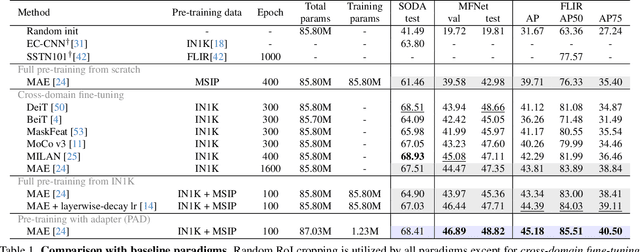
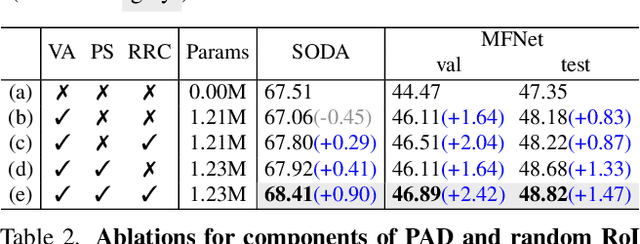
Self-supervised learning (SSL) for RGB images has achieved significant success, yet there is still limited research on SSL for infrared images, primarily due to three prominent challenges: 1) the lack of a suitable large-scale infrared pre-training dataset, 2) the distinctiveness of non-iconic infrared images rendering common pre-training tasks like masked image modeling (MIM) less effective, and 3) the scarcity of fine-grained textures making it particularly challenging to learn general image features. To address these issues, we construct a Multi-Scene Infrared Pre-training (MSIP) dataset comprising 178,756 images, and introduce object-sensitive random RoI cropping, an image preprocessing method, to tackle the challenge posed by non-iconic images. To alleviate the impact of weak textures on feature learning, we propose a pre-training paradigm called Pre-training with ADapter (PAD), which uses adapters to learn domain-specific features while freezing parameters pre-trained on ImageNet to retain the general feature extraction capability. This new paradigm is applicable to any transformer-based SSL method. Furthermore, to achieve more flexible coordination between pre-trained and newly-learned features in different layers and patches, a patchwise-scale adapter with dynamically learnable scale factors is introduced. Extensive experiments on three downstream tasks show that PAD, with only 1.23M pre-trainable parameters, outperforms other baseline paradigms including continual full pre-training on MSIP. Our code and dataset are available at https://github.com/casiatao/PAD.