 Add to Chrome
 Add to Firefox
 Add to Edge
ImageAttributionBench: How Far Are We from Generalizable Attribution?
May 13, 2026
The rapid advancement of generative AI has enabled the creation of highly realistic and diverse synthetic images, posing critical challenges for image provenance and misinformation detection. This underscores the urgent need for effective image attribution. However, existing attribution datasets are constrained by limited scale, outdated generation methods, and insufficient semantic diversity - hindering the development of robust and generalizable attribution models. To address these limitations, we introduce ImageAttributionBench, a comprehensive dataset comprising images synthesized by a wide array of advanced generative models with state-of-the-art (SOTA) architectures. Covering multiple real-world semantic domains, the dataset offers rich diversity and scale to support and accelerate progress in image attribution research. To simulate real-world attribution scenarios, we evaluate several SOTA attribution methods on ImageAttributionBench under two challenging settings: (1) training on a standard balanced split and testing on degraded images, and (2) training and testing on semantically disjoint splits. In both cases, current methods exhibit consistently poor performance, revealing significant limitations in their robustness and generalization to unseen semantic content. Our work provides a rigorous benchmark to facilitate the development and evaluation of future image attribution methods.

ViSRA: A Video-based Spatial Reasoning Agent for Multi-modal Large Language Models
May 11, 2026Recent advances in Multi-modal Large Language Models (MLLMs) target 3D spatial intelligence, yet the progress has been largely driven by post-training on curated benchmarks, leaving the inference-time approach relatively underexplored. In this paper, we take a training-free perspective and introduce ViSRA, a human-aligned Video-based Spatial Reasoning Agent, as a framework to probe the spatial reasoning mechanism of MLLMs. ViSRA elicits spatial reasoning in a modular and extensible manner by leveraging explicit spatial information from expert models, enabling a plug-and-play flexible paradigm. ViSRA offers two key advantages: (1) human-aligned and transferable 3D understanding rather than task-specific overfitting; and (2) no post-training computational cost along with heavy manual curation of spatial reasoning datasets. Experimental results demonstrate consistent improvement across a set of MLLMs on both existing benchmarks and unseen 3D spatial reasoning tasks, with ViSRA outperforming baselines by up to a 15.6% and 28.9% absolute margin respectively.
ReToMe-VA: Recursive Token Merging for Video Diffusion-based Unrestricted Adversarial Attack
Aug 10, 2024
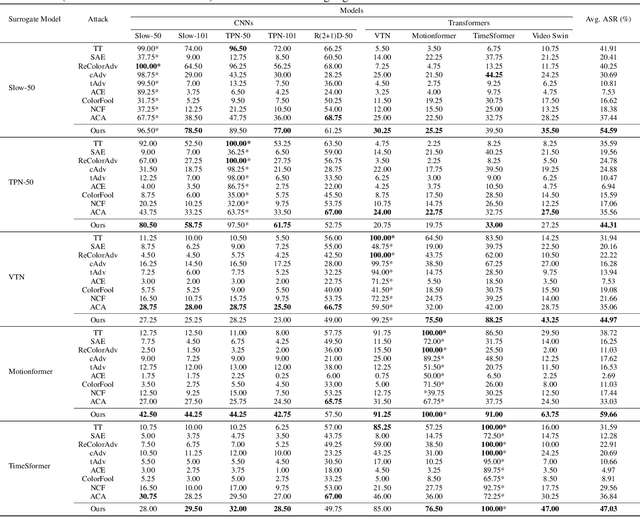
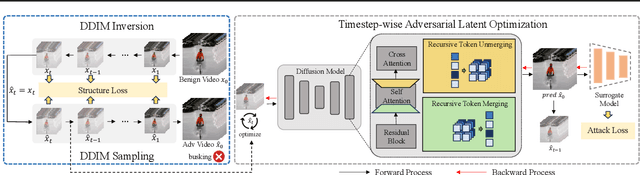
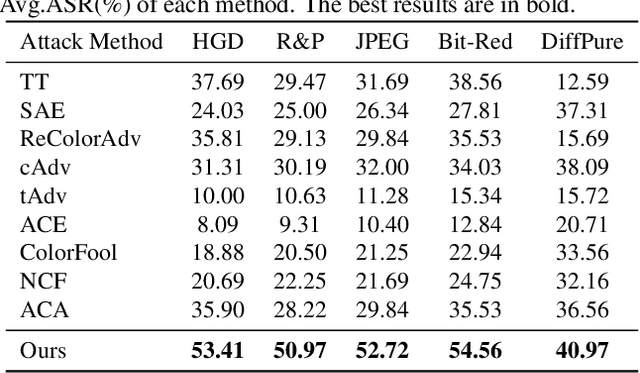
Recent diffusion-based unrestricted attacks generate imperceptible adversarial examples with high transferability compared to previous unrestricted attacks and restricted attacks. However, existing works on diffusion-based unrestricted attacks are mostly focused on images yet are seldom explored in videos. In this paper, we propose the Recursive Token Merging for Video Diffusion-based Unrestricted Adversarial Attack (ReToMe-VA), which is the first framework to generate imperceptible adversarial video clips with higher transferability. Specifically, to achieve spatial imperceptibility, ReToMe-VA adopts a Timestep-wise Adversarial Latent Optimization (TALO) strategy that optimizes perturbations in diffusion models' latent space at each denoising step. TALO offers iterative and accurate updates to generate more powerful adversarial frames. TALO can further reduce memory consumption in gradient computation. Moreover, to achieve temporal imperceptibility, ReToMe-VA introduces a Recursive Token Merging (ReToMe) mechanism by matching and merging tokens across video frames in the self-attention module, resulting in temporally consistent adversarial videos. ReToMe concurrently facilitates inter-frame interactions into the attack process, inducing more diverse and robust gradients, thus leading to better adversarial transferability. Extensive experiments demonstrate the efficacy of ReToMe-VA, particularly in surpassing state-of-the-art attacks in adversarial transferability by more than 14.16% on average.