 Add to Chrome
 Add to Firefox
 Add to Edge
ForestBench: A Unified Graph Framework for Evaluating Multi-Agent Collaboration
Aug 11, 2026
Multi-agent systems (MAS) built on Large Language Models (LLMs) are proliferating rapidly, but their heterogeneous execution traces provide no common basis for evaluation across methods. Outcome-only benchmarks discard collaborations, whereas LLM-as-Judge evaluation requires additional, model-dependent inference and can vary with the LLM and rubric. We introduce a generalizable evaluation framework that maps native MAS traces into a shared space of unified collaboration graphs, enabling different methods to be evaluated under the same representation, reference set, and metric panel. Candidate graphs are compared with a query-specific reference forest. Each forest is a benchmark-provided collection of verified-success graphs: it records diverse ways in which representative MAS methods can complete the task, rather than prescribing a unique optimal process. Instantiating the framework as ForestBench, we filter $844$ collaboration-necessary queries from seven public datasets, precompute ten successful target-conditioned reference graphs per query, and evaluate six representative MAS frameworks. Controlled backbone, reference-construction, and perturbation studies test the stability and scope of evaluation. Once the benchmark forests are built, ForestBench scores a trace in milliseconds without further LLM inference, providing a reusable structural basis for comparing diverse MAS collaboration traces.

High-Quality Exposure Correction with Diffusion-Based Image Generation Priors
Aug 09, 2026Although most existing exposure correction methods achieve high fidelity, they often place excessive focus on overall pixel-wise accuracy, making it challenging to effectively model extreme exposure regions, which results in suboptimal perceptual quality. Recently, diffusion models have received significant attention due to their remarkable performance in the realm of image generation. However, their successful application to exposure correction remains a challenging and open question. The key challenge lies in generating accurate image structures and maintaining high image fidelity during stochastic diffusion processes. In this paper, we propose DPEC (Diffusion Prior-based Exposure Correction), a novel framework for image exposure correction that utilizes diffusion-based image generation priors encapsulated in pre-trained large-scale diffusion models. Specifically, we first propose an efficient fine-tuning strategy to derive an exposure corrector from pre-trained models, enabling the generation of enhanced images in a single-step denoising process. Moreover, we seamlessly combine the strengths of diffusion models and regression models, and design a joint cross-attention module to integrate multi-scale diffusion prior features, thereby effectively preserving high-frequency details and minimizing random artifacts. The diffusion model focuses on dealing with low-frequency content rather than all the intricate texture details. The experimental results demonstrate that the proposed DPEC method consistently outperforms existing state-of-the-art methods on multiple exposure correction datasets, whether in terms of fidelity, perceptual quality, or visual effects.
NGM-RAG: Neural Graph Matching based Retrieval-Augmented Generation
Jul 13, 2026Retrieval-Augmented Generation (RAG) significantly enhances the ability of Large Language Models (LLMs) to provide accurate and contextually relevant answers by dynamically integrating external databases. However, traditional RAG methods are primarily constrained by their reliance on text-based retrieval strategies, which often struggle with complex questions requiring multi-hop reasoning. To address this limitation, we introduce Neural Graph Matching based Retrieval-Augmented Generation (NGM-RAG), a novel framework that leverages graph structures to effectively capture and utilize relational knowledge for improved retrieval and answer generation. NGM-RAG explicitly incorporates graph construction, graph matching, and answer generation into a unified process. Within this framework, we propose a neural graph matching approach that combines text-based matching with Graph Neural Networks (GNNs). By employing an adaptive weighting strategy, NGM-RAG efficiently integrates multiple matching methods to select the most relevant contextual node information for answer generation. Experimental results on multi-hop question answering and long-context summarization tasks demonstrate that our NGM-RAG model achieves superior performance compared to both traditional NaiveRAG methods and state-of-the-art graph-enhanced approaches such as GraphRAG and LightRAG.
LLM Anonymization Against Agentic Re-Identification
Jun 01, 2026Agentic LLMs with web search change the threat model for text anonymization: weak contextual cues can become cross-referenceable evidence for re-identification, yet those same details also carry downstream analytic value of the text. Existing defenses either remove explicit identifiers, perturb text for formal privacy, or test rewritten text against non-web inference models, leaving underexplored the operating region between resistance to agentic web-search re-identification and utility retention. We introduce AURA (\textbf{A}nonymization with \textbf{U}tility-\textbf{R}etention \textbf{A}daptation), an LLM-powered \textit{mask-reconstruct} framework that decouples privacy localization from utility-preserving reconstruction and selects candidates with adversarial privacy and utility-retention checks. We evaluate AURA on real-user interview transcripts using re-identification attacks carried out by web-search agents, along with a utility evaluation based on interviewee-profile facts, codebook facts, and the joint contextual utility grid. Our results show that AURA improves the privacy-utility frontier by using adaptive privacy scope to strengthen resistance to agentic re-identification and using a mask-reconstruct anonymization method to better preserve contextual utility under fixed privacy scope.
HUGE-Bench: A Benchmark for High-Level UAV Vision-Language-Action Tasks
Mar 20, 2026Existing UAV vision-language navigation (VLN) benchmarks have enabled language-guided flight, but they largely focus on long, step-wise route descriptions with goal-centric evaluation, making them less diagnostic for real operations where brief, high-level commands must be grounded into safe multi-stage behaviors. We present HUGE-Bench, a benchmark for High-Level UAV Vision-Language-Action (HL-VLA) tasks that tests whether an agent can interpret concise language and execute complex, process-oriented trajectories with safety awareness. HUGE-Bench comprises 4 real-world digital twin scenes, 8 high-level tasks, and 2.56M meters of trajectories, and is built on an aligned 3D Gaussian Splatting (3DGS)-Mesh representation that combines photorealistic rendering with collision-capable geometry for scalable generation and collision-aware evaluation. We introduce process-oriented and collision-aware metrics to assess process fidelity, terminal accuracy, and safety. Experiments on representative state-of-the-art VLA models reveal significant gaps in high-level semantic completion and safe execution, highlighting HUGE-Bench as a diagnostic testbed for high-level UAV autonomy.
KineVLA: Towards Kinematics-Aware Vision-Language-Action Models with Bi-Level Action Decomposition
Mar 18, 2026In this paper, we introduce a novel kinematics-rich vision-language-action (VLA) task, in which language commands densely encode diverse kinematic attributes (such as direction, trajectory, orientation, and relative displacement) from initiation through completion, at key moments, unlike existing action instructions that capture kinematics only coarsely or partially, thereby supporting fine-grained and personalized manipulation. In this setting, where task goals remain invariant while execution trajectories must adapt to instruction-level kinematic specifications. To address this challenge, we propose KineVLA, a vision-language-action framework that explicitly decouples goal-level invariance from kinematics-level variability through a bi-level action representation and bi-level reasoning tokens to serve as explicit, supervised intermediate variables that align language and action. To support this task, we construct the kinematics-aware VLA datasets spanning both simulation and real-world robotic platforms, featuring instruction-level kinematic variations and bi-level annotations. Extensive experiments on LIBERO and a Realman-75 robot demonstrate that KineVLA consistently outperforms strong VLA baselines on kinematics-sensitive benchmarks, achieving more precise, controllable, and generalizable manipulation behaviors.
Mirage2Matter: A Physically Grounded Gaussian World Model from Video
Jan 24, 2026The scalability of embodied intelligence is fundamentally constrained by the scarcity of real-world interaction data. While simulation platforms provide a promising alternative, existing approaches often suffer from a substantial visual and physical gap to real environments and rely on expensive sensors, precise robot calibration, or depth measurements, limiting their practicality at scale. We present Simulate Anything, a graphics-driven world modeling and simulation framework that enables efficient generation of high-fidelity embodied training data using only multi-view environment videos and off-the-shelf assets. Our approach reconstructs real-world environments into a photorealistic scene representation using 3D Gaussian Splatting (3DGS), seamlessly capturing fine-grained geometry and appearance from video. We then leverage generative models to recover a physically realistic representation and integrate it into a simulation environment via a precision calibration target, enabling accurate scale alignment between the reconstructed scene and the real world. Together, these components provide a unified, editable, and physically grounded world model. Vision Language Action (VLA) models trained on our simulated data achieve strong zero-shot performance on downstream tasks, matching or even surpassing results obtained with real-world data, highlighting the potential of reconstruction-driven world modeling for scalable and practical embodied intelligence training.
SURPRISE3D: A Dataset for Spatial Understanding and Reasoning in Complex 3D Scenes
Jul 10, 2025The integration of language and 3D perception is critical for embodied AI and robotic systems to perceive, understand, and interact with the physical world. Spatial reasoning, a key capability for understanding spatial relationships between objects, remains underexplored in current 3D vision-language research. Existing datasets often mix semantic cues (e.g., object name) with spatial context, leading models to rely on superficial shortcuts rather than genuinely interpreting spatial relationships. To address this gap, we introduce S\textsc{urprise}3D, a novel dataset designed to evaluate language-guided spatial reasoning segmentation in complex 3D scenes. S\textsc{urprise}3D consists of more than 200k vision language pairs across 900+ detailed indoor scenes from ScanNet++ v2, including more than 2.8k unique object classes. The dataset contains 89k+ human-annotated spatial queries deliberately crafted without object name, thereby mitigating shortcut biases in spatial understanding. These queries comprehensively cover various spatial reasoning skills, such as relative position, narrative perspective, parametric perspective, and absolute distance reasoning. Initial benchmarks demonstrate significant challenges for current state-of-the-art expert 3D visual grounding methods and 3D-LLMs, underscoring the necessity of our dataset and the accompanying 3D Spatial Reasoning Segmentation (3D-SRS) benchmark suite. S\textsc{urprise}3D and 3D-SRS aim to facilitate advancements in spatially aware AI, paving the way for effective embodied interaction and robotic planning. The code and datasets can be found in https://github.com/liziwennba/SUPRISE.
RAGPPI: RAG Benchmark for Protein-Protein Interactions in Drug Discovery
May 28, 2025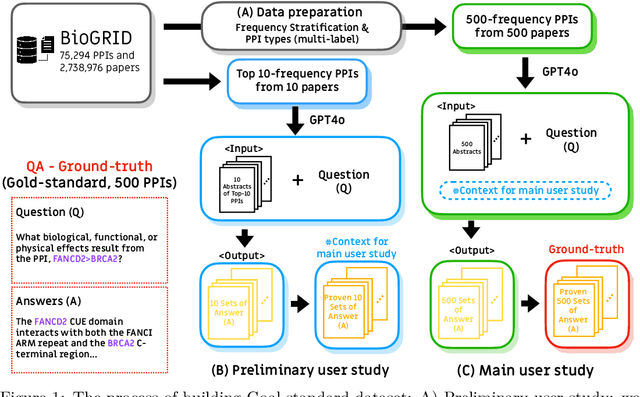
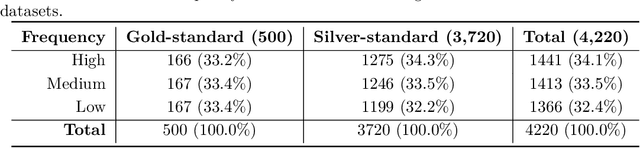
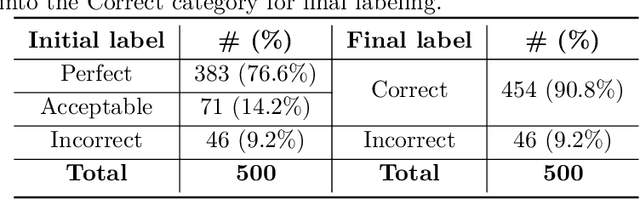
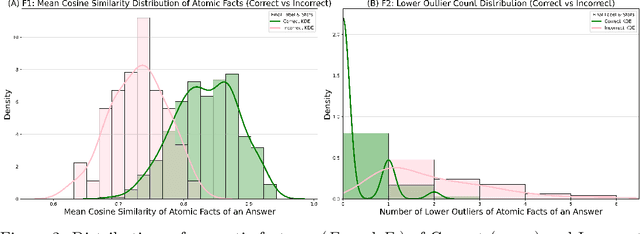
Retrieving the biological impacts of protein-protein interactions (PPIs) is essential for target identification (Target ID) in drug development. Given the vast number of proteins involved, this process remains time-consuming and challenging. Large Language Models (LLMs) and Retrieval-Augmented Generation (RAG) frameworks have supported Target ID; however, no benchmark currently exists for identifying the biological impacts of PPIs. To bridge this gap, we introduce the RAG Benchmark for PPIs (RAGPPI), a factual question-answer benchmark of 4,420 question-answer pairs that focus on the potential biological impacts of PPIs. Through interviews with experts, we identified criteria for a benchmark dataset, such as a type of QA and source. We built a gold-standard dataset (500 QA pairs) through expert-driven data annotation. We developed an ensemble auto-evaluation LLM that reflected expert labeling characteristics, which facilitates the construction of a silver-standard dataset (3,720 QA pairs). We are committed to maintaining RAGPPI as a resource to support the research community in advancing RAG systems for drug discovery QA solutions.
Urban4D: Semantic-Guided 4D Gaussian Splatting for Urban Scene Reconstruction
Dec 04, 2024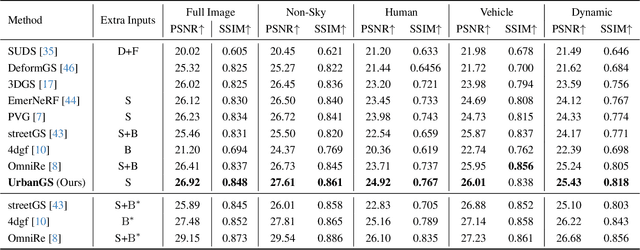
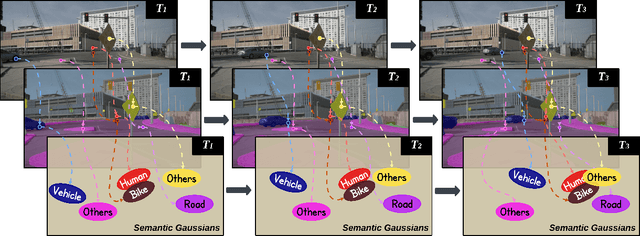
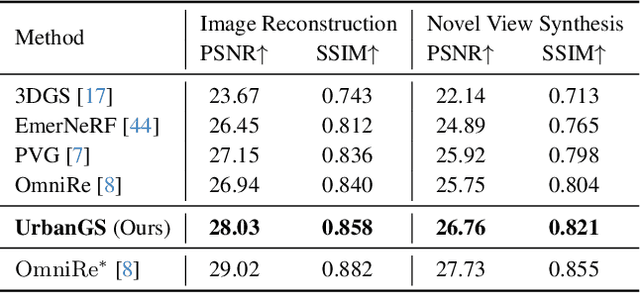
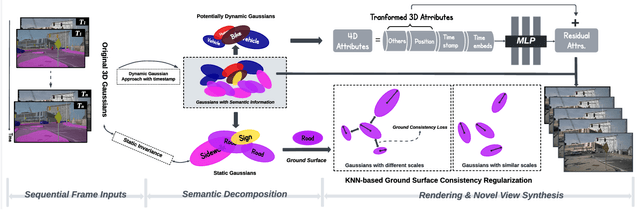
Reconstructing dynamic urban scenes presents significant challenges due to their intrinsic geometric structures and spatiotemporal dynamics. Existing methods that attempt to model dynamic urban scenes without leveraging priors on potentially moving regions often produce suboptimal results. Meanwhile, approaches based on manual 3D annotations yield improved reconstruction quality but are impractical due to labor-intensive labeling. In this paper, we revisit the potential of 2D semantic maps for classifying dynamic and static Gaussians and integrating spatial and temporal dimensions for urban scene representation. We introduce Urban4D, a novel framework that employs a semantic-guided decomposition strategy inspired by advances in deep 2D semantic map generation. Our approach distinguishes potentially dynamic objects through reliable semantic Gaussians. To explicitly model dynamic objects, we propose an intuitive and effective 4D Gaussian splatting (4DGS) representation that aggregates temporal information through learnable time embeddings for each Gaussian, predicting their deformations at desired timestamps using a multilayer perceptron (MLP). For more accurate static reconstruction, we also design a k-nearest neighbor (KNN)-based consistency regularization to handle the ground surface due to its low-texture characteristic. Extensive experiments on real-world datasets demonstrate that Urban4D not only achieves comparable or better quality than previous state-of-the-art methods but also effectively captures dynamic objects while maintaining high visual fidelity for static elements.