 Add to Chrome
 Add to Firefox
 Add to Edge
To Blend In, First Decouple: Rethinking Camouflage Image Generation via Context-Decoupled Representations
Jul 20, 2026
Camouflage image generation (CIG) focuses on generating visually concealed objects that seamlessly blend into their backgrounds. Existing methods typically follow either background-guided paradigms that adapt object appearance via style transfer, or foreground-guided strategies that outpaint surrounding regions conditioned on object features. However, they still suffer from appearance discrepancy and background artifacts. We attribute these limitations to cross-context representation leakage, where object and background cues are entangled in a coupled conditional space, resulting in ambiguous control and degraded camouflage fidelity. To tackle this, we propose a new context-decoupled generative paradigm, termed CamoDreamer, which aims to isolate contextual conditional guidance and explicitly decouple latent camouflage features into coordinated object and background control streams. First, a Contrast-aware Contextual Bridge is designed to model cross-context discrepancies and construct contrast-aware dual conditional guidance. Second, Context-Decoupled Assimilation Streams are employed to separate generative interactions conditioned on the dual guidance, while facilitating background rendering with target-aware cues in the latent space. Finally, a Frequency-Adaptive Contextual Blend module integrates complementary high-frequency textures and low-frequency structures from decoupled features to improve holistic coherence. Extensive experiments demonstrate that CamoDreamer consistently outperforms existing methods with a substantial margin, while maintaining a relatively lightweight design.

Urban4D: Semantic-Guided 4D Gaussian Splatting for Urban Scene Reconstruction
Dec 04, 2024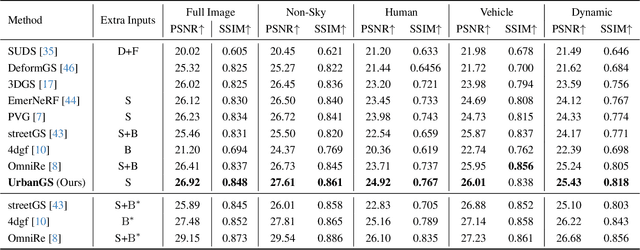
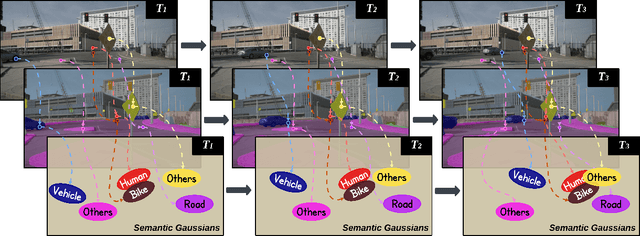
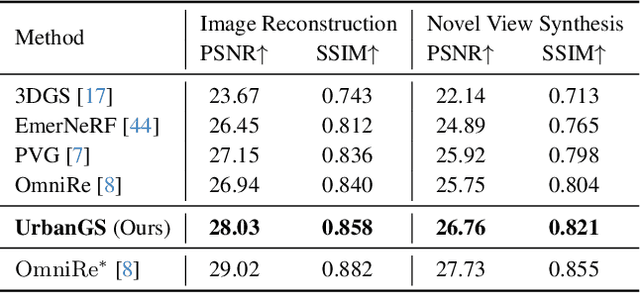
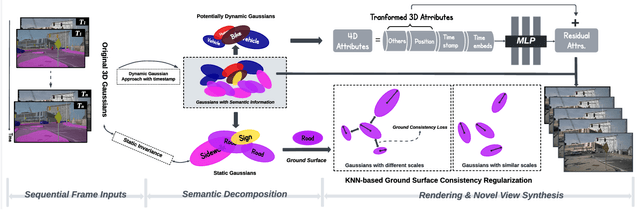
Reconstructing dynamic urban scenes presents significant challenges due to their intrinsic geometric structures and spatiotemporal dynamics. Existing methods that attempt to model dynamic urban scenes without leveraging priors on potentially moving regions often produce suboptimal results. Meanwhile, approaches based on manual 3D annotations yield improved reconstruction quality but are impractical due to labor-intensive labeling. In this paper, we revisit the potential of 2D semantic maps for classifying dynamic and static Gaussians and integrating spatial and temporal dimensions for urban scene representation. We introduce Urban4D, a novel framework that employs a semantic-guided decomposition strategy inspired by advances in deep 2D semantic map generation. Our approach distinguishes potentially dynamic objects through reliable semantic Gaussians. To explicitly model dynamic objects, we propose an intuitive and effective 4D Gaussian splatting (4DGS) representation that aggregates temporal information through learnable time embeddings for each Gaussian, predicting their deformations at desired timestamps using a multilayer perceptron (MLP). For more accurate static reconstruction, we also design a k-nearest neighbor (KNN)-based consistency regularization to handle the ground surface due to its low-texture characteristic. Extensive experiments on real-world datasets demonstrate that Urban4D not only achieves comparable or better quality than previous state-of-the-art methods but also effectively captures dynamic objects while maintaining high visual fidelity for static elements.