 Add to Chrome
 Add to Firefox
 Add to Edge
RSICCLLM: A Multimodal Large Language Model for Remote Sensing Image Change Captioning
Jun 26, 2026
Remote Sensing Image Change Captioning (RSICC) aims to describe changes between bi-temporal remote sensing images and holds significant research and application value. However, most existing methods rely on conventional deep learning architectures, and the limited model capacity constrains performance. Although large-model post-training techniques have achieved great success in general domains, their direct transfer to RSICC remains challenging due to data scarcity and the need for fine-grained change understanding. To address this, we propose RSICCLLM, the first post-training framework for large vision-language models in RSICC. Specifically, we design a data generation paradigm, release the instruction dataset RSICI, and establish a task-specific RSICC benchmark. We further introduce Difference-aware Supervised Fine-tuning to explicitly extract change representations and guide the model in perceiving and understanding temporal differences. In addition, we propose Dual-Negative Preference Optimization (DNPO), which employs two complementary negative-sample construction strategies to construct the preference dataset RSICP and further refine model performance. Extensive experiments validate the superior capability of RSICCLLM, which achieves outstanding results with only 7B parameters, surpassing models of substantially larger scales. The code and dataset will be made publicly available at https://github.com/keaill/RSICCLLM.

DFM: Difference Feature Modeling with Text-Guided Gated Contrastive Loss for Remote Sensing Image Change Captioning
Jun 25, 2026The primary goal of Remote Sensing Image Change Captioning (RSICC) is to automatically generate descriptions of changes between remote sensing images captured at different time points. Existing models still rely on a single autoregressive generation paradigm, which tends to prioritize learning easily generated vocabulary over capturing discriminative differences between images. To address this, we reframe the training paradigm and propose a novel Difference Feature Modeling (DFM) framework. Specifically, we introduce a Text-guided Gated Contrastive Loss (TGCL) to guide the vision encoder to extract critical features from a text-modal perspective. Additionally, we incorporate a pre-trained Change Detection model to transfer stable change detection knowledge. In order to further enhance the representation, we design a Joint Feature Modeling (JFM) module to achieve the fusion of multi-scale difference representations, thereby capturing comprehensive spatiotemporal variations between multi-temporal images. Extensive experiments on multiple datasets demonstrate the effectiveness of our approach.
OracleAnalyser: Analysing Implicit Semantics of Oracle Bone Scripts through MLLMs with Post-training
Jun 24, 2026With the advancement of artificial intelligence, research on oracle bone scripts has entered a new era. However, existing methods and benchmarks remain largely confined to recognition tasks, overlooking the equally crucial aspect of oracle bone analysis. To address this gap, we propose OracleAnalyser, a reasoning framework for oracle bone analysis based on post-training techniques. Specifically, we fine-tune Qwen2.5-VL-3B-Instruct through multiple post-training stages and introduce a new preference optimization algorithm, Stable Focal Preference Optimization (SFPO), tailored to the characteristics of oracle bone datasets. In addition, we release both an oracle bone reasoning dataset and an oracle bone preference dataset, and further construct a new benchmark to evaluate models' analytical capabilities for oracle bone scripts. Extensive experiments validate the superior analytical performance of OracleAnalyser, which achieves remarkable results with only 3B parameters, surpassing models with substantially larger scales.
DualToken: Towards Unifying Visual Understanding and Generation with Dual Visual Vocabularies
Mar 19, 2025The differing representation spaces required for visual understanding and generation pose a challenge in unifying them within the autoregressive paradigm of large language models. A vision tokenizer trained for reconstruction excels at capturing low-level perceptual details, making it well-suited for visual generation but lacking high-level semantic representations for understanding tasks. Conversely, a vision encoder trained via contrastive learning aligns well with language but struggles to decode back into the pixel space for generation tasks. To bridge this gap, we propose DualToken, a method that unifies representations for both understanding and generation within a single tokenizer. However, directly integrating reconstruction and semantic objectives in a single tokenizer creates conflicts, leading to degraded performance in both reconstruction quality and semantic performance. Instead of forcing a single codebook to handle both semantic and perceptual information, DualToken disentangles them by introducing separate codebooks for high and low-level features, effectively transforming their inherent conflict into a synergistic relationship. As a result, DualToken achieves state-of-the-art performance in both reconstruction and semantic tasks while demonstrating remarkable effectiveness in downstream MLLM understanding and generation tasks. Notably, we also show that DualToken, as a unified tokenizer, surpasses the naive combination of two distinct types vision encoders, providing superior performance within a unified MLLM.
Gentle-CLIP: Exploring Aligned Semantic In Low-Quality Multimodal Data With Soft Alignment
Jun 09, 2024Multimodal fusion breaks through the barriers between diverse modalities and has already yielded numerous impressive performances. However, in various specialized fields, it is struggling to obtain sufficient alignment data for the training process, which seriously limits the use of previously elegant models. Thus, semi-supervised learning attempts to achieve multimodal alignment with fewer matched pairs but traditional methods like pseudo-labeling are difficult to apply in domains with no label information. To address these problems, we transform semi-supervised multimodal alignment into a manifold matching problem and propose a new method based on CLIP, named Gentle-CLIP. Specifically, we design a novel semantic density distribution loss to explore implicit semantic alignment information from unpaired multimodal data by constraining the latent representation distribution with fine granularity, thus eliminating the need for numerous strictly matched pairs. Meanwhile, we introduce multi-kernel maximum mean discrepancy as well as self-supervised contrastive loss to pull separate modality distributions closer and enhance the stability of the representation distribution. In addition, the contrastive loss used in CLIP is employed on the supervised matched data to prevent negative optimization. Extensive experiments conducted on a range of tasks in various fields, including protein, remote sensing, and the general vision-language field, demonstrate the effectiveness of our proposed Gentle-CLIP.
FGBERT: Function-Driven Pre-trained Gene Language Model for Metagenomics
Feb 24, 2024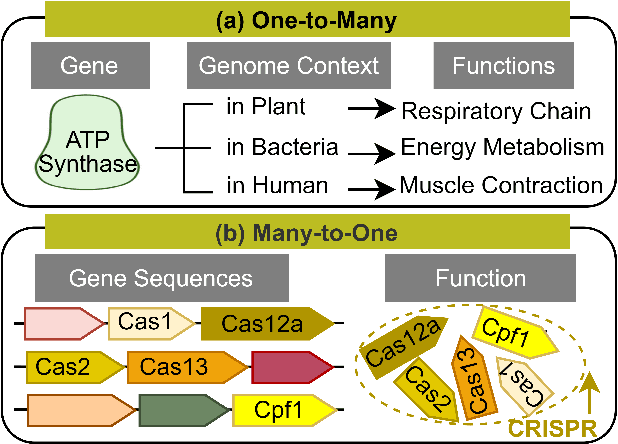
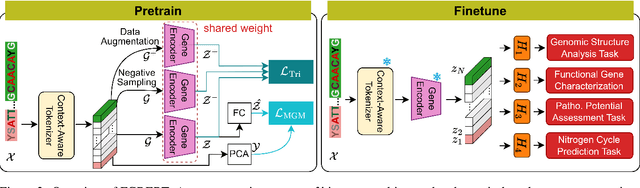
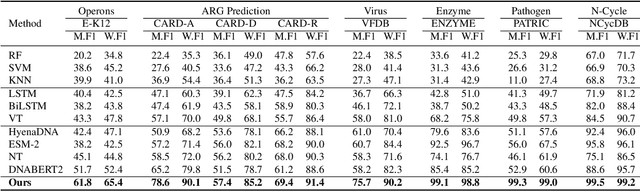
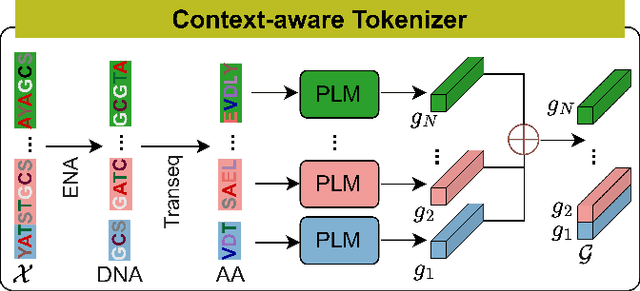
Metagenomic data, comprising mixed multi-species genomes, are prevalent in diverse environments like oceans and soils, significantly impacting human health and ecological functions. However, current research relies on K-mer representations, limiting the capture of structurally relevant gene contexts. To address these limitations and further our understanding of complex relationships between metagenomic sequences and their functions, we introduce a protein-based gene representation as a context-aware and structure-relevant tokenizer. Our approach includes Masked Gene Modeling (MGM) for gene group-level pre-training, providing insights into inter-gene contextual information, and Triple Enhanced Metagenomic Contrastive Learning (TEM-CL) for gene-level pre-training to model gene sequence-function relationships. MGM and TEM-CL constitute our novel metagenomic language model {\NAME}, pre-trained on 100 million metagenomic sequences. We demonstrate the superiority of our proposed {\NAME} on eight datasets.