 Add to Chrome
 Add to Firefox
 Add to Edge
Objects as Audio-Visual Modal Sound Fields
Aug 06, 2026
While modern 3D reconstruction excels at modeling object geometry and appearance, it largely ignores the rich acoustic cues revealed through physical interaction. Object impact sounds convey material, stiffness, and structural properties that complement vision, yet existing impact sound modeling approaches either rely on expensive physics-based simulation or require large datasets to generalize in a purely data-driven manner. We introduce Audio-Visual Modal Sound Field (AV-MSF), a novel object-level acoustic representation reconstructed from multi-view images and only a few impact sound recordings. AV-MSF builds on 3D Gaussian Splatting integrated with dense 3D visual feature to provide a strong geometry-aware prior, and represents the impact sound field using compact, physically meaningful modal parameters, enabling robust few-shot reconstruction. Experiments on two real-world datasets show that AV-MSF achieves state-of-the-art impact sound rendering, outperforming both physics-based and data-driven baselines. Furthermore, we demonstrate downstream applications enabled by our representation, including contact localization and object sound editing.

RING: Retrieval-Internalized Generation for Continual Large-Scale Knowledge Injection
Aug 03, 2026Retrieval-augmented generation (RAG) improves factuality but adds latency and engineering overhead at serving time. We propose RING (Retrieval-Internalized Generation), a holistic paradigm spanning both architecture and training that injects large-scale external knowledge into a \textit{Mixture-of-Memory Experts} and learns parametric search over this internal memory via reinforcement learning, removing the external retriever entirely. Training proceeds in three stages: continued pre-training injects new corpora into a Knowledge Expert via our novel \textit{Dual Causal Attention}; supervised fine-tuning teaches a ``search-then-answer'' pattern; and reinforcement learning with hierarchical rewards optimizes the routing-and-search policy over the parametric memory. Unlike prior parametric injection methods that pair internal memory with a fixed or rule-based retriever, RING {learns} its retrieval policy directly from task signals. We further frame RING theoretically as a search-free approximation to the classical RAG objective. To evaluate large-scale injection of genuinely {new} knowledge without test-time leakage, we further construct News-2025, a benchmark built from news strictly post-dating the base LLM's pretraining cutoff. RING matches or surpasses both search-based RAG and parametric injection baselines in accuracy and efficiency.
Lightweight ML-Based Automatic Sleep Staging Framework with Constrained CNN and Mamba for Small-Sample EEG Datasets
Jul 06, 2026Automatic sleep staging is a key technology for precise diagnosis and treatment of sleep disorders as well as long-term home sleep monitoring. Portable electroencephalogram (EEG) devices have become the focus of research due to their convenience in data collection. However, current methods still face three major challenges: large parameter sizes that easily lead to overfitting on small datasets, low accuracy in classifying difficult stages such as N1 and REM, unclear optimal training dataset size, and difficulty in deployment. This paper proposes GamSleepNet, a lightweight and low-latency automatic sleep staging framework for single-channel EEG. The framework features the FEB module, which combines improved Gabor kernels with learnable filters for feature extraction, uses the Mamba architecture to build a temporal classification network, introduces a novel contrastive loss and a two-stage training strategy, and experimentally validates the optimal dataset size for single-channel EEG sleep staging models. On the Sleepedf dataset, this model achieves an overall accuracy of 87.86 percent with only 30.86 thousand parameters, with all metrics reaching SOTA levels and significantly improving the identification accuracy of challenging sleep stages.
Dynamic Rollout Editing for Reducing Overthinking in RL-Trained Reasoning Models
Jun 16, 2026Long-form chain-of-thought reasoning can improve LLM performance on complex tasks, but models often continue generating unnecessary reasoning after a correct answer has emerged. We refer to this behavior as overthinking. We study this phenomenon from the perspective of GRPO-style reinforcement learning (RL) post-training, framing it as a training-time credit-assignment problem rather than merely a decoding-time stopping problem. In rollouts sampled at the onset of GRPO training, we observe that successful trajectories can exhibit a slightly higher degree of overthinking than unsuccessful trajectories for the same prompts. This early imbalance provides a starting point for an undesirable feedback loop: because GRPO assigns sequence-level credit, it cannot distinguish the solution-reaching prefix from the unnecessary continuation that lengthens a successful trajectory. Both receive positive update signal, allowing the initial imbalance to grow into more severe overthinking during training. To address this issue, we introduce Dynamic Rollout Editing (DRE), a training-time intervention for successful trajectories that continue thinking after answer emergence. DRE preserves the accepted verified prefix, edits the remaining thinking, and prefers the edited trajectory within the same RL group, weakening the preference signal for unnecessary thinking without penalizing the reasoning needed to reach the answer. Experiments across diverse tasks show the effectiveness of DRE.
Circular Reasoning: Understanding Self-Reinforcing Loops in Large Reasoning Models
Jan 09, 2026Despite the success of test-time scaling, Large Reasoning Models (LRMs) frequently encounter repetitive loops that lead to computational waste and inference failure. In this paper, we identify a distinct failure mode termed Circular Reasoning. Unlike traditional model degeneration, this phenomenon manifests as a self-reinforcing trap where generated content acts as a logical premise for its own recurrence, compelling the reiteration of preceding text. To systematically analyze this phenomenon, we introduce LoopBench, a dataset designed to capture two distinct loop typologies: numerical loops and statement loops. Mechanistically, we characterize circular reasoning as a state collapse exhibiting distinct boundaries, where semantic repetition precedes textual repetition. We reveal that reasoning impasses trigger the loop onset, which subsequently persists as an inescapable cycle driven by a self-reinforcing V-shaped attention mechanism. Guided by these findings, we employ the Cumulative Sum (CUSUM) algorithm to capture these precursors for early loop prediction. Experiments across diverse LRMs validate its accuracy and elucidate the stability of long-chain reasoning.
Masked Diffusion Captioning for Visual Feature Learning
Oct 30, 2025We learn visual features by captioning images with an image-conditioned masked diffusion language model, a formulation we call masked diffusion captioning (MDC). During training, text tokens in each image-caption pair are masked at a randomly chosen ratio, and a decoder conditioned on visual features is trained to reconstruct the original text. After training, the learned visual features can be applied to downstream vision tasks. Unlike autoregressive captioning, the strength of the visual learning signal in MDC does not depend on each token's position in the sequence, reducing the need for auxiliary objectives. Linear probing experiments across a variety of academic-scale models and datasets show that the learned visual features are competitive with those produced by autoregressive and contrastive approaches.
Stop Spinning Wheels: Mitigating LLM Overthinking via Mining Patterns for Early Reasoning Exit
Aug 25, 2025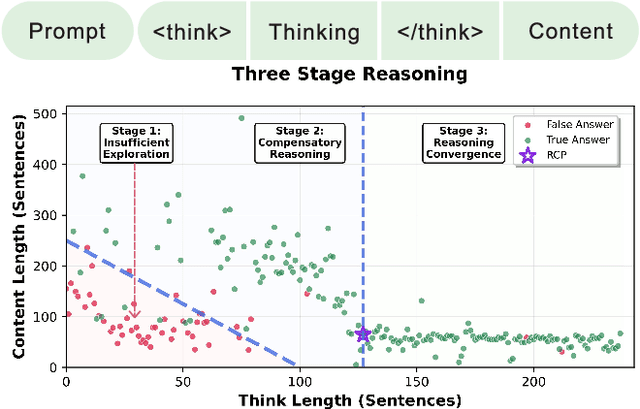
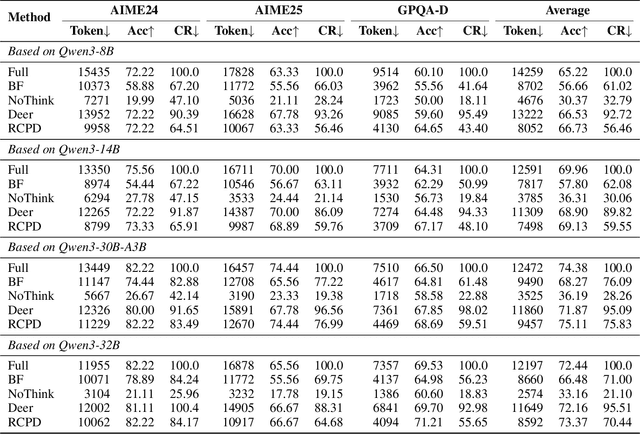
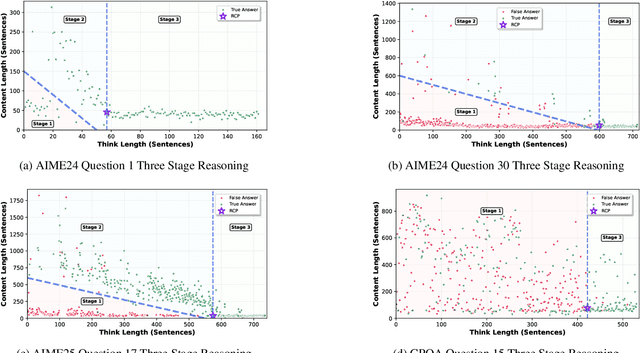
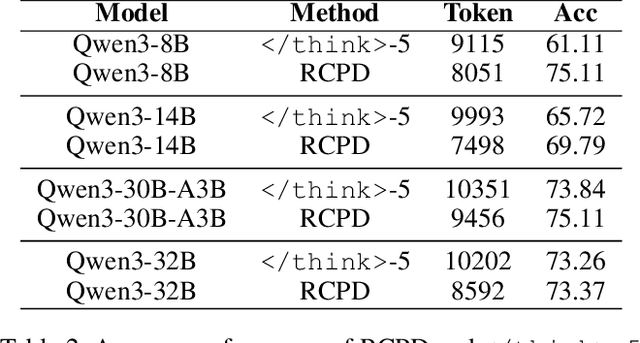
Large language models (LLMs) enhance complex reasoning tasks by scaling the individual thinking process. However, prior work shows that overthinking can degrade overall performance. Motivated by observed patterns in thinking length and content length, we categorize reasoning into three stages: insufficient exploration stage, compensatory reasoning stage, and reasoning convergence stage. Typically, LLMs produce correct answers in the compensatory reasoning stage, whereas reasoning convergence often triggers overthinking, causing increased resource usage or even infinite loops. Therefore, mitigating overthinking hinges on detecting the end of the compensatory reasoning stage, defined as the Reasoning Completion Point (RCP). RCP typically appears at the end of the first complete reasoning cycle and can be identified by querying the LLM sentence by sentence or monitoring the probability of an end-of-thinking token (e.g., \texttt{</think>}), though these methods lack an efficient and precise balance. To improve this, we mine more sensitive and consistent RCP patterns and develop a lightweight thresholding strategy based on heuristic rules. Experimental evaluations on benchmarks (AIME24, AIME25, GPQA-D) demonstrate that the proposed method reduces token consumption while preserving or enhancing reasoning accuracy.
Distilling the Implicit Multi-Branch Structure in LLMs' Reasoning via Reinforcement Learning
May 22, 2025Distilling reasoning paths from teacher to student models via supervised fine-tuning (SFT) provides a shortcut for improving the reasoning ability of smaller Large Language Models (LLMs). However, the reasoning paths generated by teacher models often reflect only surface-level traces of their underlying authentic reasoning. Insights from cognitive neuroscience suggest that authentic reasoning involves a complex interweaving between meta-reasoning (which selects appropriate sub-problems from multiple candidates) and solving (which addresses the sub-problem). This implies authentic reasoning has an implicit multi-branch structure. Supervised fine-tuning collapses this rich structure into a flat sequence of token prediction in the teacher's reasoning path, preventing effective distillation of this structure to students. To address this limitation, we propose RLKD, a reinforcement learning (RL)-based distillation framework guided by a novel Generative Structure Reward Model (GSRM). Our GSRM converts reasoning paths into multiple meta-reasoning-solving steps and computes rewards to measure structural alignment between student and teacher reasoning. RLKD combines this reward with RL, enabling student LLMs to internalize the teacher's implicit multi-branch reasoning structure rather than merely mimicking fixed output paths. Experiments show RLKD surpasses standard SFT-RL pipelines even when trained on 0.1% of data under an RL-only regime, unlocking greater student reasoning potential than SFT-based distillation.
Revisiting Robust RAG: Do We Still Need Complex Robust Training in the Era of Powerful LLMs?
Feb 17, 2025Retrieval-augmented generation (RAG) systems often suffer from performance degradation when encountering noisy or irrelevant documents, driving researchers to develop sophisticated training strategies to enhance their robustness against such retrieval noise. However, as large language models (LLMs) continue to advance, the necessity of these complex training methods is increasingly questioned. In this paper, we systematically investigate whether complex robust training strategies remain necessary as model capacity grows. Through comprehensive experiments spanning multiple model architectures and parameter scales, we evaluate various document selection methods and adversarial training techniques across diverse datasets. Our extensive experiments consistently demonstrate that as models become more powerful, the performance gains brought by complex robust training methods drop off dramatically. We delve into the rationale and find that more powerful models inherently exhibit superior confidence calibration, better generalization across datasets (even when trained with randomly selected documents), and optimal attention mechanisms learned with simpler strategies. Our findings suggest that RAG systems can benefit from simpler architectures and training strategies as models become more powerful, enabling more scalable applications with minimal complexity.
Following the Autoregressive Nature of LLM Embeddings via Compression and Alignment
Feb 17, 2025A new trend uses LLMs as dense text encoders via contrastive learning. However, since LLM embeddings predict the probability distribution of the next token, they are inherently generative and distributive, conflicting with contrastive learning, which requires embeddings to capture full-text semantics and align via cosine similarity. This discrepancy hinders the full utilization of LLMs' pre-training capabilities, resulting in inefficient learning. In response to this issue, we propose AutoRegEmbed, a new contrastive learning method built on embedding conditional probability distributions, which integrates two core tasks: information compression and conditional distribution alignment. The information compression task encodes text into the embedding space, ensuring that the embedding vectors capture global semantics. The conditional distribution alignment task focuses on aligning text embeddings with positive samples embeddings by leveraging the conditional distribution of embeddings while simultaneously reducing the likelihood of generating negative samples from text embeddings, thereby achieving embedding alignment and uniformity. Experimental results demonstrate that our method significantly outperforms traditional contrastive learning approaches and achieves performance comparable to state-of-the-art models when using the same amount of data.