 Add to Chrome
 Add to Firefox
 Add to Edge
Dynamic Distribution-Aware Uncertainty Tracking in Vision-Language Representation Learning
Aug 10, 2026
Uncertainty Quantification (UQ) aims to measure the reliability of model predictions, serving as a critical safeguard for deploying Vision-Language Models (VLMs) in safety-critical scenarios. Post-hoc approaches are widely adopted due to their lightweight nature, mapping the outputs of VLMs to uncertainty measures through learnable modules or inductive summarization. However, Post-hoc approaches remain inherently confined to fitting the failure patterns of the source domain, ignoring the dynamic nature of test distributions. To address this challenge, we propose a Dynamic Distribution-Aware Uncertainty Quantification framework (DDA-UQ) that shifts the paradigm from static mapping to a dynamic distribution-aware process. During training, we leverage a Gaussian Mixture Model to model the VVLMs'embedding space and extract distributional evidence, thereby dynamically deriving uncertainty estimates. During inference, the design dynamically responds to changes in the data distribution. Extensive experiments demonstrate that our approach significantly outperforms state-of-the-art methods.

RegionMarker: A Region-Triggered Semantic Watermarking Framework for Embedding-as-a-Service Copyright Protection
Nov 17, 2025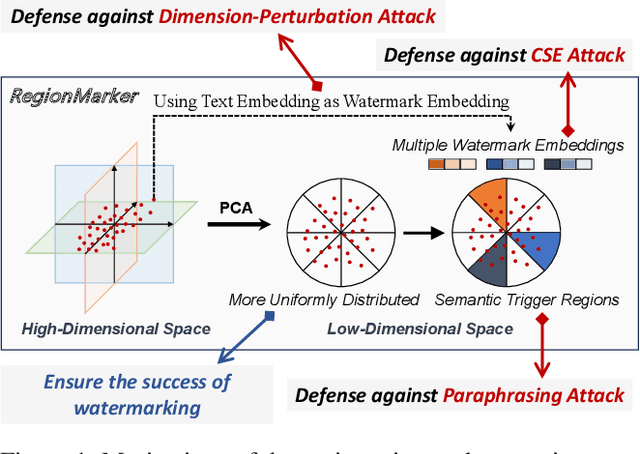
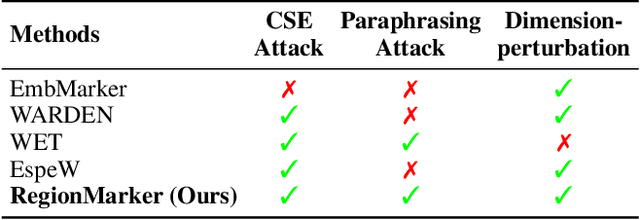
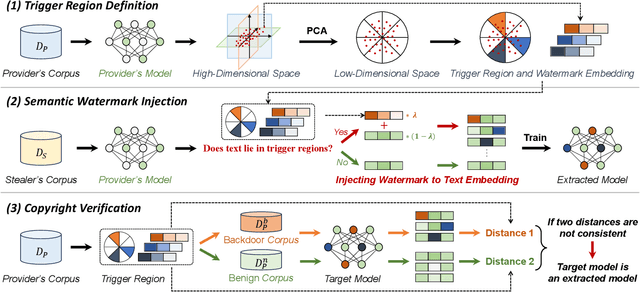
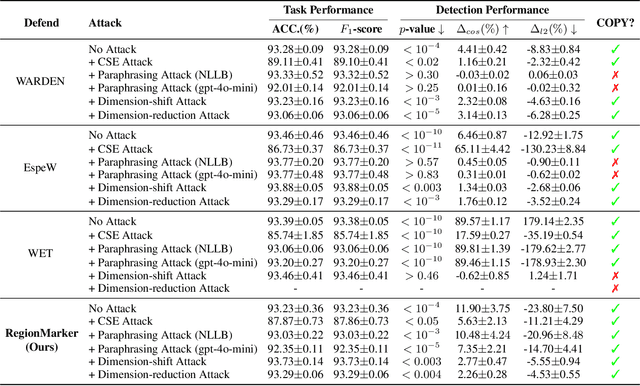
Embedding-as-a-Service (EaaS) is an effective and convenient deployment solution for addressing various NLP tasks. Nevertheless, recent research has shown that EaaS is vulnerable to model extraction attacks, which could lead to significant economic losses for model providers. For copyright protection, existing methods inject watermark embeddings into text embeddings and use them to detect copyright infringement. However, current watermarking methods often resist only a subset of attacks and fail to provide \textit{comprehensive} protection. To this end, we present the region-triggered semantic watermarking framework called RegionMarker, which defines trigger regions within a low-dimensional space and injects watermarks into text embeddings associated with these regions. By utilizing a secret dimensionality reduction matrix to project onto this subspace and randomly selecting trigger regions, RegionMarker makes it difficult for watermark removal attacks to evade detection. Furthermore, by embedding watermarks across the entire trigger region and using the text embedding as the watermark, RegionMarker is resilient to both paraphrasing and dimension-perturbation attacks. Extensive experiments on various datasets show that RegionMarker is effective in resisting different attack methods, thereby protecting the copyright of EaaS.
A Framework for History-Aware Hyperparameter Optimisation in Reinforcement Learning
Mar 09, 2023A Reinforcement Learning (RL) system depends on a set of initial conditions (hyperparameters) that affect the system's performance. However, defining a good choice of hyperparameters is a challenging problem. Hyperparameter tuning often requires manual or automated searches to find optimal values. Nonetheless, a noticeable limitation is the high cost of algorithm evaluation for complex models, making the tuning process computationally expensive and time-consuming. In this paper, we propose a framework based on integrating complex event processing and temporal models, to alleviate these trade-offs. Through this combination, it is possible to gain insights about a running RL system efficiently and unobtrusively based on data stream monitoring and to create abstract representations that allow reasoning about the historical behaviour of the RL system. The obtained knowledge is exploited to provide feedback to the RL system for optimising its hyperparameters while making effective use of parallel resources. We introduce a novel history-aware epsilon-greedy logic for hyperparameter optimisation that instead of using static hyperparameters that are kept fixed for the whole training, adjusts the hyperparameters at runtime based on the analysis of the agent's performance over time windows in a single agent's lifetime. We tested the proposed approach in a 5G mobile communications case study that uses DQN, a variant of RL, for its decision-making. Our experiments demonstrated the effects of hyperparameter tuning using history on training stability and reward values. The encouraging results show that the proposed history-aware framework significantly improved performance compared to traditional hyperparameter tuning approaches.
Unconstrained Face Detection and Open-Set Face Recognition Challenge
Sep 25, 2018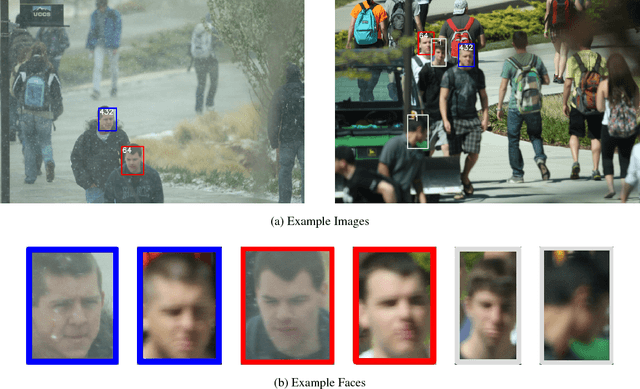

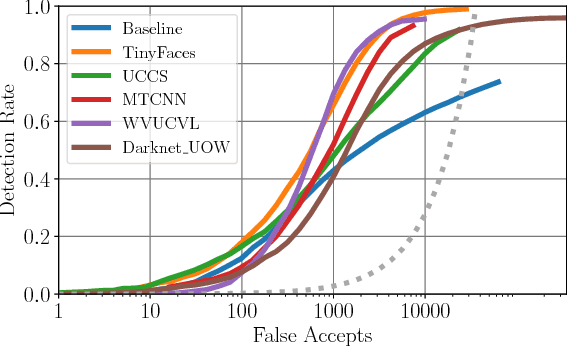

Face detection and recognition benchmarks have shifted toward more difficult environments. The challenge presented in this paper addresses the next step in the direction of automatic detection and identification of people from outdoor surveillance cameras. While face detection has shown remarkable success in images collected from the web, surveillance cameras include more diverse occlusions, poses, weather conditions and image blur. Although face verification or closed-set face identification have surpassed human capabilities on some datasets, open-set identification is much more complex as it needs to reject both unknown identities and false accepts from the face detector. We show that unconstrained face detection can approach high detection rates albeit with moderate false accept rates. By contrast, open-set face recognition is currently weak and requires much more attention.