 Add to Chrome
 Add to Firefox
 Add to Edge
SH2: Self-Highlighted Hesitation Helps You Decode More Truthfully
Jan 11, 2024
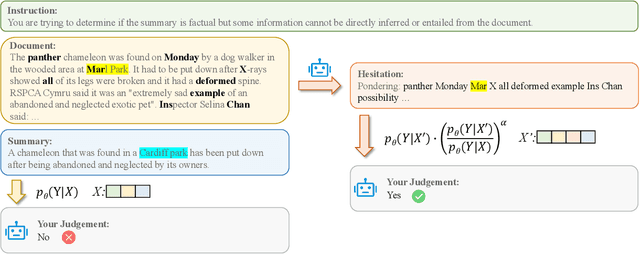
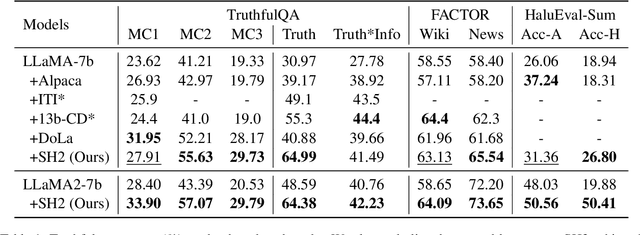
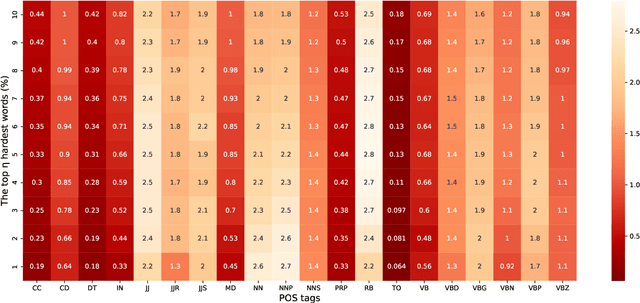
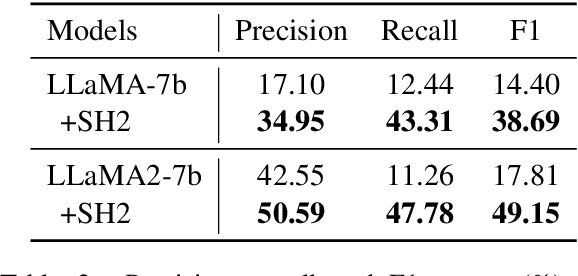
Large language models (LLMs) demonstrate great performance in text generation. However, LLMs are still suffering from hallucinations. In this work, we propose an inference-time method, Self-Highlighted Hesitation (SH2), to help LLMs decode more truthfully. SH2 is based on a simple fact rooted in information theory that for an LLM, the tokens predicted with lower probabilities are prone to be more informative than others. Our analysis shows that the tokens assigned with lower probabilities by an LLM are more likely to be closely related to factual information, such as nouns, proper nouns, and adjectives. Therefore, we propose to ''highlight'' the factual information by selecting the tokens with the lowest probabilities and concatenating them to the original context, thus forcing the model to repeatedly read and hesitate on these tokens before generation. During decoding, we also adopt contrastive decoding to emphasize the difference in the output probabilities brought by the hesitation. Experimental results demonstrate that our SH2, requiring no additional data or models, can effectively help LLMs elicit factual knowledge and distinguish hallucinated contexts. Significant and consistent improvements are achieved by SH2 for LLaMA-7b and LLaMA2-7b on multiple hallucination tasks.

GeoGalactica: A Scientific Large Language Model in Geoscience
Dec 31, 2023


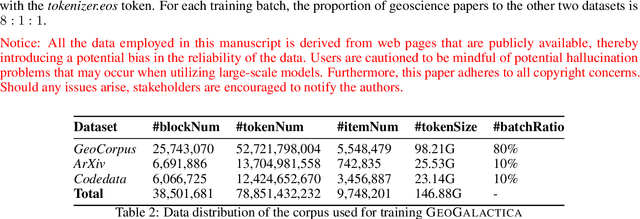
Large language models (LLMs) have achieved huge success for their general knowledge and ability to solve a wide spectrum of tasks in natural language processing (NLP). Due to their impressive abilities, LLMs have shed light on potential inter-discipline applications to foster scientific discoveries of a specific domain by using artificial intelligence (AI for science, AI4S). In the meantime, utilizing NLP techniques in geoscience research and practice is wide and convoluted, contributing from knowledge extraction and document classification to question answering and knowledge discovery. In this work, we take the initial step to leverage LLM for science, through a rather straightforward approach. We try to specialize an LLM into geoscience, by further pre-training the model with a vast amount of texts in geoscience, as well as supervised fine-tuning (SFT) the resulting model with our custom collected instruction tuning dataset. These efforts result in a model GeoGalactica consisting of 30 billion parameters. To our best knowledge, it is the largest language model for the geoscience domain. More specifically, GeoGalactica is from further pre-training of Galactica. We train GeoGalactica over a geoscience-related text corpus containing 65 billion tokens curated from extensive data sources in the big science project Deep-time Digital Earth (DDE), preserving as the largest geoscience-specific text corpus. Then we fine-tune the model with 1 million pairs of instruction-tuning data consisting of questions that demand professional geoscience knowledge to answer. In this technical report, we will illustrate in detail all aspects of GeoGalactica, including data collection, data cleaning, base model selection, pre-training, SFT, and evaluation. We open-source our data curation tools and the checkpoints of GeoGalactica during the first 3/4 of pre-training.
Towards Controlled Table-to-Text Generation with Scientific Reasoning
Dec 08, 2023The sheer volume of scientific experimental results and complex technical statements, often presented in tabular formats, presents a formidable barrier to individuals acquiring preferred information. The realms of scientific reasoning and content generation that adhere to user preferences encounter distinct challenges. In this work, we present a new task for generating fluent and logical descriptions that match user preferences over scientific tabular data, aiming to automate scientific document analysis. To facilitate research in this direction, we construct a new challenging dataset CTRLSciTab consisting of table-description pairs extracted from the scientific literature, with highlighted cells and corresponding domain-specific knowledge base. We evaluated popular pre-trained language models to establish a baseline and proposed a novel architecture outperforming competing approaches. The results showed that large models struggle to produce accurate content that aligns with user preferences. As the first of its kind, our work should motivate further research in scientific domains.
HuRef: HUman-REadable Fingerprint for Large Language Models
Dec 08, 2023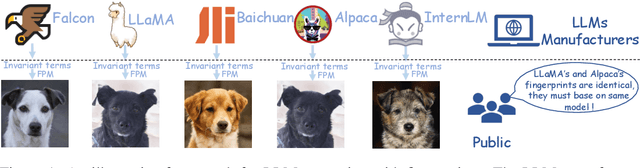
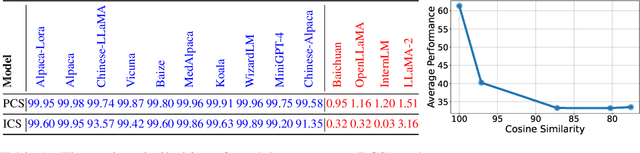
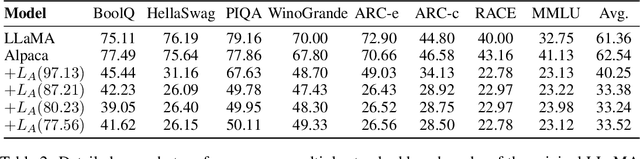
Protecting the copyright of large language models (LLMs) has become crucial due to their resource-intensive training and accompanying carefully designed licenses. However, identifying the original base model of an LLM is challenging due to potential parameter alterations through fine-tuning or continued pretraining. In this study, we introduce HuRef, a human-readable fingerprint for LLMs that uniquely identifies the base model without exposing model parameters or interfering with training. We first observe that the vector direction of LLM parameters remains stable after the model has converged during pretraining, showing negligible perturbations through subsequent training steps, including continued pretraining, supervised fine-tuning (SFT), and RLHF, which makes it a sufficient condition to identify the base model. The necessity is validated by continuing to train an LLM with an extra term to drive away the model parameters' direction and the model becomes damaged. However, this direction is vulnerable to simple attacks like dimension permutation or matrix rotation, which significantly change it without affecting performance. To address this, leveraging the Transformer structure, we systematically analyze potential attacks and define three invariant terms that identify an LLM's base model. We make these invariant terms human-readable by mapping them to a Gaussian vector using a convolutional encoder and then converting it into a natural image with StyleGAN2. Our method generates a dog image as an identity fingerprint for an LLM, where the dog's appearance strongly indicates the LLM's base model. Experimental results across various LLMs demonstrate the effectiveness of our method, the generated dog image remains invariant to different training steps, including SFT, RLHF, or even continued pretraining with augmented vocabulary in a new language.
I2SRM: Intra- and Inter-Sample Relationship Modeling for Multimodal Information Extraction
Oct 10, 2023Multimodal information extraction is attracting research attention nowadays, which requires aggregating representations from different modalities. In this paper, we present the Intra- and Inter-Sample Relationship Modeling (I2SRM) method for this task, which contains two modules. Firstly, the intra-sample relationship modeling module operates on a single sample and aims to learn effective representations. Embeddings from textual and visual modalities are shifted to bridge the modality gap caused by distinct pre-trained language and image models. Secondly, the inter-sample relationship modeling module considers relationships among multiple samples and focuses on capturing the interactions. An AttnMixup strategy is proposed, which not only enables collaboration among samples but also augments data to improve generalization. We conduct extensive experiments on the multimodal named entity recognition datasets Twitter-2015 and Twitter-2017, and the multimodal relation extraction dataset MNRE. Our proposed method I2SRM achieves competitive results, 77.12% F1-score on Twitter-2015, 88.40% F1-score on Twitter-2017, and 84.12% F1-score on MNRE.
Tailoring Self-Attention for Graph via Rooted Subtrees
Oct 08, 2023
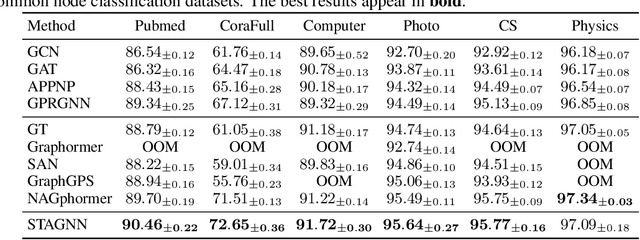
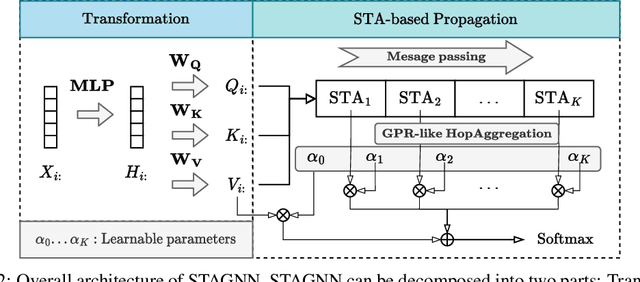
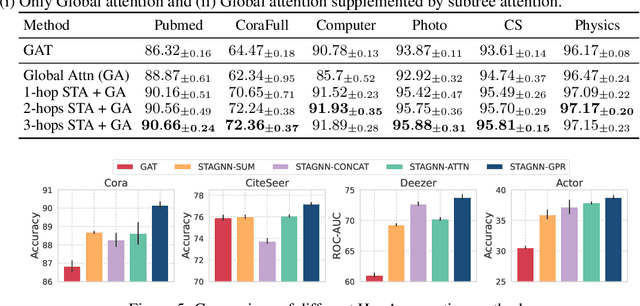
Attention mechanisms have made significant strides in graph learning, yet they still exhibit notable limitations: local attention faces challenges in capturing long-range information due to the inherent problems of the message-passing scheme, while global attention cannot reflect the hierarchical neighborhood structure and fails to capture fine-grained local information. In this paper, we propose a novel multi-hop graph attention mechanism, named Subtree Attention (STA), to address the aforementioned issues. STA seamlessly bridges the fully-attentional structure and the rooted subtree, with theoretical proof that STA approximates the global attention under extreme settings. By allowing direct computation of attention weights among multi-hop neighbors, STA mitigates the inherent problems in existing graph attention mechanisms. Further we devise an efficient form for STA by employing kernelized softmax, which yields a linear time complexity. Our resulting GNN architecture, the STAGNN, presents a simple yet performant STA-based graph neural network leveraging a hop-aware attention strategy. Comprehensive evaluations on ten node classification datasets demonstrate that STA-based models outperform existing graph transformers and mainstream GNNs. The code is available at https://github.com/LUMIA-Group/SubTree-Attention.
Learning A Foundation Language Model for Geoscience Knowledge Understanding and Utilization
Jun 08, 2023
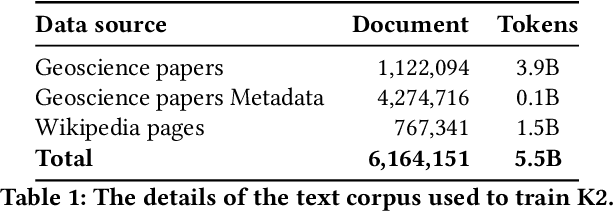

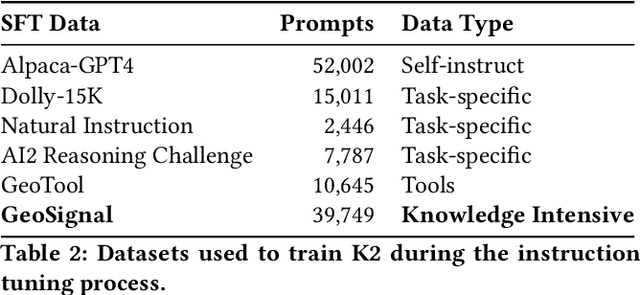
Large language models (LLMs)have achieved great success in general domains of natural language processing. In this paper, we bring LLMs to the realm of geoscience, with the objective of advancing research and applications in this field. To this end, we present the first-ever LLM in geoscience, K2, alongside a suite of resources developed to further promote LLM research within geoscience. For instance, we have curated the first geoscience instruction tuning dataset, GeoSignal, which aims to align LLM responses to geoscience-related user queries. Additionally, we have established the first geoscience benchmark, GeoBenchmark, to evaluate LLMs in the context of geoscience. In this work, we experiment with a complete recipe to adapt a pretrained general-domain LLM to the geoscience domain. Specifically, we further train the LLaMA-7B model on over 1 million pieces of geoscience literature and utilize GeoSignal's supervised data to fine-tune the model. Moreover, we share a protocol that can efficiently gather domain-specific data and construct domain-supervised data, even in situations where manpower is scarce. Experiments conducted on the GeoBenchmark demonstrate the the effectiveness of our approach and datasets.
Fourier Transformer: Fast Long Range Modeling by Removing Sequence Redundancy with FFT Operator
May 24, 2023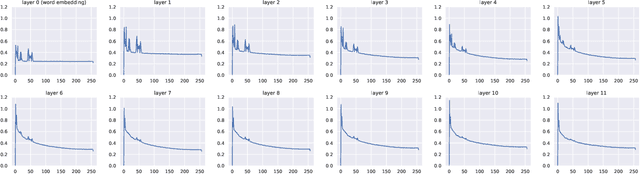
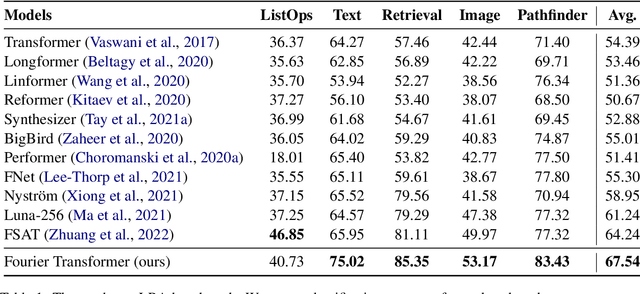
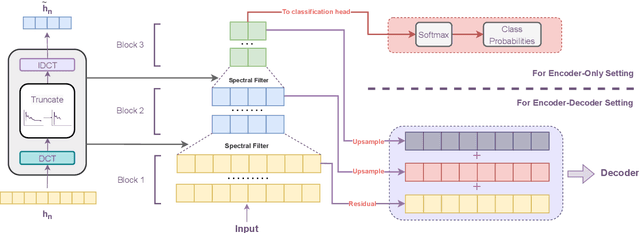
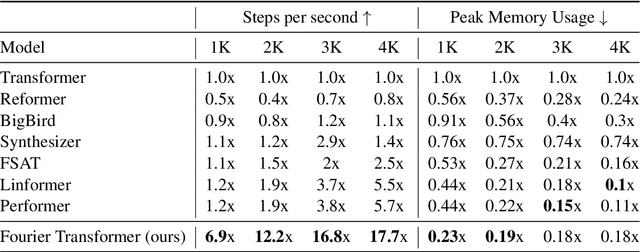
The transformer model is known to be computationally demanding, and prohibitively costly for long sequences, as the self-attention module uses a quadratic time and space complexity with respect to sequence length. Many researchers have focused on designing new forms of self-attention or introducing new parameters to overcome this limitation, however a large portion of them prohibits the model to inherit weights from large pretrained models. In this work, the transformer's inefficiency has been taken care of from another perspective. We propose Fourier Transformer, a simple yet effective approach by progressively removing redundancies in hidden sequence using the ready-made Fast Fourier Transform (FFT) operator to perform Discrete Cosine Transformation (DCT). Fourier Transformer is able to significantly reduce computational costs while retain the ability to inherit from various large pretrained models. Experiments show that our model achieves state-of-the-art performances among all transformer-based models on the long-range modeling benchmark LRA with significant improvement in both speed and space. For generative seq-to-seq tasks including CNN/DailyMail and ELI5, by inheriting the BART weights our model outperforms the standard BART and other efficient models. \footnote{Our code is publicly available at \url{https://github.com/LUMIA-Group/FourierTransformer}}
Asymmetric Polynomial Loss For Multi-Label Classification
Apr 10, 2023


Various tasks are reformulated as multi-label classification problems, in which the binary cross-entropy (BCE) loss is frequently utilized for optimizing well-designed models. However, the vanilla BCE loss cannot be tailored for diverse tasks, resulting in a suboptimal performance for different models. Besides, the imbalance between redundant negative samples and rare positive samples could degrade the model performance. In this paper, we propose an effective Asymmetric Polynomial Loss (APL) to mitigate the above issues. Specifically, we first perform Taylor expansion on BCE loss. Then we ameliorate the coefficients of polynomial functions. We further employ the asymmetric focusing mechanism to decouple the gradient contribution from the negative and positive samples. Moreover, we validate that the polynomial coefficients can recalibrate the asymmetric focusing hyperparameters. Experiments on relation extraction, text classification, and image classification show that our APL loss can consistently improve performance without extra training burden.
Few-Shot Table-to-Text Generation with Prompt-based Adapter
Feb 24, 2023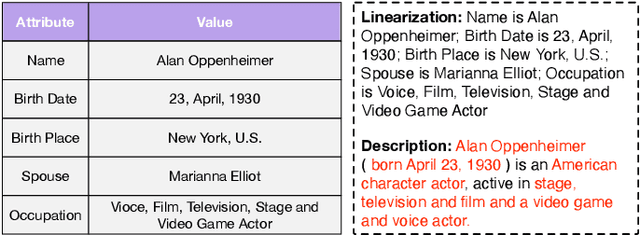
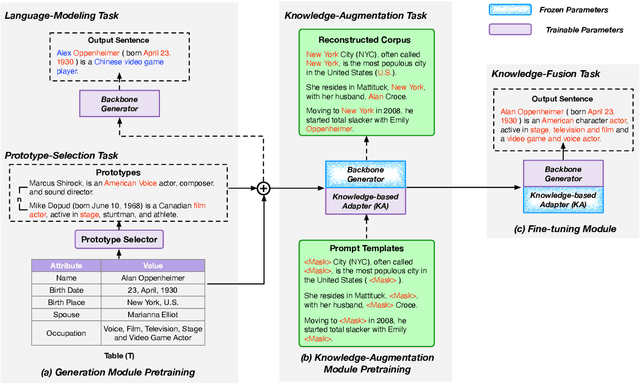
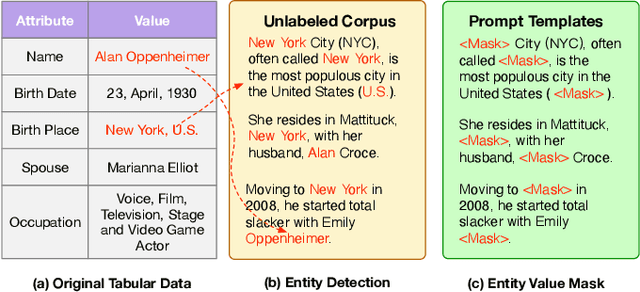
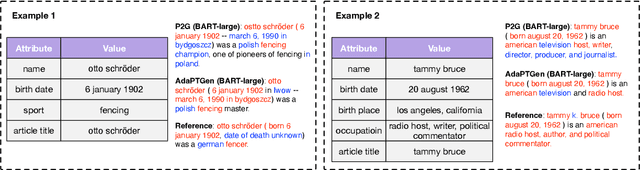
Pre-trained language models (PLMs) have made remarkable progress in table-to-text generation tasks. However, the topological gap between tabular data and text and the lack of domain-specific knowledge make it difficult for PLMs to produce faithful text, especially in real-world applications with limited resources. In this paper, we mitigate the above challenges by introducing a novel augmentation method: Prompt-based Adapter (PA), which targets table-to-text generation under few-shot conditions. The core insight design of the PA is to inject prompt templates for augmenting domain-specific knowledge and table-related representations into the model for bridging the structural gap between tabular data and descriptions through adapters. Such prompt-based knowledge augmentation method brings at least two benefits: (1) enables us to fully use the large amounts of unlabelled domain-specific knowledge, which can alleviate the PLMs' inherent shortcomings of lacking domain knowledge; (2) allows us to design different types of tasks supporting the generative challenge. Extensive experiments and analyses are conducted on three open-domain few-shot NLG datasets: Humans, Books, and Songs. Compared to previous state-of-the-art approaches, our model achieves superior performance in terms of both fluency and accuracy as judged by human and automatic evaluations.