 Add to Chrome
 Add to Firefox
 Add to Edge
Information-Aware KV Cache Compression for Long Reasoning
Jun 25, 2026
Reasoning capability has advanced rapidly in large language models (LLMs), leading to an increasing size of key-value (KV) cache in both prefilling and decoding stages. Existing KV cache compression methods mainly rely on attention weights to estimate token importance. While attention effectively captures contextual relevance, it overlooks complementary information-theoretic signals related to predictive uncertainty and token informativeness. In this paper, we revisit token importance from a forward-looking perspective and introduce \textit{Forward Influence}, a metric that measures how compressed tokens affect future contexts. Our analysis reveals that tokens selected by attention scores mainly influence nearby contexts, whereas tokens associated with high predictive uncertainty exhibit substantially stronger influence on distant future contexts. Based on the observation, we propose \textbf{InfoKV}, an entropy-aware KV cache compression framework that incorporates information-theoretic signals. It combines token-level predictive uncertainty with layer-wise representation evolution and integrates the resulting entropy scores with attention scores during reasoning. Experiments on long-context reasoning benchmarks with Llama-3.1, Llama-3.2, and DeepSeek-R1 demonstrate that InfoKV consistently outperforms existing attention-based KV compression methods in both long prefilling and decoding scenarios.

Towards Compressive and Scalable Recurrent Memory
Feb 11, 2026Transformers face a quadratic bottleneck in attention when scaling to long contexts. Recent approaches introduce recurrent memory to extend context beyond the current window, yet these often face a fundamental trade-off between theoretical principles and practical scalability. To address this, we introduce Elastic Memory, a novel memory architecture grounded in the HiPPO framework for online function approximation. Elastic Memory treats historical sequence as samples from continuous signals, applying optimal online compression to encode them into a fixed-size memory state. For retrieval, we propose a flexible \textit{polynomial sampling} mechanism that reconstructs a history summary from this compressed state. Elastic Memory consistently outperformed baselines on long-context (32k+) datasets across three domains. With equal parameters, it beat Memorizing Transformer by 16x memory and outperformed Melodi at all memory sizes, even when Melodi had 30% more parameters. When scaling model size, Elastic Memory stayed ahead of all baselines and was significantly faster than Melodi at 4x size. Furthermore, its decoupled design allows for injecting inductive biases at test-time to boost performance.
FreqKV: Frequency Domain Key-Value Compression for Efficient Context Window Extension
May 01, 2025Extending the context window in large language models (LLMs) is essential for applications involving long-form content generation. However, the linear increase in key-value (KV) cache memory requirements and the quadratic complexity of self-attention with respect to sequence length present significant challenges during fine-tuning and inference. Existing methods suffer from performance degradation when extending to longer contexts. In this work, we introduce a novel context extension method that optimizes both fine-tuning and inference efficiency. Our method exploits a key observation: in the frequency domain, the energy distribution of the KV cache is primarily concentrated in low-frequency components. By filtering out the high-frequency components, the KV cache can be effectively compressed with minimal information loss. Building on this insight, we propose an efficient compression technique, FreqKV, that iteratively compresses the increasing KV cache to a fixed size in the frequency domain, applicable to both fine-tuning and inference. FreqKV introduces no additional parameters or architectural modifications. With minimal fine-tuning, LLMs can learn to leverage the limited cache that is compressed in the frequency domain and extend the context window efficiently. Experiments on various long context language modeling and understanding tasks demonstrate the efficiency and efficacy of the proposed method.
Leveraging Grammar Induction for Language Understanding and Generation
Oct 07, 2024

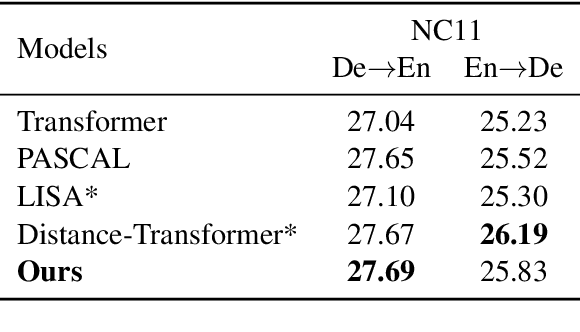

Grammar induction has made significant progress in recent years. However, it is not clear how the application of induced grammar could enhance practical performance in downstream tasks. In this work, we introduce an unsupervised grammar induction method for language understanding and generation. We construct a grammar parser to induce constituency structures and dependency relations, which is simultaneously trained on downstream tasks without additional syntax annotations. The induced grammar features are subsequently incorporated into Transformer as a syntactic mask to guide self-attention. We evaluate and apply our method to multiple machine translation tasks and natural language understanding tasks. Our method demonstrates superior performance compared to the original Transformer and other models enhanced with external parsers. Experimental results indicate that our method is effective in both from-scratch and pre-trained scenarios. Additionally, our research highlights the contribution of explicitly modeling the grammatical structure of texts to neural network models.
SH2: Self-Highlighted Hesitation Helps You Decode More Truthfully
Jan 11, 2024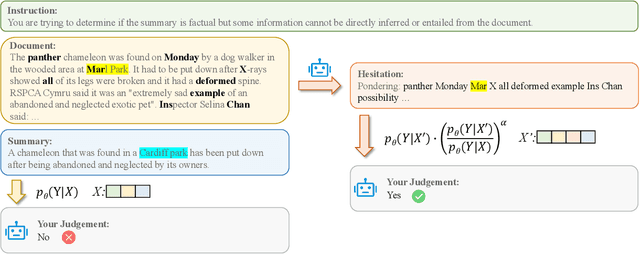
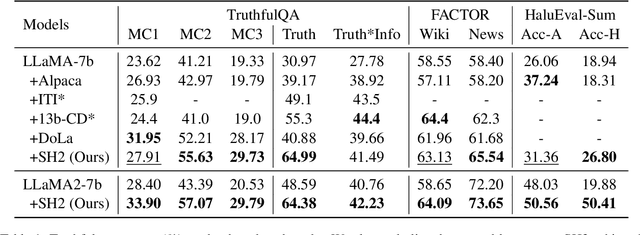
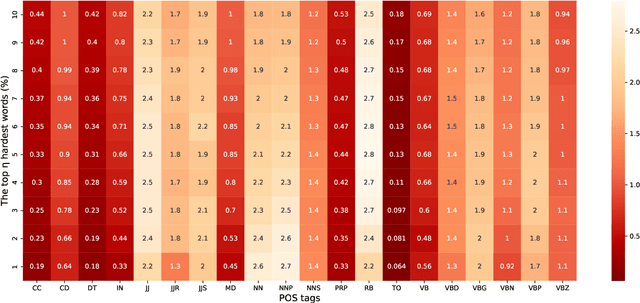
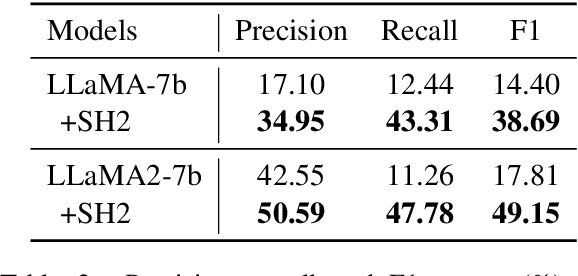
Large language models (LLMs) demonstrate great performance in text generation. However, LLMs are still suffering from hallucinations. In this work, we propose an inference-time method, Self-Highlighted Hesitation (SH2), to help LLMs decode more truthfully. SH2 is based on a simple fact rooted in information theory that for an LLM, the tokens predicted with lower probabilities are prone to be more informative than others. Our analysis shows that the tokens assigned with lower probabilities by an LLM are more likely to be closely related to factual information, such as nouns, proper nouns, and adjectives. Therefore, we propose to ''highlight'' the factual information by selecting the tokens with the lowest probabilities and concatenating them to the original context, thus forcing the model to repeatedly read and hesitate on these tokens before generation. During decoding, we also adopt contrastive decoding to emphasize the difference in the output probabilities brought by the hesitation. Experimental results demonstrate that our SH2, requiring no additional data or models, can effectively help LLMs elicit factual knowledge and distinguish hallucinated contexts. Significant and consistent improvements are achieved by SH2 for LLaMA-7b and LLaMA2-7b on multiple hallucination tasks.