 Add to Chrome
 Add to Firefox
 Add to Edge
A Blind Spot in Alignment: Quantifying Biosecurity Risks in Large Language Models
Aug 05, 2026
Large Language Models (LLMs) are accelerating biological research, yet this same capability poses a critical biosecurity threat: models that assist in protein engineering can equally be prompted to generate predicted toxin-like sequences, potentially lowering the barrier to biological misuse. Current safety evaluations, however, operate in natural language and cannot determine whether a model-generated amino acid sequence is biological gibberish or a computational risk signal. To address this evaluation blind spot, we introduce SPIKE-Bench, coupling 631 curated toxin-design prompts across seven functional categories with the SPIKE funnel, a three-stage protocol that filters output through compliance, biological plausibility, and predicted toxicity, producing stage-level diagnostics and an aggregate function-aware metric: the Functional Harmfulness Rate (FHR). An audit of 32 LLMs reveals that most models freely comply with toxin-design requests; FHR is driven primarily by biological generation capability rather than safety alignment, reaching 50.7%; and Refusal Rate fails to predict functional risk. As a first step toward mitigation, we provide BioSafe-Guard, a domain-specialized classifier that substantially reduces predicted functional risk while preserving benign utility. We release SPIKE-Bench and BioSafe-Guard at https://github.com/PKU-Alignment/SPIKE-Bench to support more rigorous biosecurity evaluation of LLMs.

ProMedical: Hierarchical Fine-Grained Criteria Modeling for Medical LLM Alignment via Explicit Injection
Apr 09, 2026Aligning Large Language Models (LLMs) with high-stakes medical standards remains a significant challenge, primarily due to the dissonance between coarse-grained preference signals and the complex, multi-dimensional nature of clinical protocols. To bridge this gap, we introduce ProMedical, a unified alignment framework grounded in fine-grained clinical criteria. We first construct ProMedical-Preference-50k, a dataset generated via a human-in-the-loop pipeline that augments medical instructions with rigorous, physician-derived rubrics. Leveraging this corpus, we propose the Explicit Criteria Injection paradigm to train a multi-dimensional reward model. Unlike traditional scalar reward models, our approach explicitly disentangles safety constraints from general proficiency, enabling precise guidance during reinforcement learning. To rigorously validate this framework, we establish ProMedical-Bench, a held-out evaluation suite anchored by double-blind expert adjudication. Empirical evaluations demonstrate that optimizing the Qwen3-8B base model via ProMedical-RM-guided GRPO yields substantial gains, improving overall accuracy by 22.3% and safety compliance by 21.7%, effectively rivaling proprietary frontier models. Furthermore, the aligned policy generalizes robustly to external benchmarks, demonstrating performance comparable to state-of-the-art models on UltraMedical. We publicly release our datasets, reward models, and benchmarks to facilitate reproducible research in safety-aware medical alignment.
VLA-Mark: A cross modal watermark for large vision-language alignment model
Jul 18, 2025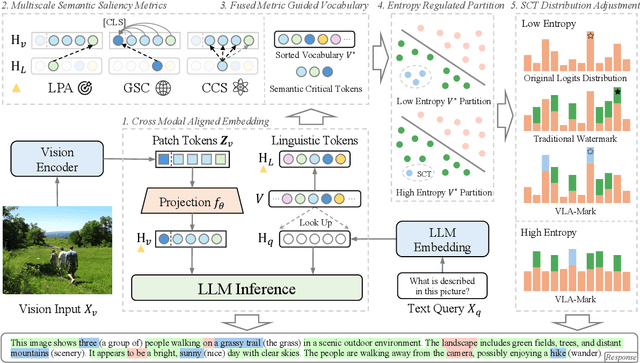
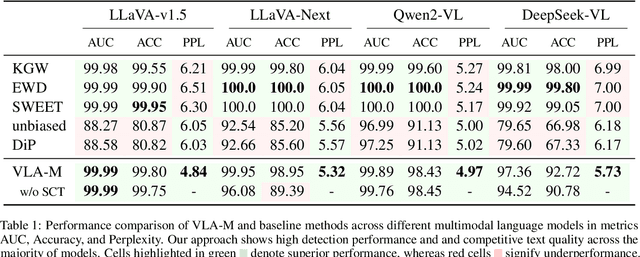
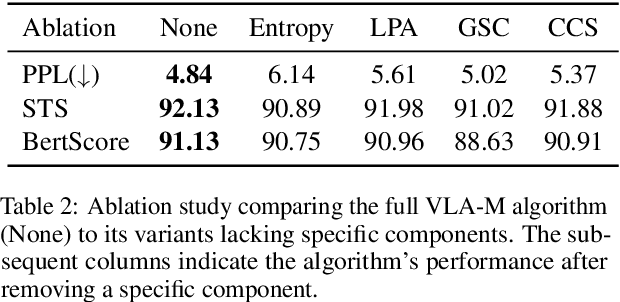
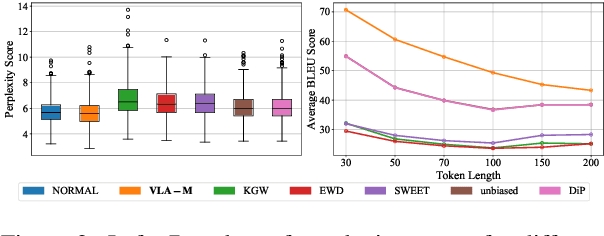
Vision-language models demand watermarking solutions that protect intellectual property without compromising multimodal coherence. Existing text watermarking methods disrupt visual-textual alignment through biased token selection and static strategies, leaving semantic-critical concepts vulnerable. We propose VLA-Mark, a vision-aligned framework that embeds detectable watermarks while preserving semantic fidelity through cross-modal coordination. Our approach integrates multiscale visual-textual alignment metrics, combining localized patch affinity, global semantic coherence, and contextual attention patterns, to guide watermark injection without model retraining. An entropy-sensitive mechanism dynamically balances watermark strength and semantic preservation, prioritizing visual grounding during low-uncertainty generation phases. Experiments show 7.4% lower PPL and 26.6% higher BLEU than conventional methods, with near-perfect detection (98.8% AUC). The framework demonstrates 96.1\% attack resilience against attacks such as paraphrasing and synonym substitution, while maintaining text-visual consistency, establishing new standards for quality-preserving multimodal watermarking