 Add to Chrome
 Add to Firefox
 Add to Edge
MemSyco-Bench: Benchmarking Sycophancy in Agent Memory
Jul 01, 2026
Memory has emerged as a cornerstone of modern LLM-based agents, supporting their evolution from single-turn assistants to long-term collaborators. However, memory is not always beneficial: retrieved memories often induce a critical issue of sycophancy, causing agents to over-align with the user at the cost of factual accuracy or objective reasoning. Despite this emerging risk, existing memory benchmarks primarily evaluate whether memories are correctly stored, retrieved, or updated, while overlooking how retrieved memories influence downstream reasoning and decision-making. To bridge this gap, we propose MemSyco-Bench, a comprehensive benchmark for evaluating memory-induced sycophancy in agent systems. MemSyco-Bench measures when memory should influence a decision and how valid memory should be used. Specifically, it covers five tasks that assess whether agents can reject memory as factual evidence, respect its applicable scope, resolve conflicts between memory and objective evidence, track memory updates, and use valid memory for personalization. All related resources are collected for the community at https://github.com/XMUDeepLIT/MemSyco-Bench.

MemGraphRAG: Memory-based Multi-Agent System for Graph Retrieval-Augmented Generation
May 30, 2026Retrieval-Augmented Generation (RAG) has become an essential method for mitigating hallucinations in Large Language Models (LLMs) by leveraging external knowledge. Although effective for simple queries, traditional RAG struggles with large-scale, unstructured corpora where information is highly fragmented. Graph-based RAG (GraphRAG) incorporates knowledge graphs to capture structural relationships, enabling more comprehensive retrieval for complex reasoning. However, existing GraphRAG methods rely on isolated, fragment-level extraction for graph construction, lacking a global perspective on the whole corpus. As a result, these methods frequently lead to thematically inconsistent, logically conflicting, and structurally fragmented graphs that degrade retrieval performance. In this paper, we propose MemGraphRAG, a novel framework that introduces a memory-based multi-agent system to ensure high-quality graph construction. Specifically, MemGraphRAG employs a collaborative society of agents supported by shared memory, which provides a unified global context throughout the extraction process. This mechanism allows agents to dynamically resolve logical conflicts and maintain structural connectivity throughout the corpus. Furthermore, we propose a memory-aware hierarchical retrieval algorithm tailored for the constructed graph. Extensive experiments on multiple benchmarks demonstrate that MemGraphRAG outperforms the state-of-the-art baseline models with comparable efficiency. Our code is available at https://github.com/XMUDeepLIT/MemGraphRAG.
SAAS: Self-Aware Reinforcement Learning for Over-Search Mitigation in Agentic Search
May 28, 2026Agentic search enables LLMs to solve complex multi-hop questions through iterative reasoning and external search. Despite the effectiveness, these systems often suffer from a critical limitation in practice: agents fail to recognize their own knowledge boundaries, blindly triggering searches when internal knowledge suffices and failing to terminate search even when adequate evidence has been collected. The lack of self-awareness leads to severe \textbf{over-search}, incurring substantial inference latency and prohibitive computational cost. To this end, we propose SAAS, a novel RL framework designed to cultivate dynamic self-awareness that precisely regulates search behavior without compromising accuracy. SAAS introduces three key components: (i) a search boundary modeling mechanism, which identifies the search boundary under the evolving policy by contrasting search-disabled and search-enabled rollouts; (ii) a boundary-aware reward module, which translates this boundary awareness into trajectory-level penalties, suppressing unnecessary and redundant searches; and (iii) a stage-wise optimization strategy, which leverages a sequential curriculum to prioritize reasoning over search regularization, thereby avoiding reward hacking. Extensive experiments demonstrate that SAAS substantially reduces over-search, while maintaining accuracy. Our code is anonymously released at https://github.com/XMUDeepLIT/SAAS.
LegalGraphRAG: Multi-Agent Graph Retrieval-Augmented Generation for Reliable Legal Reasoning
May 27, 2026Graph-based Retrieval-Augmented Generation (GraphRAG) advances flat document retrieval by structuring knowledge as relational graphs, enabling more coherent and effective reasoning. However, applying it to specific domains like legal reasoning faces critical challenges. (i) Legal corpora are heterogeneous, containing multi-granular knowledge from cases, articles and interpretations. A flat knowledge graph cannot adequately differentiate between factual details, applied rules, and abstract principles, limiting accurate retrieval. (ii) Reliable legal judgment demands transparent, evidence-based reasoning. Traditional RAG passes retrieved context directly to an LLM without verification, resulting in opaque, error-prone reasoning. To this end, we propose LegalGraphRAG, a framework designed for reliable legal reasoning. Our approach introduces two core components: a hierarchical legal graph that hierarchically organizes legal sources to enable retrieval at appropriate abstraction levels, and a multi-agent system for reliable legal reasoning, where a Researcher retrieves candidate evidence, an Auditor rigorously verifies its validity against source documents, and an Adjudicator synthesizes the set of verified evidence to render a final judgment. Extensive experiments show that LegalGraphRAG achieves the state-of-the-art performance, outperforming existing GraphRAG baselines in accurate and trustworthy legal analysis. Our code, datasets and implementation details are available at https://github.com/XMUDeepLIT/LegalGraphRAG.
HEALing Entropy Collapse: Enhancing Exploration in Few-Shot RLVR via Hybrid-Domain Entropy Dynamics Alignment
Apr 20, 2026Reinforcement Learning with Verifiable Reward (RLVR) has proven effective for training reasoning-oriented large language models, but existing methods largely assume high-resource settings with abundant training data. In low-resource scenarios, RLVR is prone to more severe entropy collapse, which substantially limits exploration and degrades reasoning performance. To address this issue, we propose Hybrid-domain Entropy dynamics ALignment (HEAL), a framework tailored for few-shot RLVR. HEAL first selectively incorporates high-value general-domain data to promote more diverse exploration. Then, we introduce Entropy Dynamics Alignment (EDA), a reward mechanism that aligns trajectory-level entropy dynamics between the target and general domains, capturing both entropy magnitude and fine-grained variation. Through this alignment, EDA not only further mitigates entropy collapse but also encourages the policy to acquire more diverse exploration behaviors from the general domain. Experiments across multiple domains show that HEAL consistently improves few-shot RLVR performance. Notably, using only 32 target-domain samples, HEAL matches or even surpasses full-shot RLVR trained with 1K target-domain samples.
Graph-based Agent Memory: Taxonomy, Techniques, and Applications
Feb 05, 2026Memory emerges as the core module in the Large Language Model (LLM)-based agents for long-horizon complex tasks (e.g., multi-turn dialogue, game playing, scientific discovery), where memory can enable knowledge accumulation, iterative reasoning and self-evolution. Among diverse paradigms, graph stands out as a powerful structure for agent memory due to the intrinsic capabilities to model relational dependencies, organize hierarchical information, and support efficient retrieval. This survey presents a comprehensive review of agent memory from the graph-based perspective. First, we introduce a taxonomy of agent memory, including short-term vs. long-term memory, knowledge vs. experience memory, non-structural vs. structural memory, with an implementation view of graph-based memory. Second, according to the life cycle of agent memory, we systematically analyze the key techniques in graph-based agent memory, covering memory extraction for transforming the data into the contents, storage for organizing the data efficiently, retrieval for retrieving the relevant contents from memory to support reasoning, and evolution for updating the contents in the memory. Third, we summarize the open-sourced libraries and benchmarks that support the development and evaluation of self-evolving agent memory. We also explore diverse application scenarios. Finally, we identify critical challenges and future research directions. This survey aims to offer actionable insights to advance the development of more efficient and reliable graph-based agent memory systems. All the related resources, including research papers, open-source data, and projects, are collected for the community in https://github.com/DEEP-PolyU/Awesome-GraphMemory.
TTCS: Test-Time Curriculum Synthesis for Self-Evolving
Jan 30, 2026Test-Time Training offers a promising way to improve the reasoning ability of large language models (LLMs) by adapting the model using only the test questions. However, existing methods struggle with difficult reasoning problems for two reasons: raw test questions are often too difficult to yield high-quality pseudo-labels, and the limited size of test sets makes continuous online updates prone to instability. To address these limitations, we propose TTCS, a co-evolving test-time training framework. Specifically, TTCS initializes two policies from the same pretrained model: a question synthesizer and a reasoning solver. These policies evolve through iterative optimization: the synthesizer generates progressively challenging question variants conditioned on the test questions, creating a structured curriculum tailored to the solver's current capability, while the solver updates itself using self-consistency rewards computed from multiple sampled responses on both original test and synthetic questions. Crucially, the solver's feedback guides the synthesizer to generate questions aligned with the model's current capability, and the generated question variants in turn stabilize the solver's test-time training. Experiments show that TTCS consistently strengthens the reasoning ability on challenging mathematical benchmarks and transfers to general-domain tasks across different LLM backbones, highlighting a scalable path towards dynamically constructing test-time curricula for self-evolving. Our code and implementation details are available at https://github.com/XMUDeepLIT/TTCS.
FaithfulRAG: Fact-Level Conflict Modeling for Context-Faithful Retrieval-Augmented Generation
Jun 10, 2025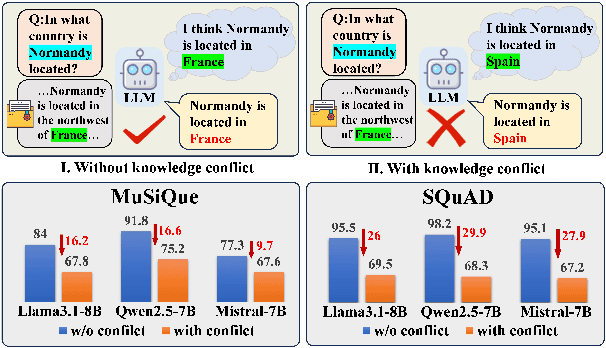
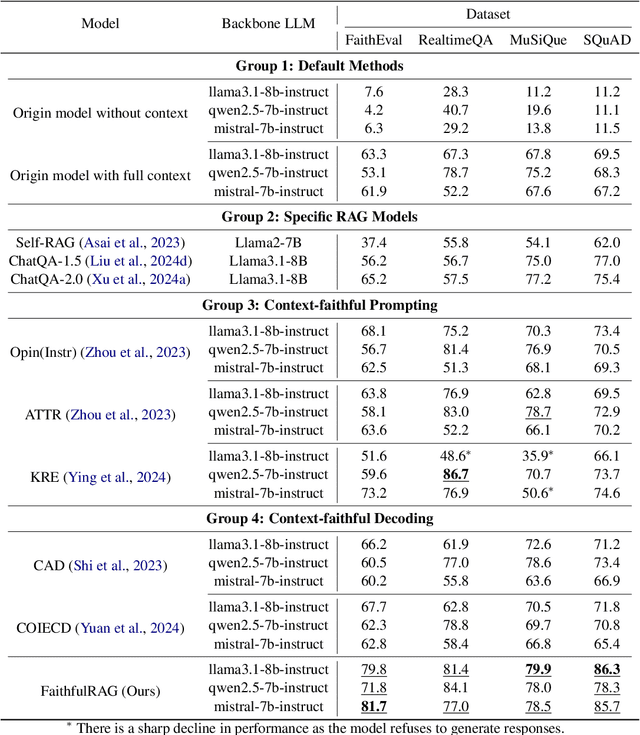
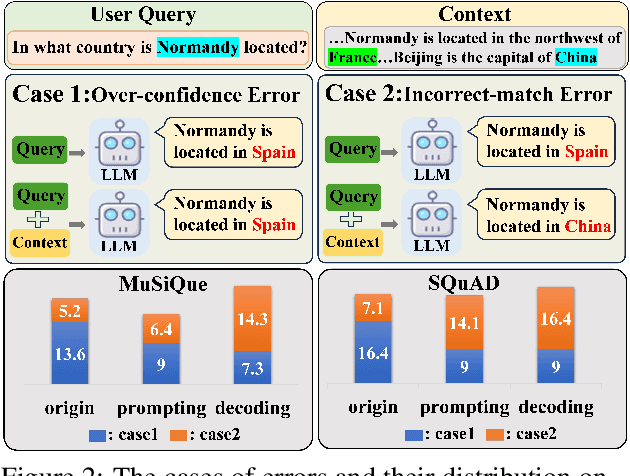

Large language models (LLMs) augmented with retrieval systems have demonstrated significant potential in handling knowledge-intensive tasks. However, these models often struggle with unfaithfulness issues, generating outputs that either ignore the retrieved context or inconsistently blend it with the LLM`s parametric knowledge. This issue is particularly severe in cases of knowledge conflict, where the retrieved context conflicts with the model`s parametric knowledge. While existing faithful RAG approaches enforce strict context adherence through well-designed prompts or modified decoding strategies, our analysis reveals a critical limitation: they achieve faithfulness by forcibly suppressing the model`s parametric knowledge, which undermines the model`s internal knowledge structure and increases the risk of misinterpreting the context. To this end, this paper proposes FaithfulRAG, a novel framework that resolves knowledge conflicts by explicitly modeling discrepancies between the model`s parametric knowledge and retrieved context. Specifically, FaithfulRAG identifies conflicting knowledge at the fact level and designs a self-thinking process, allowing LLMs to reason about and integrate conflicting facts before generating responses. Extensive experiments demonstrate that our method outperforms state-of-the-art methods. The code is available at https:// github.com/DeepLearnXMU/Faithful-RAG
When to use Graphs in RAG: A Comprehensive Analysis for Graph Retrieval-Augmented Generation
Jun 06, 2025Graph retrieval-augmented generation (GraphRAG) has emerged as a powerful paradigm for enhancing large language models (LLMs) with external knowledge. It leverages graphs to model the hierarchical structure between specific concepts, enabling more coherent and effective knowledge retrieval for accurate reasoning.Despite its conceptual promise, recent studies report that GraphRAG frequently underperforms vanilla RAG on many real-world tasks. This raises a critical question: Is GraphRAG really effective, and in which scenarios do graph structures provide measurable benefits for RAG systems? To address this, we propose GraphRAG-Bench, a comprehensive benchmark designed to evaluate GraphRAG models onboth hierarchical knowledge retrieval and deep contextual reasoning. GraphRAG-Bench features a comprehensive dataset with tasks of increasing difficulty, coveringfact retrieval, complex reasoning, contextual summarization, and creative generation, and a systematic evaluation across the entire pipeline, from graph constructionand knowledge retrieval to final generation. Leveraging this novel benchmark, we systematically investigate the conditions when GraphRAG surpasses traditional RAG and the underlying reasons for its success, offering guidelines for its practical application. All related resources and analyses are collected for the community at https://github.com/GraphRAG-Bench/GraphRAG-Benchmark.