 Add to Chrome
 Add to Firefox
 Add to Edge
Modeling Behavioral Intensity and Transitions for Generative Recommendation
Apr 27, 2026
Multi-behavior recommendation aims to predict user conversions by modeling various interaction types that carry distinct intent signals. Recently, generative sequence modeling methods have emerged as an important paradigm for multi-behavior recommendation by achieving flexible sequence generation. However, existing generative methods typically treat behaviors as auxiliary token features and feed them into unified attention mechanisms. These models implicitly assume uniform activation of dependencies among historical behaviors, thereby failing to discern differences in intensity or capture transition patterns. To address these limitations, we propose BITRec, a novel generative multi-behavior recommendation framework that introduces structured behavioral modeling through selective dependency activation. BITRec incorporates (i) Hierarchical Behavior Aggregation (HBA), which explicitly models behavioral intensity differences through separated exploration and commitment pathways, and (ii) Transition Relation Encoding (TRE), which encodes transition structures through explicit learnable relation matrices. Experiments on four large-scale datasets (RetailRocket, Taobao, Tmall, Insurance Dataset) with millions of interactions achieve consistent improvements of 15-23% across multiple metrics, with peak gains of 22.79% MRR on Tmall and 17.83% HR@10, 17.55% NDCG@10 on Taobao.

WideSeek-R1: Exploring Width Scaling for Broad Information Seeking via Multi-Agent Reinforcement Learning
Feb 04, 2026Recent advancements in Large Language Models (LLMs) have largely focused on depth scaling, where a single agent solves long-horizon problems with multi-turn reasoning and tool use. However, as tasks grow broader, the key bottleneck shifts from individual competence to organizational capability. In this work, we explore a complementary dimension of width scaling with multi-agent systems to address broad information seeking. Existing multi-agent systems often rely on hand-crafted workflows and turn-taking interactions that fail to parallelize work effectively. To bridge this gap, we propose WideSeek-R1, a lead-agent-subagent framework trained via multi-agent reinforcement learning (MARL) to synergize scalable orchestration and parallel execution. By utilizing a shared LLM with isolated contexts and specialized tools, WideSeek-R1 jointly optimizes the lead agent and parallel subagents on a curated dataset of 20k broad information-seeking tasks. Extensive experiments show that WideSeek-R1-4B achieves an item F1 score of 40.0% on the WideSearch benchmark, which is comparable to the performance of single-agent DeepSeek-R1-671B. Furthermore, WideSeek-R1-4B exhibits consistent performance gains as the number of parallel subagents increases, highlighting the effectiveness of width scaling.
RLinf: Flexible and Efficient Large-scale Reinforcement Learning via Macro-to-Micro Flow Transformation
Sep 19, 2025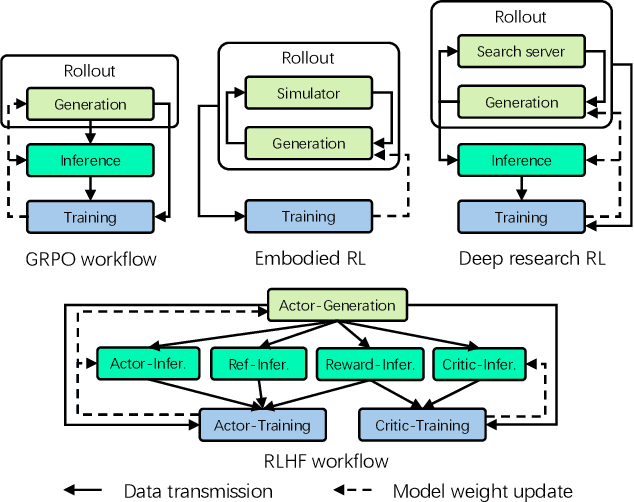
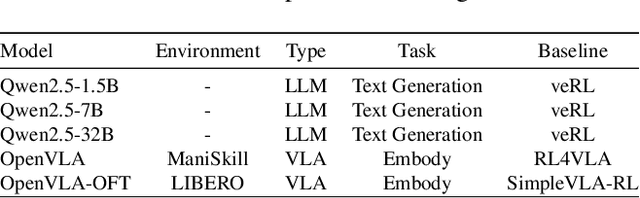
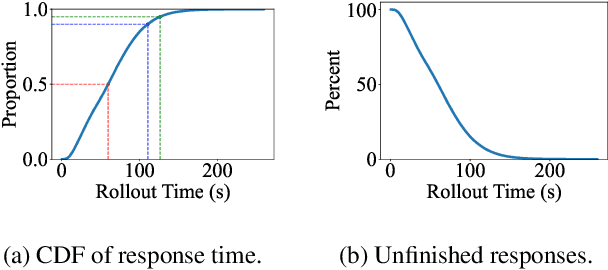
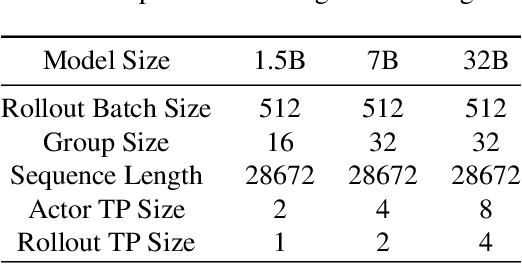
Reinforcement learning (RL) has demonstrated immense potential in advancing artificial general intelligence, agentic intelligence, and embodied intelligence. However, the inherent heterogeneity and dynamicity of RL workflows often lead to low hardware utilization and slow training on existing systems. In this paper, we present RLinf, a high-performance RL training system based on our key observation that the major roadblock to efficient RL training lies in system flexibility. To maximize flexibility and efficiency, RLinf is built atop a novel RL system design paradigm called macro-to-micro flow transformation (M2Flow), which automatically breaks down high-level, easy-to-compose RL workflows at both the temporal and spatial dimensions, and recomposes them into optimized execution flows. Supported by RLinf worker's adaptive communication capability, we devise context switching and elastic pipelining to realize M2Flow transformation, and a profiling-guided scheduling policy to generate optimal execution plans. Extensive evaluations on both reasoning RL and embodied RL tasks demonstrate that RLinf consistently outperforms state-of-the-art systems, achieving 1.1x-2.13x speedup in end-to-end training throughput.
Hierarchical Bayesian Personalized Recommendation: A Case Study and Beyond
Aug 20, 2019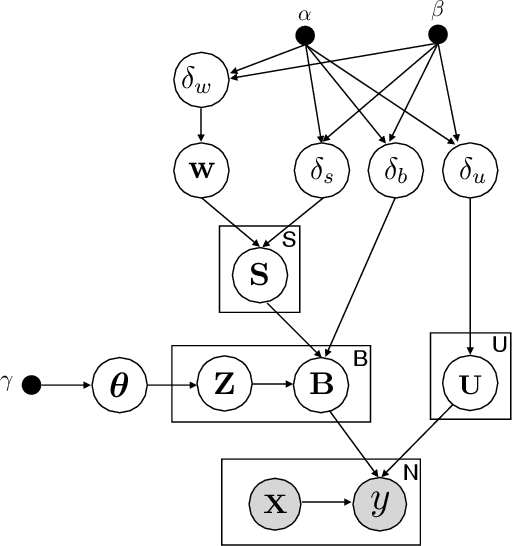
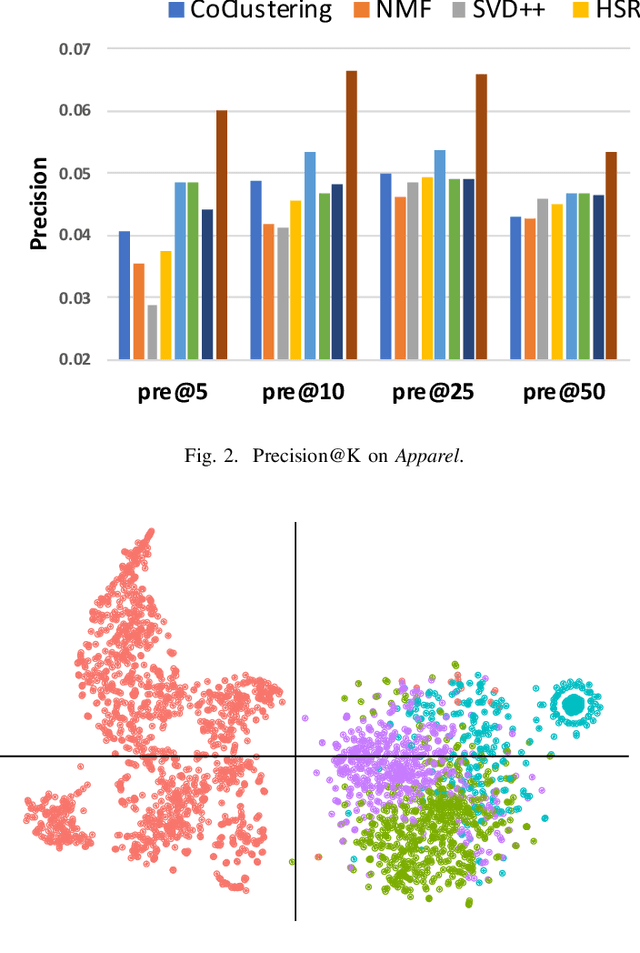
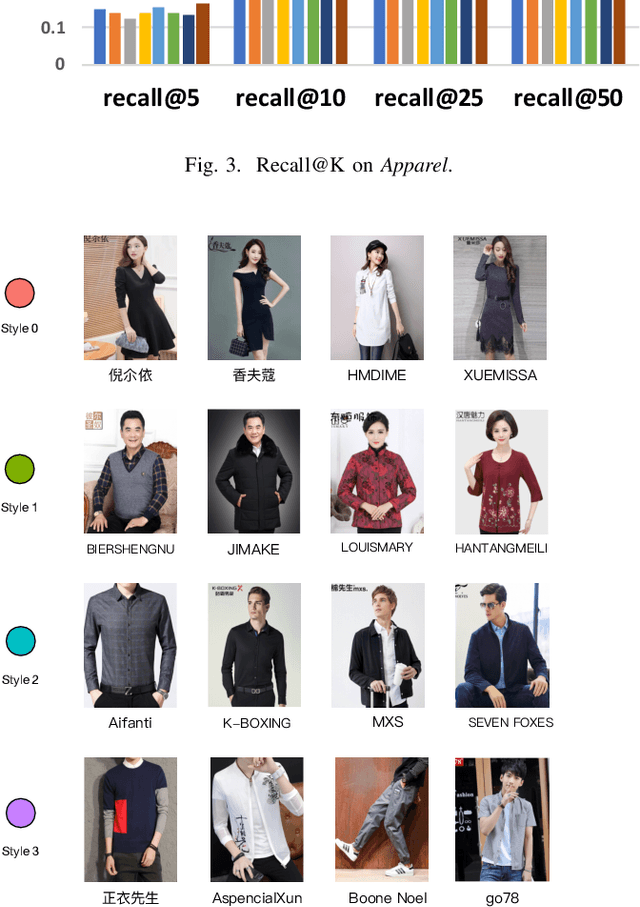
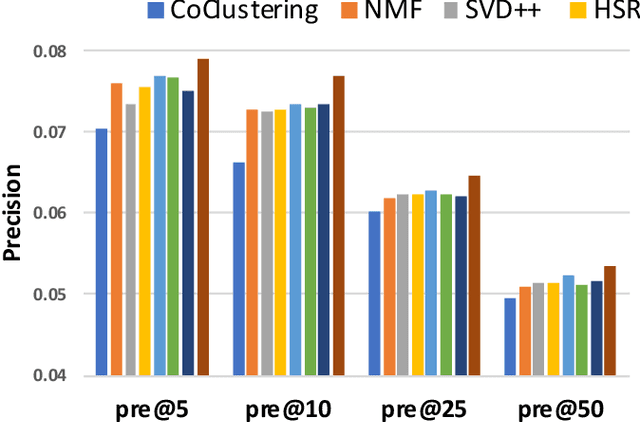
Items in modern recommender systems are often organized in hierarchical structures. These hierarchical structures and the data within them provide valuable information for building personalized recommendation systems. In this paper, we propose a general hierarchical Bayesian learning framework, i.e., \emph{HBayes}, to learn both the structures and associated latent factors. Furthermore, we develop a variational inference algorithm that is able to learn model parameters with fast empirical convergence rate. The proposed HBayes is evaluated on two real-world datasets from different domains. The results demonstrate the benefits of our approach on item recommendation tasks, and show that it can outperform the state-of-the-art models in terms of precision, recall, and normalized discounted cumulative gain. To encourage the reproducible results, we make our code public on a git repo: \url{https://tinyurl.com/ycruhk4t}.