 Add to Chrome
 Add to Firefox
 Add to Edge
Multiphase-Diff: Diffusion-Based Generative Modeling for High-Contrast Multiphase Physical Systems with Sharp Interfaces
Aug 13, 2026
Physics-constrained diffusion for high-contrast, sharp-interface multiphase fields faces three coupled difficulties. At coefficient jumps, expanded pointwise strong-form PDE residuals contain singular gradient terms that can penalize physical interfaces. Under extreme contrast, low-magnitude phases may fall below the diffusion noise floor and be erased, misscaled, or generated with negative coefficients, while a global likelihood scale allows high-magnitude phases to dominate supervision. We therefore propose Multiphase-Diff, which makes three corresponding contributions: (i) a conservative flux residual that avoids differentiating discontinuous coefficients and enforces discrete conservation; (ii) an analytic bijective representation that maps low-amplitude signals to order-one latent scales and guarantees coefficient positivity through exponential decoding; and (iii) a Jacobi-preconditioned likelihood that normalizes local residual scales for balanced supervision. Experiments on three complementary multiphase benchmarks demonstrate the superiority of Multiphase-Diff over seven baselines in both physical and distributional fidelity and its robustness across phase contrasts and compositions, establishing its effectiveness for scientific sample generation in this challenging regime.

Persistent Recursive Worlds Enable Autonomous Software Evolution
Aug 12, 2026Complex software systems develop over timescales that exceed the lifespan of any individual coding agent. Most agentic software systems preserve continuity through persistent sessions, memories, managers or shared context. We introduce EvoX Genesis (hereafter, Genesis), which instead makes the software project persistent while allowing local agents to remain finite-lived. Genesis represents software as a persistent recursive world: each local world is situated by an accepted version and a repository path, finite-lived agents propose local changes, recursive delegation moves work across paths, and only accepted consequences advance the persistent version history. We evaluate this organization across formation, continuation and redevelopment. Starting from a repository with no compiler implementation, Genesis used DeepSeek V4 Flash to build a Rust-based C compiler with about 250k tracked lines; the run lasted over 120 hours, archived over 1,000 agent episodes and incurred only US$44 in model-token charges. The compiler passed the complete c-testsuite and most LLVM and Csmith tests. In a separate compiler world generated with GLM 5.2, development continued after repeated agent replacement while retaining full test performance. Genesis also reimplemented 13 MESA modules with over 100k Fortran lines as a Rust workspace with nearly 90k Rust lines; across six numerical workloads, it achieved median speedups of 1.55--6.87x. These results show that long-horizon software development can be organized around a persistent project rather than a persistent agent.
RefGlass-GS: A UAV-Enabled Fusion Framework for Photorealistic, Semantic and Interactive Digitization of Reflective Glass Facades via Gaussian Splatting
Jun 27, 2026Existing digitization of buildings with reflective glass facades suffers from geometric reconstruction distortion, unrealistic view-dependent texture rendering, and difficulties in object-based semantic enhancement. Therefore, we propose RefGlass-GS, a fusion framework that enables end-to-end UAV-based photorealistic, semantic, and interactive digitization of reflective glass facades. The contributions include: (1) proposing an individual glass panel segmentation method based on maximum a posteriori estimation with structural regularities, robust to severe reflection and background interference; (2) formulating a UAV viewpoint planning optimization function that maximizes the coverage of view-dependent appearance for sufficient data capture; (3) developing an optimized Gaussian Splatting framework with a Reflection MLP, a novel deferred shading function, and two enhanced regularization terms for effective modeling of high-frequency near-field reflections; (4) introducing a standardized data organization paradigm for structuring GS-based representations into object-based models, facilitating interactive facility management on digital twin platforms. Experiments on real-world reflective glass facade scenes validate the effectiveness and superiority of the proposed method. Specifically, the glass panel segmentation achieves an improvement of 0.1927 in mIoU over SOTA methods, and only our method enables instance-level panel extraction. The UAV view planning improves novel view synthesis for reflective facades by 13.15 dB in PSNR compared to commercially used nap-of-the-object planning methods. The RefGlass-GS modeling outperforms SOTA Gaussian Splatting approaches for reflective scenes with an average improvement of 5.08 dB in PSNR.
TransmissiveGS: Residual-Guided Disentangled Gaussian Splatting for Transmissive Scene Reconstruction and Rendering
May 11, 2026Transmissive scenes are ubiquitous in daily life, yet reconstructing and rendering them remains highly challenging due to the inherent entanglement between near-field reflections from the surrounding environment on the transmissive surface, and the transmitted content of the scene behind it. This coupling gives rise to dual surface geometries and dual radiance components within each observation, posing ambiguities for standard methods. We present TransmissiveGS, a novel framework for disentangled reconstruction and rendering of transmissive scenes. Specifically, we model the scene with a dual-Gaussian representation and introduce a deferred shading function to jointly render the two Gaussian components. To separate reflection and transmission, we exploit the inherent multi-view inconsistency of reflections and leverage the residuals from reconstructing multi-view consistent content as cues for disentangled geometry and appearance modeling. We further propose a reflection light field that enables high-fidelity estimation of near-field reflections. During training, we introduce a high-frequency regularization to preserve fine details. We also contribute a new synthetic dataset for evaluating transmissive surface reconstruction. Experiments on both synthetic and real-world scenes demonstrate that TransmissiveGS consistently outperforms prior Gaussian Splatting-based methods in both reconstruction and rendering quality for transmissive scenes.
UAV-Assisted Scan-to-Simulation for Landslides Using Physics-Informed Gaussian Splatting
May 11, 2026Landslide monitoring and simulation play an important role in urban safety assessment and disaster prevention. Existing landslide simulation pipelines typically rely on digital elevation model and mesh-based representations, which are suitable for geometric analysis, but often lack visual realism. This limitation reduces their effectiveness in interactive applications, hazard communication, and public education. In this paper, we propose a UAV-based scan-to-simulation framework that bridges photorealistic scene capture and physics-based landslide simulation through 3DGS. Specifically, our pipeline includes four stages: (1) UAV-based acquisition of slope imagery, (2) reconstruction of a low-anisotropy 3DGS scene representation, (3) volumetric conversion of the target simulation region by filling the interior of the surface-based model, and (4) integration with the Material Point Method (MPM) for landslide simulation. We validate the proposed framework on a real landslide site in Hong Kong that experienced a severe landslide event. The results show that our method supports both realistic visual reconstruction and effective simulation.
Industrial3D: A Terrestrial LiDAR Point Cloud Dataset and CrossParadigm Benchmark for Industrial Infrastructure
Mar 30, 2026Automated semantic understanding of dense point clouds is a prerequisite for Scan-to-BIM pipelines, digital twin construction, and as-built verification--core tasks in the digital transformation of the construction industry. Yet for industrial mechanical, electrical, and plumbing (MEP) facilities, this challenge remains largely unsolved: TLS acquisitions of water treatment plants, chiller halls, and pumping stations exhibit extreme geometric ambiguity, severe occlusion, and extreme class imbalance that architectural benchmarks (e.g., S3DIS or ScanNet) cannot adequately represent. We present Industrial3D, a terrestrial LiDAR dataset comprising 612 million expertly labelled points at 6 mm resolution from 13 water treatment facilities. At 6.6x the scale of the closest comparable MEP dataset, Industrial3D provides the largest and most demanding testbed for industrial 3D scene understanding to date. We further establish the first industrial cross-paradigm benchmark, evaluating nine representative methods across fully supervised, weakly supervised, unsupervised, and foundation model settings under a unified benchmark protocol. The best supervised method achieves 55.74% mIoU, whereas zero-shot Point-SAM reaches only 15.79%--a 39.95 percentage-point gap that quantifies the unresolved domain-transfer challenge for industrial TLS data. Systematic analysis reveals that this gap originates from a dual crisis: statistical rarity (215:1 imbalance, 3.5x more severe than S3DIS) and geometric ambiguity (tail-class points share cylindrical primitives with head-class pipes) that frequency-based re-weighting alone cannot resolve. Industrial3D, along with benchmark code and pre-trained models, will be publicly available at https://github.com/pointcloudyc/Industrial3D.
2K Retrofit: Entropy-Guided Efficient Sparse Refinement for High-Resolution 3D Geometry Prediction
Mar 23, 2026High-resolution geometric prediction is essential for robust perception in autonomous driving, robotics, and AR/MR, but current foundation models are fundamentally limited by their scalability to real-world, high-resolution scenarios. Direct inference on 2K images with these models incurs prohibitive computational and memory demands, making practical deployment challenging. To tackle the issue, we present 2K Retrofit, a novel framework that enables efficient 2K-resolution inference for any geometric foundation model, without modifying or retraining the backbone. Our approach leverages fast coarse predictions and an entropy-based sparse refinement to selectively enhance high-uncertainty regions, achieving precise and high-fidelity 2K outputs with minimal overhead. Extensive experiments on widely used benchmark demonstrate that 2K Retrofit consistently achieves state-of-the-art accuracy and speed, bridging the gap between research advances and scalable deployment in high-resolution 3D vision applications. Code will be released upon acceptance.
GPU-accelerated Evolutionary Many-objective Optimization Using Tensorized NSGA-III
Apr 08, 2025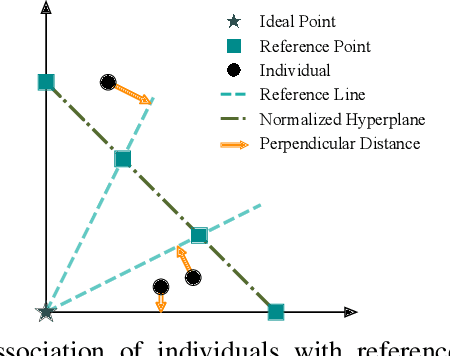
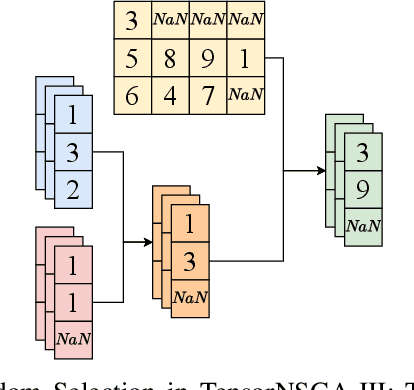
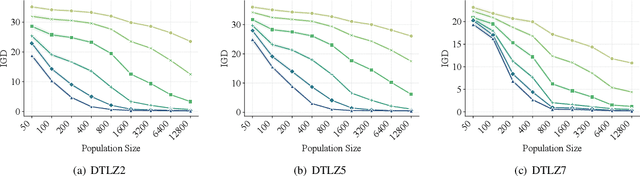
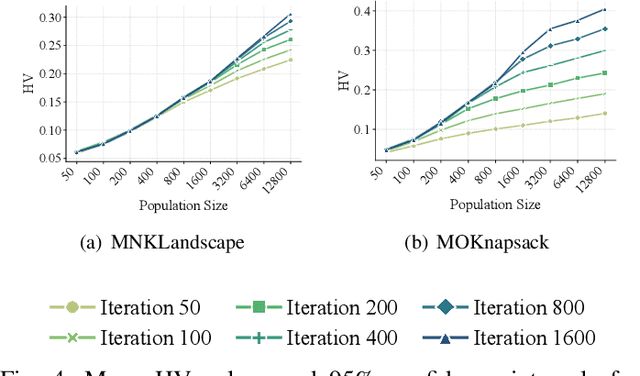
NSGA-III is one of the most widely adopted algorithms for tackling many-objective optimization problems. However, its CPU-based design severely limits scalability and computational efficiency. To address the limitations, we propose {TensorNSGA-III}, a fully tensorized implementation of NSGA-III that leverages GPU parallelism for large-scale many-objective optimization. Unlike conventional GPU-accelerated evolutionary algorithms that rely on heuristic approximations to improve efficiency, TensorNSGA-III maintains the exact selection and variation mechanisms of NSGA-III while achieving significant acceleration. By reformulating the selection process with tensorized data structures and an optimized caching strategy, our approach effectively eliminates computational bottlenecks inherent in traditional CPU-based and na\"ive GPU implementations. Experimental results on widely used numerical benchmarks show that TensorNSGA-III achieves speedups of up to $3629\times$ over the CPU version of NSGA-III. Additionally, we validate its effectiveness in multiobjective robotic control tasks, where it discovers diverse and high-quality behavioral solutions. Furthermore, we investigate the critical role of large population sizes in many-objective optimization and demonstrate the scalability of TensorNSGA-III in such scenarios. The source code is available at https://github.com/EMI-Group/evomo
Bridging Evolutionary Multiobjective Optimization and GPU Acceleration via Tensorization
Mar 27, 2025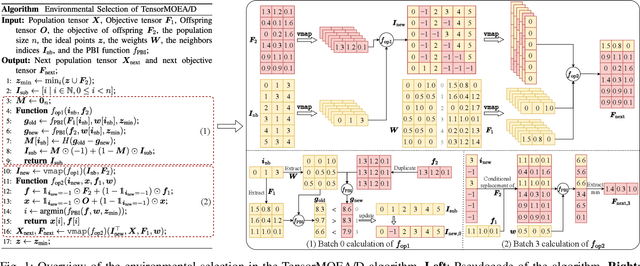
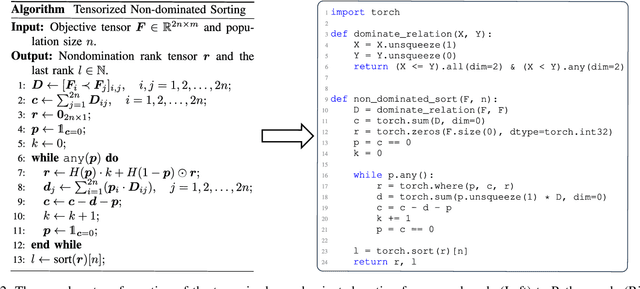
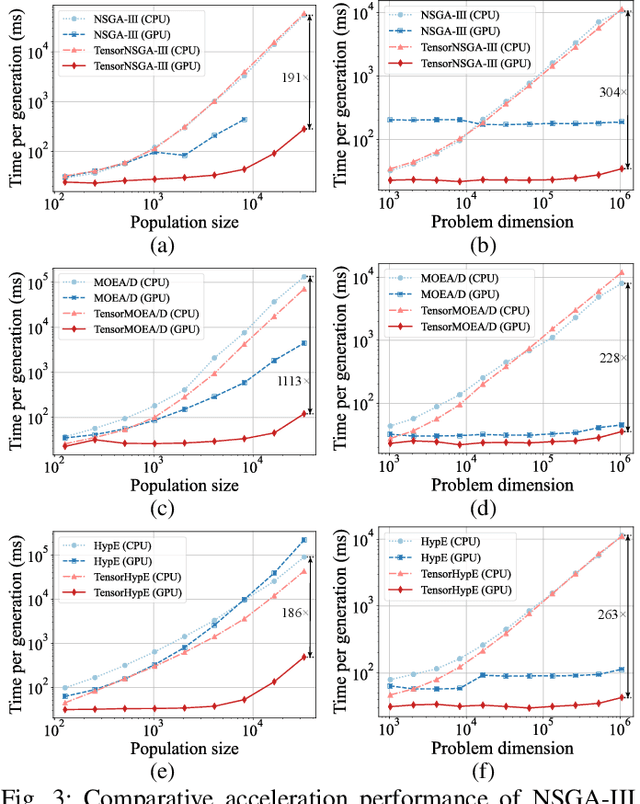
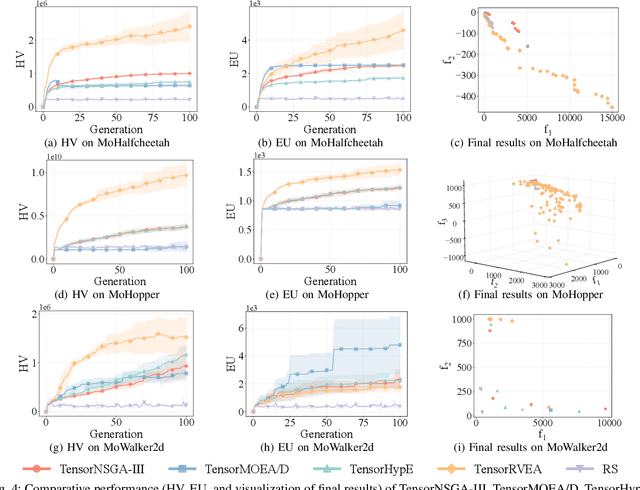
Evolutionary multiobjective optimization (EMO) has made significant strides over the past two decades. However, as problem scales and complexities increase, traditional EMO algorithms face substantial performance limitations due to insufficient parallelism and scalability. While most work has focused on algorithm design to address these challenges, little attention has been given to hardware acceleration, thereby leaving a clear gap between EMO algorithms and advanced computing devices, such as GPUs. To bridge the gap, we propose to parallelize EMO algorithms on GPUs via the tensorization methodology. By employing tensorization, the data structures and operations of EMO algorithms are transformed into concise tensor representations, which seamlessly enables automatic utilization of GPU computing. We demonstrate the effectiveness of our approach by applying it to three representative EMO algorithms: NSGA-III, MOEA/D, and HypE. To comprehensively assess our methodology, we introduce a multiobjective robot control benchmark using a GPU-accelerated physics engine. Our experiments show that the tensorized EMO algorithms achieve speedups of up to 1113x compared to their CPU-based counterparts, while maintaining solution quality and effectively scaling population sizes to hundreds of thousands. Furthermore, the tensorized EMO algorithms efficiently tackle complex multiobjective robot control tasks, producing high-quality solutions with diverse behaviors. Source codes are available at https://github.com/EMI-Group/evomo.
A Multi-objective Optimization Benchmark Test Suite for Real-time Semantic Segmentation
Apr 29, 2024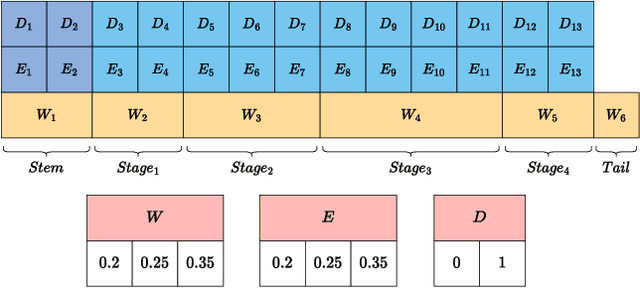
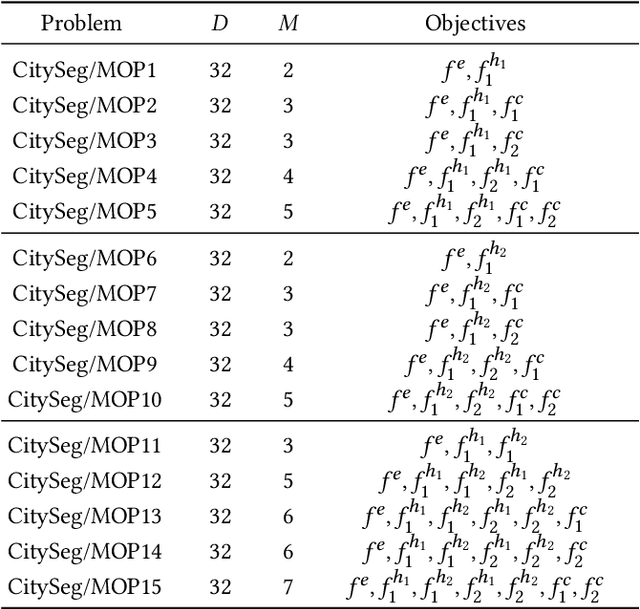
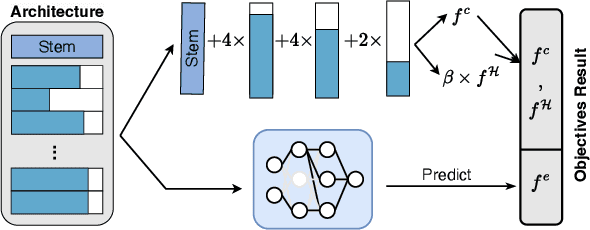
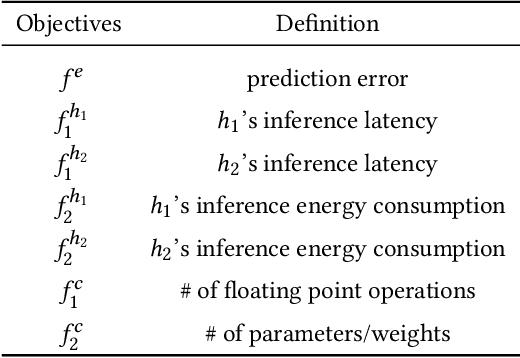
As one of the emerging challenges in Automated Machine Learning, the Hardware-aware Neural Architecture Search (HW-NAS) tasks can be treated as black-box multi-objective optimization problems (MOPs). An important application of HW-NAS is real-time semantic segmentation, which plays a pivotal role in autonomous driving scenarios. The HW-NAS for real-time semantic segmentation inherently needs to balance multiple optimization objectives, including model accuracy, inference speed, and hardware-specific considerations. Despite its importance, benchmarks have yet to be developed to frame such a challenging task as multi-objective optimization. To bridge the gap, we introduce a tailored streamline to transform the task of HW-NAS for real-time semantic segmentation into standard MOPs. Building upon the streamline, we present a benchmark test suite, CitySeg/MOP, comprising fifteen MOPs derived from the Cityscapes dataset. The CitySeg/MOP test suite is integrated into the EvoXBench platform to provide seamless interfaces with various programming languages (e.g., Python and MATLAB) for instant fitness evaluations. We comprehensively assessed the CitySeg/MOP test suite on various multi-objective evolutionary algorithms, showcasing its versatility and practicality. Source codes are available at https://github.com/EMI-Group/evoxbench.