 Add to Chrome
 Add to Firefox
 Add to Edge
LWDrive: Layer-Wise World-Model-Guided Vision-Language Model Planning for Autonomous Driving
Jun 30, 2026
Vision-Language Models (VLMs) provide powerful semantic understanding and commonsense reasoning for End-to-End Autonomous Driving (E2E-AD) planning. However, trajectories directly generated by VLMs often encode only coarse driving intentions and remain insufficient for geometrically accurate, future-aware, and multi-view-grounded planning. To address these limitations, we develop the Layer-Wise World-Model-Guided Driving framework (LWDrive). LWDrive is a VLM planning framework that refines coarse trajectories through layer-wise world-model guidance. Instead of treating the VLM output as the final trajectory, LWDrive uses it as an intent-aware coarse plan, expands a diverse candidate space around it, and progressively refines the candidates through a Foresight Cascade Planner (FCP). Specifically, we introduce future-frame generation supervision to encourage the VLM to learn forward-looking scene representations, thereby injecting planning-relevant predictive dynamics into its internal hidden states. Built upon these world-model-supervised representations, FCP exploits VLM features across multiple layers and integrates historical temporal states, Action-Query representations, and current-frame multi-view Bird's-Eye-View (BEV) features to refine candidate trajectories in a coarse-to-fine manner. This design enables progressive correction of spatial positions and motion trends while grounding trajectory refinement with multi-view scene cues and preserving the high-level driving intention produced by the large model. Finally, a score head evaluates the refined candidates and selects the best trajectory as the final planning output. Experiments show that LWDrive achieves a score of 92.0 on the NAVSIM benchmark and 89.6 on NAVSIM-v2. Code and models will be made publicly available.

CC-OCR V2: Benchmarking Large Multimodal Models for Literacy in Real-world Document Processing
May 05, 2026Large Multimodal Models (LMMs) have recently shown strong performance on Optical Character Recognition (OCR) tasks, demonstrating their promising capability in document literacy. However, their effectiveness in real-world applications remains underexplored, as existing benchmarks adopt task scopes misaligned with practical applications and assume homogeneous acquisition conditions. To address this gap, we introduce CC-OCR V2, a comprehensive and challenging OCR benchmark tailored to real-world document processing. CC-OCR V2 focuses on practical enterprise document processing tasks and incorporates hard and corner cases that are critical yet underrepresented in prior benchmarks, covering 5 major OCR-centric tracks: text recognition, document parsing, document grounding, key information extraction, and document question answering, comprising 7,093 high-difficulty samples. Extensive experiments on 14 advanced LMMs reveal that current models fall short of real-world application requirements. Even state-of-the-art LMMs exhibit substantial performance degradation across diverse tasks and scenarios. These findings reveal a significant gap between performance on current benchmarks and effectiveness in real-world applications. We release the full dataset and evaluation toolkit at https://github.com/eioss/CC-OCR-V2.
Mobile-Agent-v3.5: Multi-platform Fundamental GUI Agents
Feb 15, 2026The paper introduces GUI-Owl-1.5, the latest native GUI agent model that features instruct/thinking variants in multiple sizes (2B/4B/8B/32B/235B) and supports a range of platforms (desktop, mobile, browser, and more) to enable cloud-edge collaboration and real-time interaction. GUI-Owl-1.5 achieves state-of-the-art results on more than 20+ GUI benchmarks on open-source models: (1) on GUI automation tasks, it obtains 56.5 on OSWorld, 71.6 on AndroidWorld, and 48.4 on WebArena; (2) on grounding tasks, it obtains 80.3 on ScreenSpotPro; (3) on tool-calling tasks, it obtains 47.6 on OSWorld-MCP, and 46.8 on MobileWorld; (4) on memory and knowledge tasks, it obtains 75.5 on GUI-Knowledge Bench. GUI-Owl-1.5 incorporates several key innovations: (1) Hybird Data Flywheel: we construct the data pipeline for UI understanding and trajectory generation based on a combination of simulated environments and cloud-based sandbox environments, in order to improve the efficiency and quality of data collection. (2) Unified Enhancement of Agent Capabilities: we use a unified thought-synthesis pipeline to enhance the model's reasoning capabilities, while placing particular emphasis on improving key agent abilities, including Tool/MCP use, memory and multi-agent adaptation; (3) Multi-platform Environment RL Scaling: We propose a new environment RL algorithm, MRPO, to address the challenges of multi-platform conflicts and the low training efficiency of long-horizon tasks. The GUI-Owl-1.5 models are open-sourced, and an online cloud-sandbox demo is available at https://github.com/X-PLUG/MobileAgent.
P-GenRM: Personalized Generative Reward Model with Test-time User-based Scaling
Feb 12, 2026Personalized alignment of large language models seeks to adapt responses to individual user preferences, typically via reinforcement learning. A key challenge is obtaining accurate, user-specific reward signals in open-ended scenarios. Existing personalized reward models face two persistent limitations: (1) oversimplifying diverse, scenario-specific preferences into a small, fixed set of evaluation principles, and (2) struggling with generalization to new users with limited feedback. To this end, we propose P-GenRM, the first Personalized Generative Reward Model with test-time user-based scaling. P-GenRM transforms preference signals into structured evaluation chains that derive adaptive personas and scoring rubrics across various scenarios. It further clusters users into User Prototypes and introduces a dual-granularity scaling mechanism: at the individual level, it adaptively scales and aggregates each user's scoring scheme; at the prototype level, it incorporates preferences from similar users. This design mitigates noise in inferred preferences and enhances generalization to unseen users through prototype-based transfer. Empirical results show that P-GenRM achieves state-of-the-art results on widely-used personalized reward model benchmarks, with an average improvement of 2.31%, and demonstrates strong generalization on an out-of-distribution dataset. Notably, Test-time User-based scaling provides an additional 3% boost, demonstrating stronger personalized alignment with test-time scalability.
Unmasking Reasoning Processes: A Process-aware Benchmark for Evaluating Structural Mathematical Reasoning in LLMs
Jan 31, 2026Recent large language models (LLMs) achieve near-saturation accuracy on many established mathematical reasoning benchmarks, raising concerns about their ability to diagnose genuine reasoning competence. This saturation largely stems from the dominance of template-based computation and shallow arithmetic decomposition in existing datasets, which underrepresent reasoning skills such as multi-constraint coordination, constructive logical synthesis, and spatial inference. To address this gap, we introduce ReasoningMath-Plus, a benchmark of 150 carefully curated problems explicitly designed to evaluate structural reasoning. Each problem emphasizes reasoning under interacting constraints, constructive solution formation, or non-trivial structural insight, and is annotated with a minimal reasoning skeleton to support fine-grained process-level evaluation. Alongside the dataset, we introduce HCRS (Hazard-aware Chain-based Rule Score), a deterministic step-level scoring function, and train a Process Reward Model (PRM) on the annotated reasoning traces. Empirically, while leading models attain relatively high final-answer accuracy (up to 5.8/10), HCRS-based holistic evaluation yields substantially lower scores (average 4.36/10, best 5.14/10), showing that answer-only metrics can overestimate reasoning robustness.
EcomBench: Towards Holistic Evaluation of Foundation Agents in E-commerce
Dec 11, 2025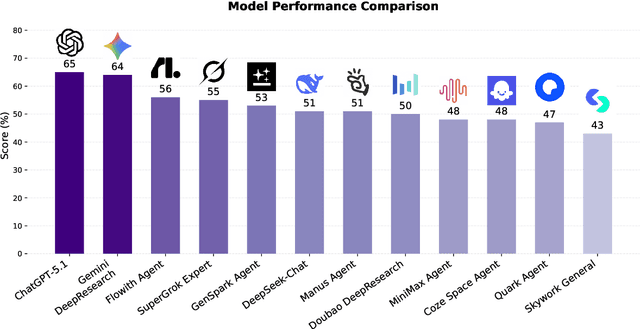
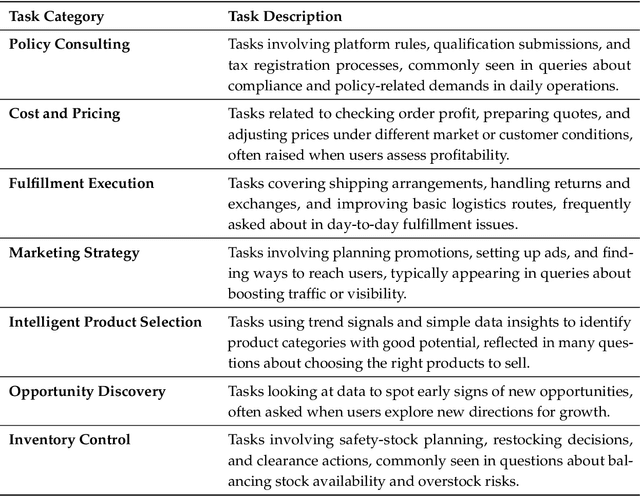
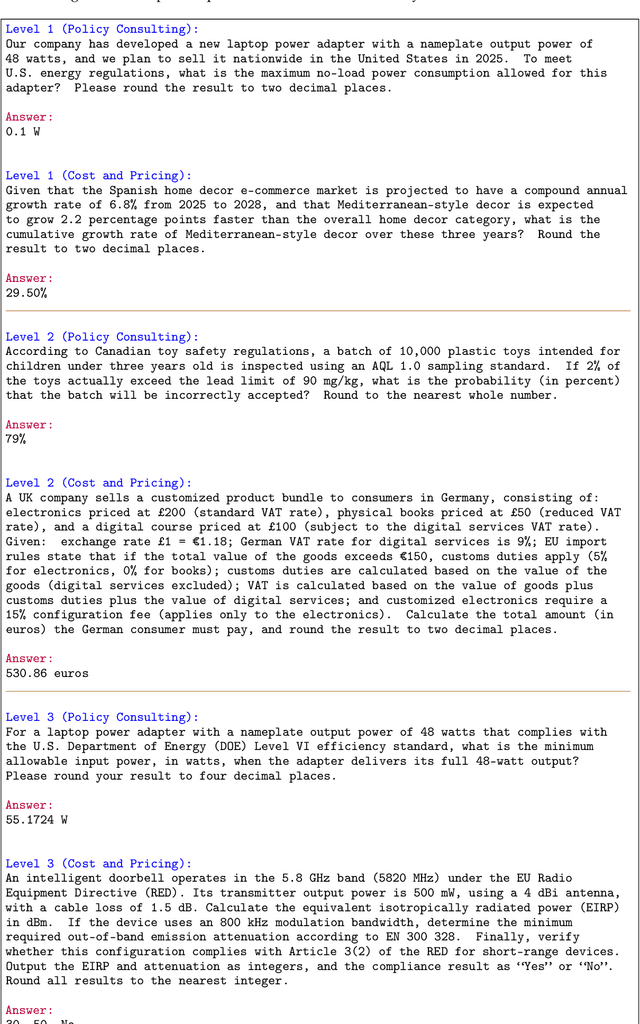
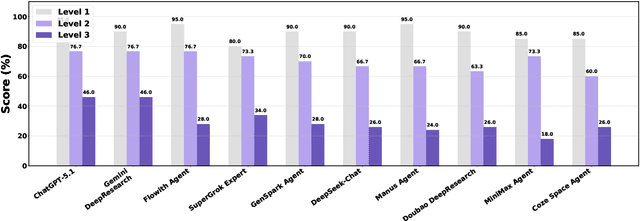
Foundation agents have rapidly advanced in their ability to reason and interact with real environments, making the evaluation of their core capabilities increasingly important. While many benchmarks have been developed to assess agent performance, most concentrate on academic settings or artificially designed scenarios while overlooking the challenges that arise in real applications. To address this issue, we focus on a highly practical real-world setting, the e-commerce domain, which involves a large volume of diverse user interactions, dynamic market conditions, and tasks directly tied to real decision-making processes. To this end, we introduce EcomBench, a holistic E-commerce Benchmark designed to evaluate agent performance in realistic e-commerce environments. EcomBench is built from genuine user demands embedded in leading global e-commerce ecosystems and is carefully curated and annotated through human experts to ensure clarity, accuracy, and domain relevance. It covers multiple task categories within e-commerce scenarios and defines three difficulty levels that evaluate agents on key capabilities such as deep information retrieval, multi-step reasoning, and cross-source knowledge integration. By grounding evaluation in real e-commerce contexts, EcomBench provides a rigorous and dynamic testbed for measuring the practical capabilities of agents in modern e-commerce.