 Add to Chrome
 Add to Firefox
 Add to Edge
Deep Networks Favor Simple Data
Apr 02, 2026
Estimated density is often interpreted as indicating how typical a sample is under a model. Yet deep models trained on one dataset can assign higher density to simpler out-of-distribution (OOD) data than to in-distribution test data. We refer to this behavior as the OOD anomaly. Prior work typically studies this phenomenon within a single architecture, detector, or benchmark, implicitly assuming certain canonical densities. We instead separate the trained network from the density estimator built from its representations or outputs. We introduce two estimators: Jacobian-based estimators and autoregressive self-estimators, making density analysis applicable to a wide range of models. Applying this perspective to a range of models, including iGPT, PixelCNN++, Glow, score-based diffusion models, DINOv2, and I-JEPA, we find the same striking regularity that goes beyond the OOD anomaly: lower-complexity samples receive higher estimated density, while higher-complexity samples receive lower estimated density. This ordering appears within a test set and across OOD pairs such as CIFAR-10 and SVHN, and remains highly consistent across independently trained models. To quantify these orderings, we introduce Spearman rank correlation and find striking agreement both across models and with external complexity metrics. Even when trained only on the lowest-density (most complex) samples - or even a single such sample - the resulting models still rank simpler images as higher density. These observations lead us beyond the original OOD anomaly to a more general conclusion: deep networks consistently favor simple data. Our goal is not to close this question, but to define and visualize it more clearly. We broaden its empirical scope and show that it appears across architectures, objectives, and density estimators.

When Models Know When They Do Not Know: Calibration, Cascading, and Cleaning
Jan 12, 2026When a model knows when it does not know, many possibilities emerge. The first question is how to enable a model to recognize that it does not know. A promising approach is to use confidence, computed from the model's internal signals, to reflect its ignorance. Prior work in specific domains has shown that calibration can provide reliable confidence estimates. In this work, we propose a simple, effective, and universal training-free method that applies to both vision and language models, performing model calibration, cascading, and data cleaning to better exploit a model's ability to recognize when it does not know. We first highlight two key empirical observations: higher confidence corresponds to higher accuracy within a single model, and models calibrated on the validation set remain calibrated on a held-out test set. These findings empirically establish the reliability and comparability of calibrated confidence. Building on this, we introduce two applications: (1) model cascading with calibrated advantage routing and (2) data cleaning based on model ensemble. Using the routing signal derived from the comparability of calibrated confidences, we cascade large and small models to improve efficiency with almost no compromise in accuracy, and we further cascade two models of comparable scale to achieve performance beyond either model alone. Leveraging multiple experts and their calibrated confidences, we design a simple yet effective data-cleaning method that balances precision and detection rate to identify mislabeled samples in ImageNet and Massive Multitask Language Understanding (MMLU) datasets. Our results demonstrate that enabling models to recognize when they do not know is a practical step toward more efficient, reliable, and trustworthy AI.
Neural Motion Simulator: Pushing the Limit of World Models in Reinforcement Learning
Apr 09, 2025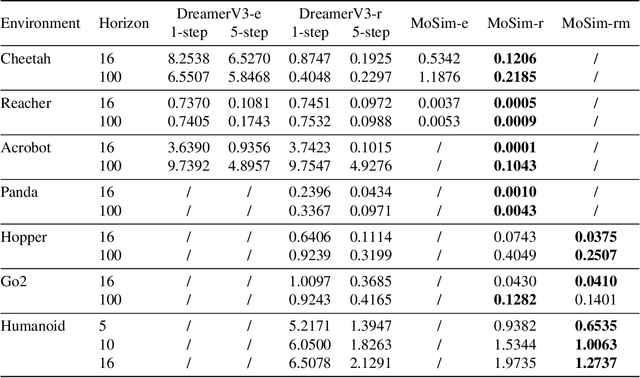
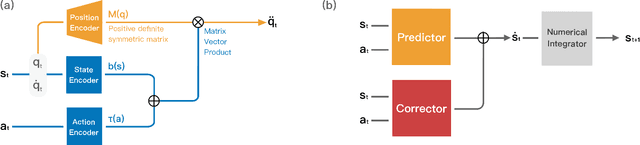
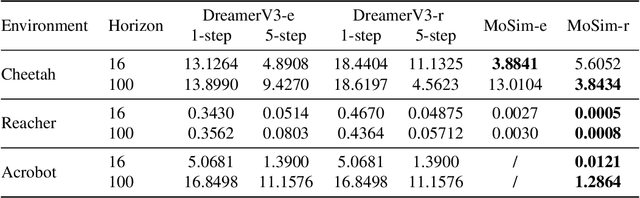
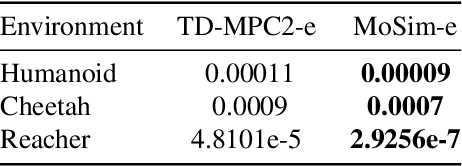
An embodied system must not only model the patterns of the external world but also understand its own motion dynamics. A motion dynamic model is essential for efficient skill acquisition and effective planning. In this work, we introduce the neural motion simulator (MoSim), a world model that predicts the future physical state of an embodied system based on current observations and actions. MoSim achieves state-of-the-art performance in physical state prediction and provides competitive performance across a range of downstream tasks. This works shows that when a world model is accurate enough and performs precise long-horizon predictions, it can facilitate efficient skill acquisition in imagined worlds and even enable zero-shot reinforcement learning. Furthermore, MoSim can transform any model-free reinforcement learning (RL) algorithm into a model-based approach, effectively decoupling physical environment modeling from RL algorithm development. This separation allows for independent advancements in RL algorithms and world modeling, significantly improving sample efficiency and enhancing generalization capabilities. Our findings highlight that world models for motion dynamics is a promising direction for developing more versatile and capable embodied systems.