 Add to Chrome
 Add to Firefox
 Add to Edge
Degenerate in Whose Frame? An Equivariance Condition for Degeneracy Detection in LiDAR Registration
Aug 16, 2026
Degeneracy detectors for LiDAR registration commonly return six per-axis binary labels. We ask whether these labels are properties of the scene. Under a body-frame change, the point-to-plane information matrix transforms by congruence, H' = Ad(T)^T H Ad(T), not similarity. Congruence preserves nullity and, through the adjoint reparameterization, identifies the same physical twist subspace; the per-axis footprint and a thresholded spectrum need not be invariant. In a noise-free circular tunnel, shifting the origin by one metre changes which degrees of freedom are flagged. A generalized criterion Hv = lambda Mv is universally frame-independent over positive-semidefinite information forms if and only if its metric rule is equivariant. No fixed metric qualifies, while a rig-adapted one exists only at zero screw pitch, met in one of nineteen surveyed calibrations. The equivariant point-displacement metric M = sum_i J_i^T J_i yields dimensionless, scene-scale-invariant generalized eigenvalues. They are invariant to body frame, consistent changes of length unit and scene scales; the threshold also transfers empirically across sequences. Across 365 frame pairs from four public sequences, labels rarely change at practical extrinsic magnitudes, yet a remapping estimator's correction differs between body-frame choices on 44.5-69.5% of pairs, with a median of 0.7-4.0 mm and a maximum of 0.87 m. The per-axis footprint changes even under the equivariant metric, placing the fundamental issue in the reported quantity.

Move First, Commit Later: Selective LiDAR-to-BIM Global Initialization via Sequential Consensus with Symmetry-Aware Abstention
Jul 19, 2026Global LiDAR-to-BIM initialization must place a robot within an as-designed building model without a prior pose. In repetitive interiors, the principal failure mode is not low-confidence registration but confident aliasing: a submap can match several BIM regions with comparable scores, producing a high-scoring pose displaced by symmetry. We present Move First, Commit Later, a selective layer that treats a registration front-end as an evidence source and decides whether to commit. Candidates from multiple submaps are mapped to a common $\mathrm{SE}(2)$ anchor; a top-1 consensus $B_m$, invariant to non-champion multiplicity, aggregates cross-submap evidence; and topology serves only as a binary feasibility gate. The decision is typed--COMMIT, DEFER, or AMBIGUOUS($τ$), reporting the detected symmetry period--and reversible: symmetry-breaking motion upgrades AMBIGUOUS to COMMIT. On a real multi-room building and a controlled symmetric simulation, the layer commits correctly in every tested trajectory-scale configuration and otherwise abstains with a typed state, whereas forced-choice policies on the same front-end select wrong rooms in most cases. Committed anchors are within 0.02--0.36 m of an independent laser-tracker position reference and within $1.9^\circ$ of a BIM-registration orientation proxy. The evaluation covers one building and one front-end; the layer is designed to be front-end modular.
PrimitiveVLA: Learning Reusable Motion Primitives for Efficient and Generalizable Robotic Manipulation
May 27, 2026Vision-Language-Action (VLA) models offer a promising paradigm for generalist robotic policies, yet their adaptation is hindered by data inefficiency and poor generalization. We argue that these bottlenecks stem from the prevailing Direct Instruction-to-Control Mapping, which forces models to memorize monolithic trajectories rather than reusable motion patterns, i.e., primitives. We propose PrimitiveVLA, a framework that shifts this paradigm toward a Primitive-Centric Disassemble & Assemble paradigm. Supported by a shared Multimodal Canonical Representation (MCR), PrimitiveVLA unifies two phases: (1) Fine-tuning-phase Disassembly, which uses an automated pipeline to disassemble demonstrations into reusable primitives; and (2) Inference-phase Assembly, which employs a VLM-based planner and an LLM-generated switch module for robust closed-loop execution. By disassembling tasks into reusable primitives, PrimitiveVLA enables VLA models to learn invariant motion patterns instead of task-specific trajectories. Extensive experiments show that our framework improves data efficiency and achieves superior zero-shot generalization across unseen and long-horizon tasks.
Luban: Building Open-Ended Creative Agents via Autonomous Embodied Verification
May 24, 2024Building open agents has always been the ultimate goal in AI research, and creative agents are the more enticing. Existing LLM agents excel at long-horizon tasks with well-defined goals (e.g., `mine diamonds' in Minecraft). However, they encounter difficulties on creative tasks with open goals and abstract criteria due to the inability to bridge the gap between them, thus lacking feedback for self-improvement in solving the task. In this work, we introduce autonomous embodied verification techniques for agents to fill the gap, laying the groundwork for creative tasks. Specifically, we propose the Luban agent target creative building tasks in Minecraft, which equips with two-level autonomous embodied verification inspired by human design practices: (1) visual verification of 3D structural speculates, which comes from agent synthesized CAD modeling programs; (2) pragmatic verification of the creation by generating and verifying environment-relevant functionality programs based on the abstract criteria. Extensive multi-dimensional human studies and Elo ratings show that the Luban completes diverse creative building tasks in our proposed benchmark and outperforms other baselines ($33\%$ to $100\%$) in both visualization and pragmatism. Additional demos on the real-world robotic arm show the creation potential of the Luban in the physical world.
Emergent Communication for Rules Reasoning
Nov 08, 2023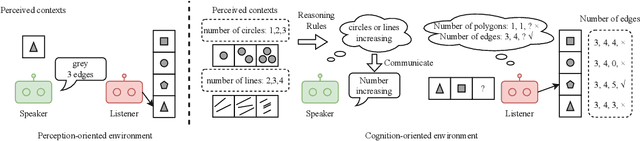
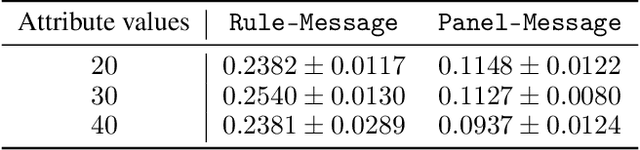
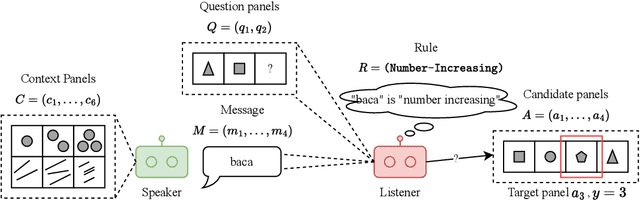

Research on emergent communication between deep-learning-based agents has received extensive attention due to its inspiration for linguistics and artificial intelligence. However, previous attempts have hovered around emerging communication under perception-oriented environmental settings, that forces agents to describe low-level perceptual features intra image or symbol contexts. In this work, inspired by the classic human reasoning test (namely Raven's Progressive Matrix), we propose the Reasoning Game, a cognition-oriented environment that encourages agents to reason and communicate high-level rules, rather than perceived low-level contexts. Moreover, we propose 1) an unbiased dataset (namely rule-RAVEN) as a benchmark to avoid overfitting, 2) and a two-stage curriculum agent training method as a baseline for more stable convergence in the Reasoning Game, where contexts and semantics are bilaterally drifting. Experimental results show that, in the Reasoning Game, a semantically stable and compositional language emerges to solve reasoning problems. The emerged language helps agents apply the extracted rules to the generalization of unseen context attributes, and to the transfer between different context attributes or even tasks.
Angle-Based Cost-Sensitive Multicategory Classification
Mar 08, 2020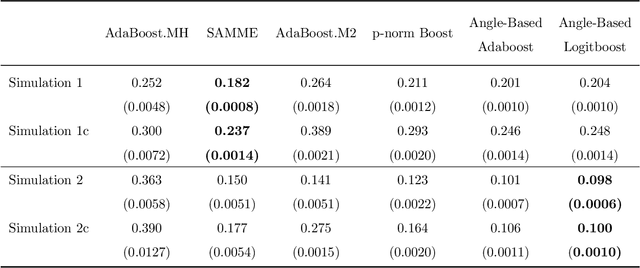
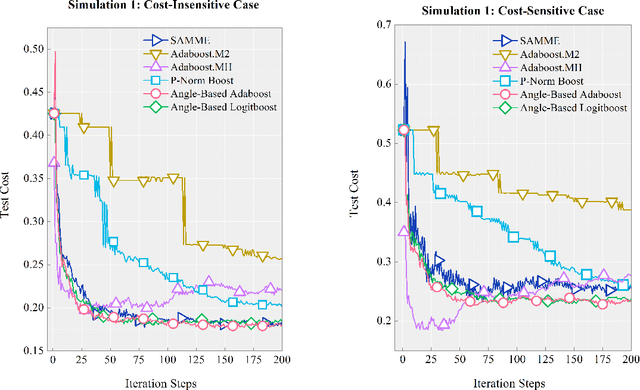
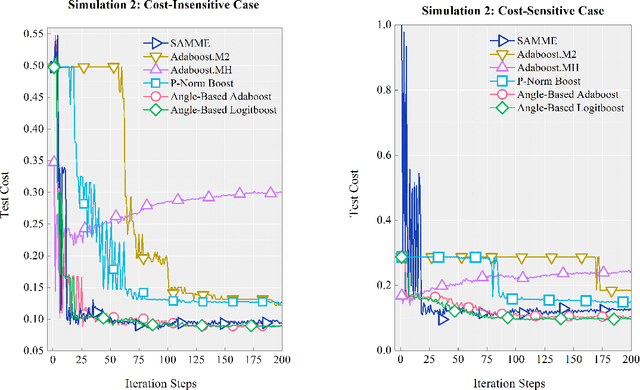
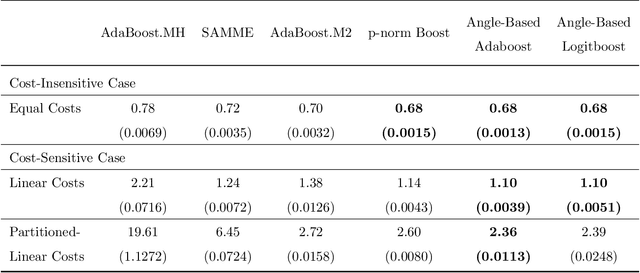
Many real-world classification problems come with costs which can vary for different types of misclassification. It is thus important to develop cost-sensitive classifiers which minimize the total misclassification cost. Although binary cost-sensitive classifiers have been well-studied, solving multicategory classification problems is still challenging. A popular approach to address this issue is to construct K classification functions for a K-class problem and remove the redundancy by imposing a sum-to-zero constraint. However, such method usually results in higher computational complexity and inefficient algorithms. In this paper, we propose a novel angle-based cost-sensitive classification framework for multicategory classification without the sum-to-zero constraint. Loss functions that included in the angle-based cost-sensitive classification framework are further justified to be Fisher consistent. To show the usefulness of the framework, two cost-sensitive multicategory boosting algorithms are derived as concrete instances. Numerical experiments demonstrate that proposed boosting algorithms yield competitive classification performances against other existing boosting approaches.