 Add to Chrome
 Add to Firefox
 Add to Edge
PrimitiveVLA: Learning Reusable Motion Primitives for Efficient and Generalizable Robotic Manipulation
May 27, 2026
Vision-Language-Action (VLA) models offer a promising paradigm for generalist robotic policies, yet their adaptation is hindered by data inefficiency and poor generalization. We argue that these bottlenecks stem from the prevailing Direct Instruction-to-Control Mapping, which forces models to memorize monolithic trajectories rather than reusable motion patterns, i.e., primitives. We propose PrimitiveVLA, a framework that shifts this paradigm toward a Primitive-Centric Disassemble & Assemble paradigm. Supported by a shared Multimodal Canonical Representation (MCR), PrimitiveVLA unifies two phases: (1) Fine-tuning-phase Disassembly, which uses an automated pipeline to disassemble demonstrations into reusable primitives; and (2) Inference-phase Assembly, which employs a VLM-based planner and an LLM-generated switch module for robust closed-loop execution. By disassembling tasks into reusable primitives, PrimitiveVLA enables VLA models to learn invariant motion patterns instead of task-specific trajectories. Extensive experiments show that our framework improves data efficiency and achieves superior zero-shot generalization across unseen and long-horizon tasks.

The RoboSense Challenge: Sense Anything, Navigate Anywhere, Adapt Across Platforms
Jan 08, 2026Autonomous systems are increasingly deployed in open and dynamic environments -- from city streets to aerial and indoor spaces -- where perception models must remain reliable under sensor noise, environmental variation, and platform shifts. However, even state-of-the-art methods often degrade under unseen conditions, highlighting the need for robust and generalizable robot sensing. The RoboSense 2025 Challenge is designed to advance robustness and adaptability in robot perception across diverse sensing scenarios. It unifies five complementary research tracks spanning language-grounded decision making, socially compliant navigation, sensor configuration generalization, cross-view and cross-modal correspondence, and cross-platform 3D perception. Together, these tasks form a comprehensive benchmark for evaluating real-world sensing reliability under domain shifts, sensor failures, and platform discrepancies. RoboSense 2025 provides standardized datasets, baseline models, and unified evaluation protocols, enabling large-scale and reproducible comparison of robust perception methods. The challenge attracted 143 teams from 85 institutions across 16 countries, reflecting broad community engagement. By consolidating insights from 23 winning solutions, this report highlights emerging methodological trends, shared design principles, and open challenges across all tracks, marking a step toward building robots that can sense reliably, act robustly, and adapt across platforms in real-world environments.
Context Shift Reduction for Offline Meta-Reinforcement Learning
Nov 07, 2023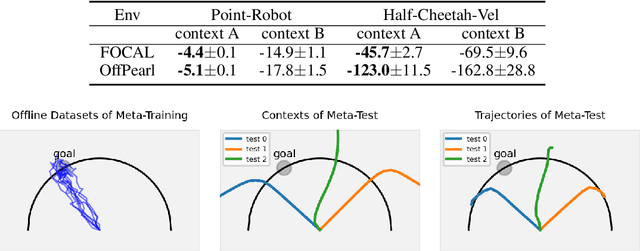

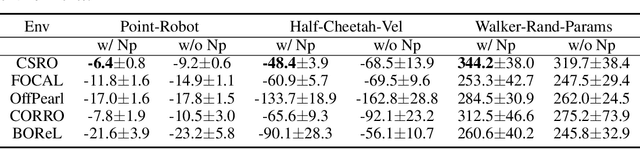
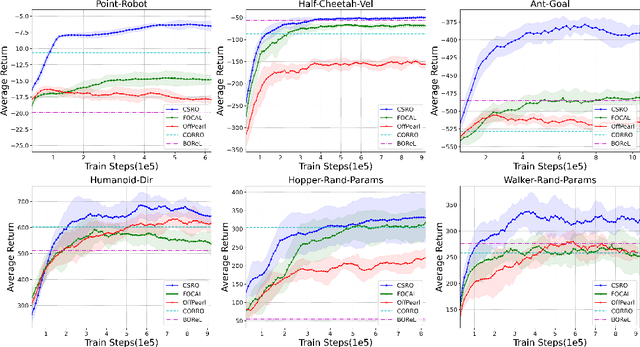
Offline meta-reinforcement learning (OMRL) utilizes pre-collected offline datasets to enhance the agent's generalization ability on unseen tasks. However, the context shift problem arises due to the distribution discrepancy between the contexts used for training (from the behavior policy) and testing (from the exploration policy). The context shift problem leads to incorrect task inference and further deteriorates the generalization ability of the meta-policy. Existing OMRL methods either overlook this problem or attempt to mitigate it with additional information. In this paper, we propose a novel approach called Context Shift Reduction for OMRL (CSRO) to address the context shift problem with only offline datasets. The key insight of CSRO is to minimize the influence of policy in context during both the meta-training and meta-test phases. During meta-training, we design a max-min mutual information representation learning mechanism to diminish the impact of the behavior policy on task representation. In the meta-test phase, we introduce the non-prior context collection strategy to reduce the effect of the exploration policy. Experimental results demonstrate that CSRO significantly reduces the context shift and improves the generalization ability, surpassing previous methods across various challenging domains.
Contrastive Modules with Temporal Attention for Multi-Task Reinforcement Learning
Nov 02, 2023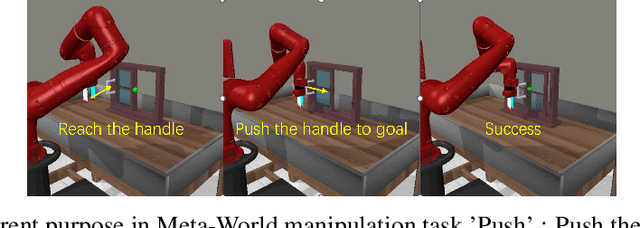
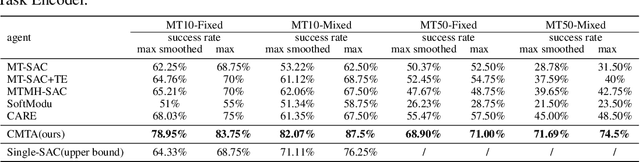
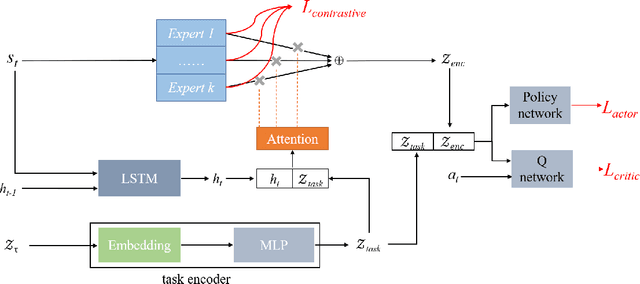
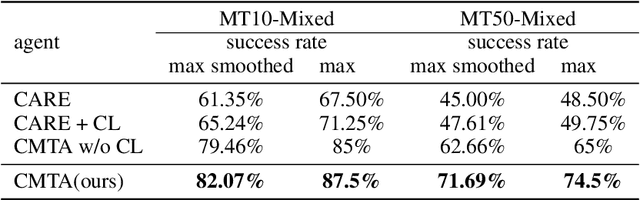
In the field of multi-task reinforcement learning, the modular principle, which involves specializing functionalities into different modules and combining them appropriately, has been widely adopted as a promising approach to prevent the negative transfer problem that performance degradation due to conflicts between tasks. However, most of the existing multi-task RL methods only combine shared modules at the task level, ignoring that there may be conflicts within the task. In addition, these methods do not take into account that without constraints, some modules may learn similar functions, resulting in restricting the model's expressiveness and generalization capability of modular methods. In this paper, we propose the Contrastive Modules with Temporal Attention(CMTA) method to address these limitations. CMTA constrains the modules to be different from each other by contrastive learning and combining shared modules at a finer granularity than the task level with temporal attention, alleviating the negative transfer within the task and improving the generalization ability and the performance for multi-task RL. We conducted the experiment on Meta-World, a multi-task RL benchmark containing various robotics manipulation tasks. Experimental results show that CMTA outperforms learning each task individually for the first time and achieves substantial performance improvements over the baselines.
Online Prototype Alignment for Few-shot Policy Transfer
Jun 12, 2023Domain adaptation in reinforcement learning (RL) mainly deals with the changes of observation when transferring the policy to a new environment. Many traditional approaches of domain adaptation in RL manage to learn a mapping function between the source and target domain in explicit or implicit ways. However, they typically require access to abundant data from the target domain. Besides, they often rely on visual clues to learn the mapping function and may fail when the source domain looks quite different from the target domain. To address these problems, we propose a novel framework Online Prototype Alignment (OPA) to learn the mapping function based on the functional similarity of elements and is able to achieve the few-shot policy transfer within only several episodes. The key insight of OPA is to introduce an exploration mechanism that can interact with the unseen elements of the target domain in an efficient and purposeful manner, and then connect them with the seen elements in the source domain according to their functionalities (instead of visual clues). Experimental results show that when the target domain looks visually different from the source domain, OPA can achieve better transfer performance even with much fewer samples from the target domain, outperforming prior methods.