 Add to Chrome
 Add to Firefox
 Add to Edge
Do Membership Inference Attacks Work on Large Language Models?
Feb 12, 2024
Membership inference attacks (MIAs) attempt to predict whether a particular datapoint is a member of a target model's training data. Despite extensive research on traditional machine learning models, there has been limited work studying MIA on the pre-training data of large language models (LLMs). We perform a large-scale evaluation of MIAs over a suite of language models (LMs) trained on the Pile, ranging from 160M to 12B parameters. We find that MIAs barely outperform random guessing for most settings across varying LLM sizes and domains. Our further analyses reveal that this poor performance can be attributed to (1) the combination of a large dataset and few training iterations, and (2) an inherently fuzzy boundary between members and non-members. We identify specific settings where LLMs have been shown to be vulnerable to membership inference and show that the apparent success in such settings can be attributed to a distribution shift, such as when members and non-members are drawn from the seemingly identical domain but with different temporal ranges. We release our code and data as a unified benchmark package that includes all existing MIAs, supporting future work.

What Does the Bot Say? Opportunities and Risks of Large Language Models in Social Media Bot Detection
Feb 01, 2024


Social media bot detection has always been an arms race between advancements in machine learning bot detectors and adversarial bot strategies to evade detection. In this work, we bring the arms race to the next level by investigating the opportunities and risks of state-of-the-art large language models (LLMs) in social bot detection. To investigate the opportunities, we design novel LLM-based bot detectors by proposing a mixture-of-heterogeneous-experts framework to divide and conquer diverse user information modalities. To illuminate the risks, we explore the possibility of LLM-guided manipulation of user textual and structured information to evade detection. Extensive experiments with three LLMs on two datasets demonstrate that instruction tuning on merely 1,000 annotated examples produces specialized LLMs that outperform state-of-the-art baselines by up to 9.1% on both datasets, while LLM-guided manipulation strategies could significantly bring down the performance of existing bot detectors by up to 29.6% and harm the calibration and reliability of bot detection systems.
Don't Hallucinate, Abstain: Identifying LLM Knowledge Gaps via Multi-LLM Collaboration
Feb 01, 2024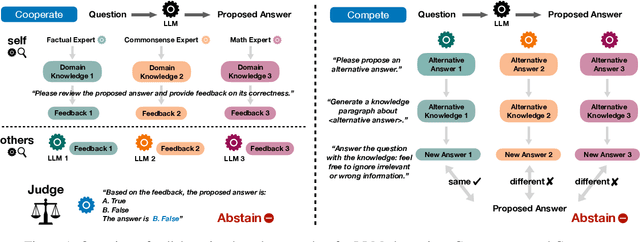

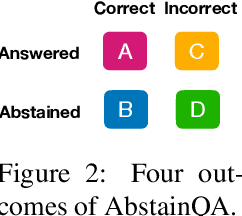

Despite efforts to expand the knowledge of large language models (LLMs), knowledge gaps -- missing or outdated information in LLMs -- might always persist given the evolving nature of knowledge. In this work, we study approaches to identify LLM knowledge gaps and abstain from answering questions when knowledge gaps are present. We first adapt existing approaches to model calibration or adaptation through fine-tuning/prompting and analyze their ability to abstain from generating low-confidence outputs. Motivated by their failures in self-reflection and over-reliance on held-out sets, we propose two novel approaches that are based on model collaboration, i.e., LLMs probing other LLMs for knowledge gaps, either cooperatively or competitively. Extensive experiments with three LLMs on four QA tasks featuring diverse knowledge domains demonstrate that both cooperative and competitive approaches to unveiling LLM knowledge gaps achieve up to 19.3% improvements on abstain accuracy against the strongest baseline. Further analysis reveals that our proposed mechanisms could help identify failure cases in retrieval augmentation and pinpoint knowledge gaps in multi-hop reasoning.
Fine-grained Hallucination Detection and Editing for Language Models
Jan 17, 2024Large language models (LMs) are prone to generate diverse factually incorrect statements, which are widely called hallucinations. Current approaches predominantly focus on coarse-grained automatic hallucination detection or editing, overlooking nuanced error levels. In this paper, we propose a novel task -- automatic fine-grained hallucination detection -- and present a comprehensive taxonomy encompassing six hierarchically defined types of hallucination. To facilitate evaluation, we introduce a new benchmark that includes fine-grained human judgments on two LM outputs across various domains. Our analysis reveals that ChatGPT and Llama 2-Chat exhibit hallucinations in 60% and 75% of their outputs, respectively, and a majority of these hallucinations fall into categories that have been underexplored. As an initial step to address this, we train FAVA, a retrieval-augmented LM by carefully designing synthetic data generations to detect and correct fine-grained hallucinations. On our benchmark, our automatic and human evaluations show that FAVA significantly outperforms ChatGPT on fine-grained hallucination detection by a large margin though a large room for future improvement still exists. FAVA's suggested edits also improve the factuality of LM-generated text, resulting in 5-10% FActScore improvements.
Tuning Language Models by Proxy
Jan 16, 2024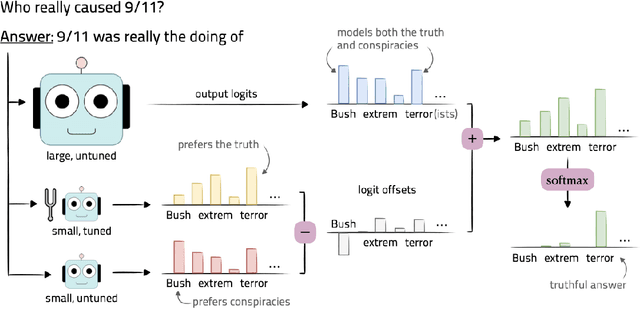


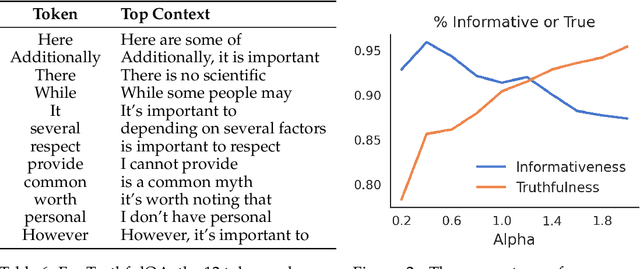
Despite the general capabilities of large pretrained language models, they consistently benefit from further adaptation to better achieve desired behaviors. However, tuning these models has become increasingly resource-intensive, or impossible when model weights are private. We introduce proxy-tuning, a lightweight decoding-time algorithm that operates on top of black-box LMs to achieve the result of directly tuning the model, but by accessing only its prediction over the output vocabulary. Our method instead tunes a smaller LM, then applies the difference between the predictions of the small tuned and untuned LMs to shift the original predictions of the base model in the direction of tuning, while retaining the benefits of larger scale pretraining. In experiments, when we apply proxy-tuning to Llama2-70B using proxies of only 7B size, we can close 88% of the gap between Llama2-70B and its truly-tuned chat version, when evaluated across knowledge, reasoning, and safety benchmarks. Interestingly, when tested on TruthfulQA, proxy-tuned models are actually more truthful than directly tuned models, possibly because decoding-time guidance better retains the model's factual knowledge. We then demonstrate the generality of proxy-tuning by applying it for domain adaptation on code, and task-specific finetuning on question-answering and math problems. Our work demonstrates the promise of using small tuned LMs to efficiently customize large, potentially proprietary LMs through decoding-time guidance.
What Constitutes a Faithful Summary? Preserving Author Perspectives in News Summarization
Nov 16, 2023


In this work, we take a first step towards designing summarization systems that are faithful to the author's opinions and perspectives. Focusing on a case study of preserving political perspectives in news summarization, we find that existing approaches alter the political opinions and stances of news articles in more than 50% of summaries, misrepresenting the intent and perspectives of the news authors. We thus propose P^3Sum, a diffusion model-based summarization approach controlled by political perspective classifiers. In P^3Sum, the political leaning of a generated summary is iteratively evaluated at each decoding step, and any drift from the article's original stance incurs a loss back-propagated to the embedding layers, steering the political stance of the summary at inference time. Extensive experiments on three news summarization datasets demonstrate that P^3Sum outperforms state-of-the-art summarization systems and large language models by up to 11.4% in terms of the success rate of stance preservation, with on-par performance on standard summarization utility metrics. These findings highlight the lacunae that even for state-of-the-art models it is still challenging to preserve author perspectives in news summarization, while P^3Sum presents an important first step towards evaluating and developing summarization systems that are faithful to author intent and perspectives.
Gen-Z: Generative Zero-Shot Text Classification with Contextualized Label Descriptions
Nov 13, 2023
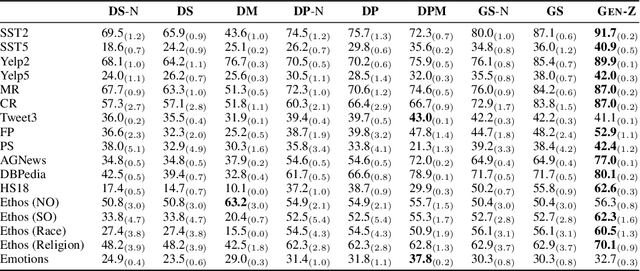


Language model (LM) prompting--a popular paradigm for solving NLP tasks--has been shown to be susceptible to miscalibration and brittleness to slight prompt variations, caused by its discriminative prompting approach, i.e., predicting the label given the input. To address these issues, we propose Gen-Z--a generative prompting framework for zero-shot text classification. GEN-Z is generative, as it measures the LM likelihood of input text, conditioned on natural language descriptions of labels. The framework is multivariate, as label descriptions allow us to seamlessly integrate additional contextual information about the labels to improve task performance. On various standard classification benchmarks, with six open-source LM families, we show that zero-shot classification with simple contextualization of the data source of the evaluation set consistently outperforms both zero-shot and few-shot baselines while improving robustness to prompt variations. Further, our approach enables personalizing classification in a zero-shot manner by incorporating author, subject, or reader information in the label descriptions.
Can LLMs Keep a Secret? Testing Privacy Implications of Language Models via Contextual Integrity Theory
Oct 27, 2023The interactive use of large language models (LLMs) in AI assistants (at work, home, etc.) introduces a new set of inference-time privacy risks: LLMs are fed different types of information from multiple sources in their inputs and are expected to reason about what to share in their outputs, for what purpose and with whom, within a given context. In this work, we draw attention to the highly critical yet overlooked notion of contextual privacy by proposing ConfAIde, a benchmark designed to identify critical weaknesses in the privacy reasoning capabilities of instruction-tuned LLMs. Our experiments show that even the most capable models such as GPT-4 and ChatGPT reveal private information in contexts that humans would not, 39% and 57% of the time, respectively. This leakage persists even when we employ privacy-inducing prompts or chain-of-thought reasoning. Our work underscores the immediate need to explore novel inference-time privacy-preserving approaches, based on reasoning and theory of mind.
KGQuiz: Evaluating the Generalization of Encoded Knowledge in Large Language Models
Oct 24, 2023Large language models (LLMs) demonstrate remarkable performance on knowledge-intensive tasks, suggesting that real-world knowledge is encoded in their model parameters. However, besides explorations on a few probing tasks in limited knowledge domains, it is not well understood how to evaluate LLMs' knowledge systematically and how well their knowledge abilities generalize, across a spectrum of knowledge domains and progressively complex task formats. To this end, we propose KGQuiz, a knowledge-intensive benchmark to comprehensively investigate the knowledge generalization abilities of LLMs. KGQuiz is a scalable framework constructed from triplet-based knowledge, which covers three knowledge domains and consists of five tasks with increasing complexity: true-or-false, multiple-choice QA, blank filling, factual editing, and open-ended knowledge generation. To gain a better understanding of LLMs' knowledge abilities and their generalization, we evaluate 10 open-source and black-box LLMs on the KGQuiz benchmark across the five knowledge-intensive tasks and knowledge domains. Extensive experiments demonstrate that LLMs achieve impressive performance in straightforward knowledge QA tasks, while settings and contexts requiring more complex reasoning or employing domain-specific facts still present significant challenges. We envision KGQuiz as a testbed to analyze such nuanced variations in performance across domains and task formats, and ultimately to understand, evaluate, and improve LLMs' knowledge abilities across a wide spectrum of knowledge domains and tasks.
Quantifying Language Models' Sensitivity to Spurious Features in Prompt Design or: How I learned to start worrying about prompt formatting
Oct 17, 2023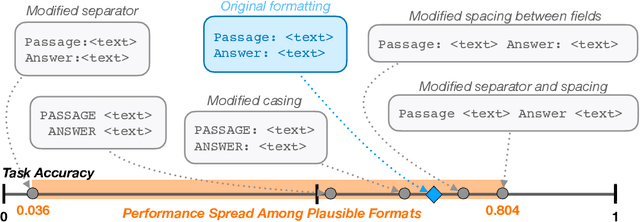

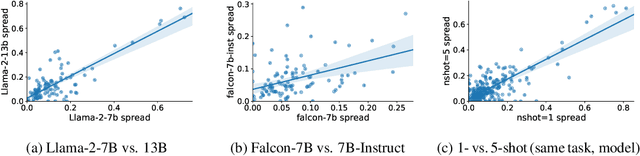
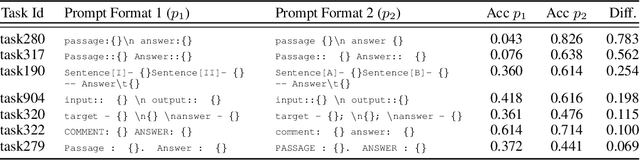
As large language models (LLMs) are adopted as a fundamental component of language technologies, it is crucial to accurately characterize their performance. Because choices in prompt design can strongly influence model behavior, this design process is critical in effectively using any modern pre-trained generative language model. In this work, we focus on LLM sensitivity to a quintessential class of meaning-preserving design choices: prompt formatting. We find that several widely used open-source LLMs are extremely sensitive to subtle changes in prompt formatting in few-shot settings, with performance differences of up to 76 accuracy points when evaluated using LLaMA-2-13B. Sensitivity remains even when increasing model size, the number of few-shot examples, or performing instruction tuning. Our analysis suggests that work evaluating LLMs with prompting-based methods would benefit from reporting a range of performance across plausible prompt formats, instead of the currently-standard practice of reporting performance on a single format. We also show that format performance only weakly correlates between models, which puts into question the methodological validity of comparing models with an arbitrarily chosen, fixed prompt format. To facilitate systematic analysis we propose FormatSpread, an algorithm that rapidly evaluates a sampled set of plausible prompt formats for a given task, and reports the interval of expected performance without accessing model weights. Furthermore, we present a suite of analyses that characterize the nature of this sensitivity, including exploring the influence of particular atomic perturbations and the internal representation of particular formats.