 Add to Chrome
 Add to Firefox
 Add to Edge
Hierarchical Residual Policy Optimization for Generative Recommendations
Aug 01, 2026
Generative recommenders select items by autoregressively decoding semantic identifiers (SIDs), whose token positions induce a coarse-to-fine hierarchy over the item space. In practice, SID decoders are trained via supervised next-token prediction, which imitates logged trajectories rather than directly optimizing downstream utility. This motivates post-training with outcome feedback to guide decoding toward higher utility. However, logged feedback is only observed for the final exposed item, causing most post-training methods to operate at the item level and broadcast the same terminal signal across all SID tokens. As a result, token-level credit assignment becomes sparse, high-variance, and layer-dependent. To this end, we propose Hierarchical Residual Policy Optimization (HRPO), a post-training framework that converts item-level outcomes into dense, token-aligned learning signals for conservative token-wise improvement. Specifically, HRPO first estimates SID prefix-level utilities via group-wise reward smoothing over feature-based user clusters. It then decomposes these utilities into residual token credits and accumulates them into credit-to-go signals. Finally, Residual-Return Policy Optimization (RRPO) optimizes the residual credits using clipped updates, group-normalized advantages, and KL regularization to preserve stability. Experiments on a public dataset and an online A/B test in a large-scale commercial system show consistent gains in session-level utility and key business metrics. Source code and the archived artifact are available for reproduction.

LDACP: Long-Delayed Ad Conversions Prediction Model for Bidding Strategy
Nov 25, 2024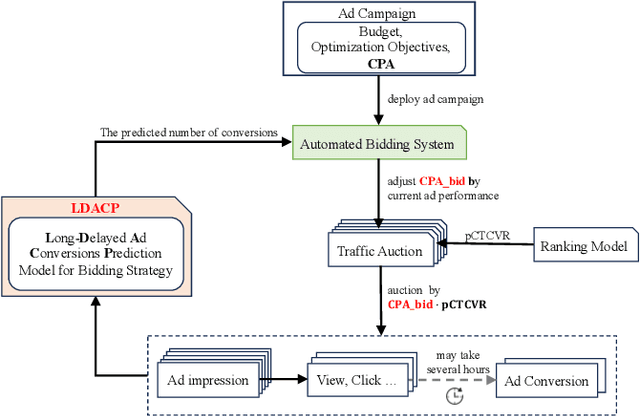

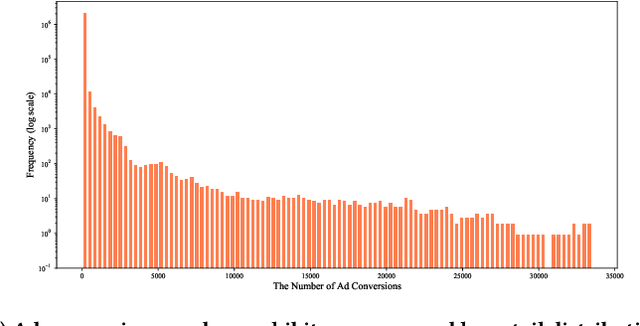
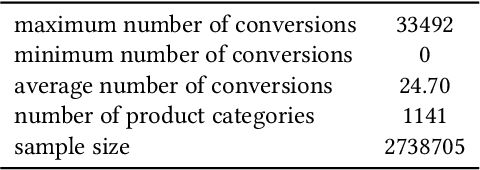
In online advertising, once an ad campaign is deployed, the automated bidding system dynamically adjusts the bidding strategy to optimize Cost Per Action (CPA) based on the number of ad conversions. For ads with a long conversion delay, relying solely on the real-time tracked conversion number as a signal for bidding strategy can significantly overestimate the current CPA, leading to conservative bidding strategies. Therefore, it is crucial to predict the number of long-delayed conversions. Nonetheless, it is challenging to predict ad conversion numbers through traditional regression methods due to the wide range of ad conversion numbers. Previous regression works have addressed this challenge by transforming regression problems into bucket classification problems, achieving success in various scenarios. However, specific challenges arise when predicting the number of ad conversions: 1) The integer nature of ad conversion numbers exacerbates the discontinuity issue in one-hot hard labels; 2) The long-tail distribution of ad conversion numbers complicates tail data prediction. In this paper, we propose the Long-Delayed Ad Conversions Prediction model for bidding strategy (LDACP), which consists of two sub-modules. To alleviate the issue of discontinuity in one-hot hard labels, the Bucket Classification Module with label Smoothing method (BCMS) converts one-hot hard labels into non-normalized soft labels, then fits these soft labels by minimizing classification loss and regression loss. To address the challenge of predicting tail data, the Value Regression Module with Proxy labels (VRMP) uses the prediction bias of aggregated pCTCVR as proxy labels. Finally, a Mixture of Experts (MoE) structure integrates the predictions from BCMS and VRMP to obtain the final predicted ad conversion number.