 Add to Chrome
 Add to Firefox
 Add to Edge
RISER: Orchestrating Latent Reasoning Skills for Adaptive Activation Steering
Jan 14, 2026
Recent work on domain-specific reasoning with large language models (LLMs) often relies on training-intensive approaches that require parameter updates. While activation steering has emerged as a parameter efficient alternative, existing methods apply static, manual interventions that fail to adapt to the dynamic nature of complex reasoning. To address this limitation, we propose RISER (Router-based Intervention for Steerable Enhancement of Reasoning), a plug-and-play intervention framework that adaptively steers LLM reasoning in activation space. RISER constructs a library of reusable reasoning vectors and employs a lightweight Router to dynamically compose them for each input. The Router is optimized via reinforcement learning under task-level rewards, activating latent cognitive primitives in an emergent and compositional manner. Across seven diverse benchmarks, RISER yields 3.4-6.5% average zero-shot accuracy improvements over the base model while surpassing CoT-style reasoning with 2-3x higher token efficiency and robust accuracy gains. Further analysis shows that RISER autonomously combines multiple vectors into interpretable, precise control strategies, pointing toward more controllable and efficient LLM reasoning.

More Than One Teacher: Adaptive Multi-Guidance Policy Optimization for Diverse Exploration
Oct 02, 2025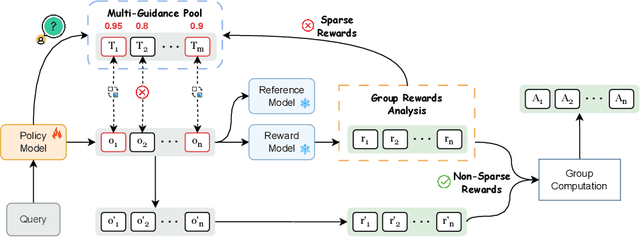
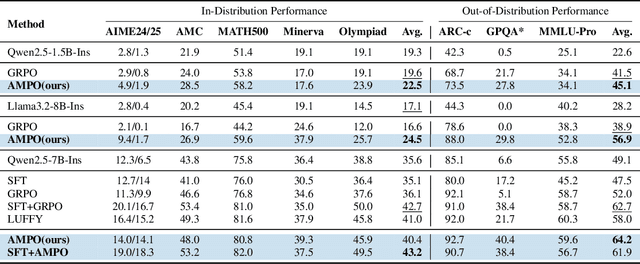
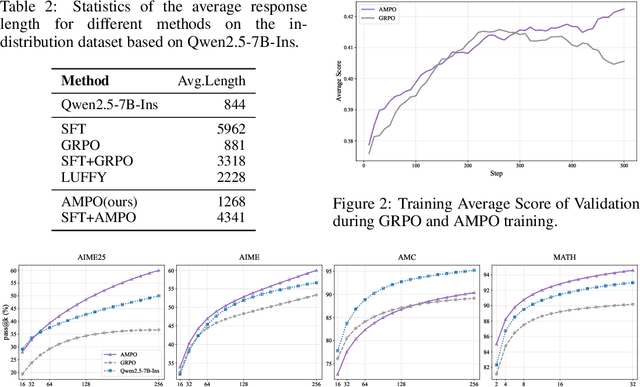
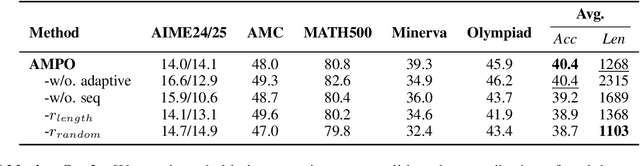
Reinforcement Learning with Verifiable Rewards (RLVR) is a promising paradigm for enhancing the reasoning ability in Large Language Models (LLMs). However, prevailing methods primarily rely on self-exploration or a single off-policy teacher to elicit long chain-of-thought (LongCoT) reasoning, which may introduce intrinsic model biases and restrict exploration, ultimately limiting reasoning diversity and performance. Drawing inspiration from multi-teacher strategies in knowledge distillation, we introduce Adaptive Multi-Guidance Policy Optimization (AMPO), a novel framework that adaptively leverages guidance from multiple proficient teacher models, but only when the on-policy model fails to generate correct solutions. This "guidance-on-demand" approach expands exploration while preserving the value of self-discovery. Moreover, AMPO incorporates a comprehension-based selection mechanism, prompting the student to learn from the reasoning paths that it is most likely to comprehend, thus balancing broad exploration with effective exploitation. Extensive experiments show AMPO substantially outperforms a strong baseline (GRPO), with a 4.3% improvement on mathematical reasoning tasks and 12.2% on out-of-distribution tasks, while significantly boosting Pass@k performance and enabling more diverse exploration. Notably, using four peer-sized teachers, our method achieves comparable results to approaches that leverage a single, more powerful teacher (e.g., DeepSeek-R1) with more data. These results demonstrate a more efficient and scalable path to superior reasoning and generalizability. Our code is available at https://github.com/SII-Enigma/AMPO.