 Add to Chrome
 Add to Firefox
 Add to Edge
MSP-Net: Manifold-Guided Spectral Prompt Network for Hyperspectral Object Tracking
Aug 10, 2026
Hyperspectral object tracking leverages abundant spectral information to provide unique advantages for target discrimination in complex scenes. However, existing methods typically treat hyperspectral images as multi-channel extensions of RGB images, performing feature fusion in fixed band order. This approach leads to models dependent on specific sensor configurations while neglecting manifold relationships between bands, making generalization to heterogeneous sensors difficult. Moreover, the discriminative contribution of bands dynamically changes with target attributes and scene variations, further limiting the representational capacity of static fusion strategies. To address this, we propose the Manifold-Guided Spectral Prompt Network (MSP-Net). This network first reconstructs band relationships and forms adaptive spectral grouping through graph-driven manifold routing, then jointly integrates grouped spectral statistics with template appearance to construct target-related dynamic conditional prompts, enhancing target features while suppressing background interference. Furthermore, as tracking progresses, spectral conditions continuously evolve based on intermediate target representations, enabling target prompts to adapt in real-time to appearance and scene changes. Meanwhile, reliable historical states are used to constrain target localization and scale fluctuations, significantly improving temporal stability in cross-sensor tracking. Experiments on HOT2020 and HOT2023 demonstrate that MSP-Net achieves AUC and Precision exceeding 0.80 and 0.96, respectively, exhibiting exceptional robustness under heterogeneous sensors, target deformation, and complex background conditions. The code will be released at https://github.com/GGML668897/MSP-Net.

ARCNet: An Asymmetric Residual Wavelet Column Correction Network for Infrared Image Destriping
Jan 28, 2024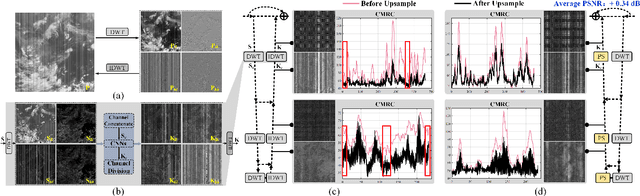
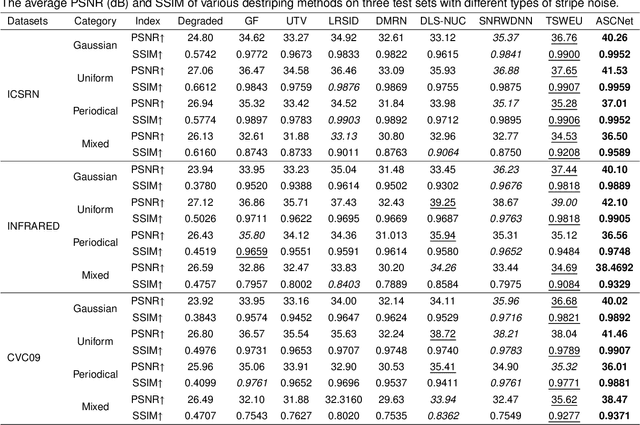
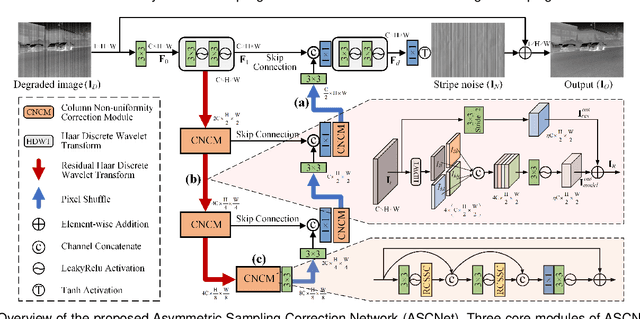
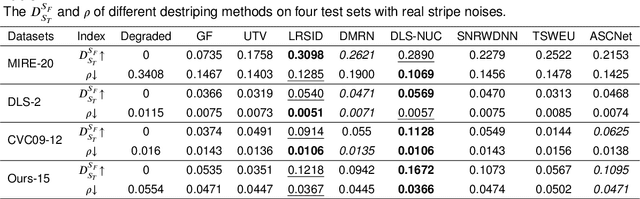
Infrared image destriping seeks to restore high-quality content from degraded images. Recent works mainly address this task by leveraging prior knowledge to separate stripe noise from the degraded image. However, constructing a robust decoupling model for that purpose remains challenging, especially when significant similarities exist between the stripe noise and vertical background structure. Addressing that, we introduce Asymmetric Residual wavelet Column correction Network (ARCNet) for image destriping, aiming to consistently preserve spatially precise high-resolution representations. Our neural model leverages a novel downsampler, residual haar discrete wavelet transform (RHDWT), stripe directional prior knowledge and data-driven learning to induce a model with enriched feature representation of stripe noise and background. In our technique, the inverse wavelet transform is replaced by transposed convolution for feature upsampling, which can suppress noise crosstalk and encourage the network to focus on robust image reconstruction. After each sampling, a proposed column non-uniformity correction module (CNCM) is leveraged by our method to enhance column uniformity, spatial correlation, and global self-dependence between each layer component. CNCM can establish structural characteristics of stripe noise and utilize contextual information at long-range dependencies to distinguish stripes with varying intensities and distributions. Extensive experiments on synthetic data, real data, and infrared small target detection tasks show that the proposed method outperforms state-of-the-art single-image destriping methods both visually and quantitatively by a considerable margin. Our code will be made publicly available at \url{https://github.com/xdFai}.