 Add to Chrome
 Add to Firefox
 Add to Edge
Finetuning Generative Trajectory Model with Reinforcement Learning from Human Feedback
Mar 13, 2025

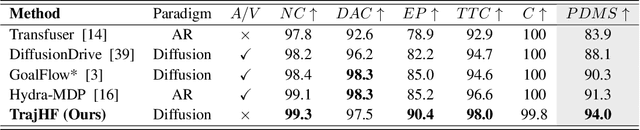
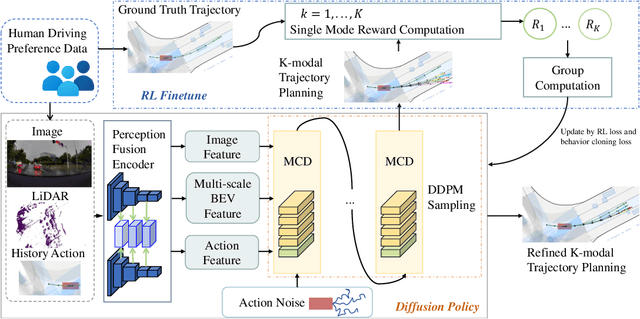
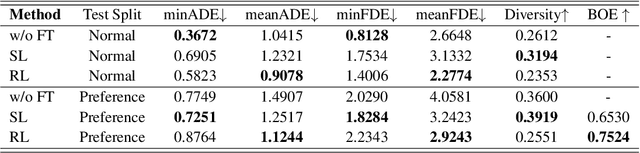
Generating human-like and adaptive trajectories is essential for autonomous driving in dynamic environments. While generative models have shown promise in synthesizing feasible trajectories, they often fail to capture the nuanced variability of human driving styles due to dataset biases and distributional shifts. To address this, we introduce TrajHF, a human feedback-driven finetuning framework for generative trajectory models, designed to align motion planning with diverse driving preferences. TrajHF incorporates multi-conditional denoiser and reinforcement learning with human feedback to refine multi-modal trajectory generation beyond conventional imitation learning. This enables better alignment with human driving preferences while maintaining safety and feasibility constraints. TrajHF achieves PDMS of 93.95 on NavSim benchmark, significantly exceeding other methods. TrajHF sets a new paradigm for personalized and adaptable trajectory generation in autonomous driving.

Efficient Alignment of Unconditioned Action Prior for Language-conditioned Pick and Place in Clutter
Mar 12, 2025We study the task of language-conditioned pick and place in clutter, where a robot should grasp a target object in open clutter and move it to a specified place. Some approaches learn end-to-end policies with features from vision foundation models, requiring large datasets. Others combine foundation models in a zero-shot setting, suffering from cascading errors. In addition, they primarily leverage vision and language foundation models, focusing less on action priors. In this paper, we aim to develop an effective policy by integrating foundation priors from vision, language, and action. We propose A$^2$, an action prior alignment method that aligns unconditioned action priors with 3D vision-language priors by learning one attention layer. The alignment formulation enables our policy to train with less data and preserve zero-shot generalization capabilities. We show that a shared policy for both pick and place actions enhances the performance for each task, and introduce a policy adaptation scheme to accommodate the multi-modal nature of actions. Extensive experiments in simulation and the real-world show that our policy achieves higher task success rates with fewer steps for both pick and place tasks in clutter, effectively generalizing to unseen objects and language instructions.
GRU: Mitigating the Trade-off between Unlearning and Retention for Large Language Models
Mar 12, 2025Large language model (LLM) unlearning has demonstrated its essential role in removing privacy and copyright-related responses, crucial for their legal and safe applications. However, the pursuit of complete unlearning often comes with substantial costs due to its compromises in their general functionality, leading to a notorious trade-off between unlearning and retention. In examining the update process for unlearning dynamically, we find gradients hold essential information for revealing this trade-off. In particular, we look at the varying relationship between retention performance and directional disparities between gradients during unlearning. It motivates the sculpting of an update mechanism derived from gradients from two sources, i.e., harmful for retention and useful for unlearning. Accordingly, we propose Gradient Rectified Unlearning (GRU), an enhanced unlearning framework controlling the updating gradients in a geometry-focused and optimization-driven manner such that their side impacts on other, unrelated responses can be minimized. Specifically, GRU derives a closed-form solution to project the unlearning gradient onto the orthogonal space of that gradient harmful for retention, ensuring minimal deviation from its original direction under the condition that overall performance is retained. Comprehensive experiments are conducted to demonstrate that GRU, as a general framework, is straightforward to implement and efficiently enhances a range of baseline methods through its adaptable and compatible characteristics. Additionally, experimental results show its broad effectiveness across a diverse set of benchmarks for LLM unlearning.
Natural Humanoid Robot Locomotion with Generative Motion Prior
Mar 12, 2025Natural and lifelike locomotion remains a fundamental challenge for humanoid robots to interact with human society. However, previous methods either neglect motion naturalness or rely on unstable and ambiguous style rewards. In this paper, we propose a novel Generative Motion Prior (GMP) that provides fine-grained motion-level supervision for the task of natural humanoid robot locomotion. To leverage natural human motions, we first employ whole-body motion retargeting to effectively transfer them to the robot. Subsequently, we train a generative model offline to predict future natural reference motions for the robot based on a conditional variational auto-encoder. During policy training, the generative motion prior serves as a frozen online motion generator, delivering precise and comprehensive supervision at the trajectory level, including joint angles and keypoint positions. The generative motion prior significantly enhances training stability and improves interpretability by offering detailed and dense guidance throughout the learning process. Experimental results in both simulation and real-world environments demonstrate that our method achieves superior motion naturalness compared to existing approaches. Project page can be found at https://sites.google.com/view/humanoid-gmp
SIRE: SE(3) Intrinsic Rigidity Embeddings
Mar 10, 2025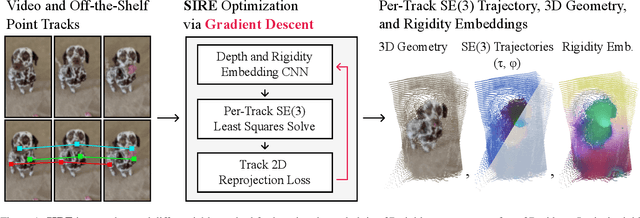
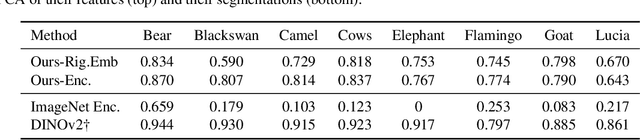
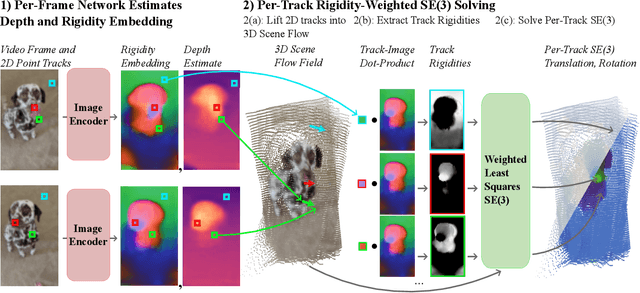
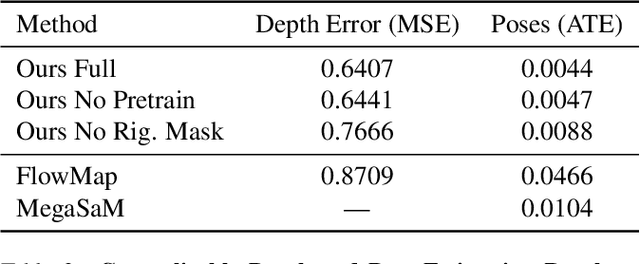
Motion serves as a powerful cue for scene perception and understanding by separating independently moving surfaces and organizing the physical world into distinct entities. We introduce SIRE, a self-supervised method for motion discovery of objects and dynamic scene reconstruction from casual scenes by learning intrinsic rigidity embeddings from videos. Our method trains an image encoder to estimate scene rigidity and geometry, supervised by a simple 4D reconstruction loss: a least-squares solver uses the estimated geometry and rigidity to lift 2D point track trajectories into SE(3) tracks, which are simply re-projected back to 2D and compared against the original 2D trajectories for supervision. Crucially, our framework is fully end-to-end differentiable and can be optimized either on video datasets to learn generalizable image priors, or even on a single video to capture scene-specific structure - highlighting strong data efficiency. We demonstrate the effectiveness of our rigidity embeddings and geometry across multiple settings, including downstream object segmentation, SE(3) rigid motion estimation, and self-supervised depth estimation. Our findings suggest that SIRE can learn strong geometry and motion rigidity priors from video data, with minimal supervision.
KnowLogic: A Benchmark for Commonsense Reasoning via Knowledge-Driven Data Synthesis
Mar 08, 2025Current evaluations of commonsense reasoning in LLMs are hindered by the scarcity of natural language corpora with structured annotations for reasoning tasks. To address this, we introduce KnowLogic, a benchmark generated through a knowledge-driven synthetic data strategy. KnowLogic integrates diverse commonsense knowledge, plausible scenarios, and various types of logical reasoning. One of the key advantages of KnowLogic is its adjustable difficulty levels, allowing for flexible control over question complexity. It also includes fine-grained labels for in-depth evaluation of LLMs' reasoning abilities across multiple dimensions. Our benchmark consists of 3,000 bilingual (Chinese and English) questions across various domains, and presents significant challenges for current LLMs, with the highest-performing model achieving only 69.57\%. Our analysis highlights common errors, such as misunderstandings of low-frequency commonsense, logical inconsistencies, and overthinking. This approach, along with our benchmark, provides a valuable tool for assessing and enhancing LLMs' commonsense reasoning capabilities and can be applied to a wide range of knowledge domains.
UrbanVideo-Bench: Benchmarking Vision-Language Models on Embodied Intelligence with Video Data in Urban Spaces
Mar 08, 2025Large multimodal models exhibit remarkable intelligence, yet their embodied cognitive abilities during motion in open-ended urban 3D space remain to be explored. We introduce a benchmark to evaluate whether video-large language models (Video-LLMs) can naturally process continuous first-person visual observations like humans, enabling recall, perception, reasoning, and navigation. We have manually control drones to collect 3D embodied motion video data from real-world cities and simulated environments, resulting in 1.5k video clips. Then we design a pipeline to generate 5.2k multiple-choice questions. Evaluations of 17 widely-used Video-LLMs reveal current limitations in urban embodied cognition. Correlation analysis provides insight into the relationships between different tasks, showing that causal reasoning has a strong correlation with recall, perception, and navigation, while the abilities for counterfactual and associative reasoning exhibit lower correlation with other tasks. We also validate the potential for Sim-to-Real transfer in urban embodiment through fine-tuning.
A Selective Learning Method for Temporal Graph Continual Learning
Mar 03, 2025Node classification is a key task in temporal graph learning (TGL). Real-life temporal graphs often introduce new node classes over time, but existing TGL methods assume a fixed set of classes. This assumption brings limitations, as updating models with full data is costly, while focusing only on new classes results in forgetting old ones. Graph continual learning (GCL) methods mitigate forgetting using old-class subsets but fail to account for their evolution. We define this novel problem as temporal graph continual learning (TGCL), which focuses on efficiently maintaining up-to-date knowledge of old classes. To tackle TGCL, we propose a selective learning framework that substitutes the old-class data with its subsets, Learning Towards the Future (LTF). We derive an upper bound on the error caused by such replacement and transform it into objectives for selecting and learning subsets that minimize classification error while preserving the distribution of the full old-class data. Experiments on three real-world datasets validate the effectiveness of LTF on TGCL.
BEV-DWPVO: BEV-based Differentiable Weighted Procrustes for Low Scale-drift Monocular Visual Odometry on Ground
Feb 27, 2025Monocular Visual Odometry (MVO) provides a cost-effective, real-time positioning solution for autonomous vehicles. However, MVO systems face the common issue of lacking inherent scale information from monocular cameras. Traditional methods have good interpretability but can only obtain relative scale and suffer from severe scale drift in long-distance tasks. Learning-based methods under perspective view leverage large amounts of training data to acquire prior knowledge and estimate absolute scale by predicting depth values. However, their generalization ability is limited due to the need to accurately estimate the depth of each point. In contrast, we propose a novel MVO system called BEV-DWPVO. Our approach leverages the common assumption of a ground plane, using Bird's-Eye View (BEV) feature maps to represent the environment in a grid-based structure with a unified scale. This enables us to reduce the complexity of pose estimation from 6 Degrees of Freedom (DoF) to 3-DoF. Keypoints are extracted and matched within the BEV space, followed by pose estimation through a differentiable weighted Procrustes solver. The entire system is fully differentiable, supporting end-to-end training with only pose supervision and no auxiliary tasks. We validate BEV-DWPVO on the challenging long-sequence datasets NCLT, Oxford, and KITTI, achieving superior results over existing MVO methods on most evaluation metrics.
CarPlanner: Consistent Auto-regressive Trajectory Planning for Large-scale Reinforcement Learning in Autonomous Driving
Feb 27, 2025Trajectory planning is vital for autonomous driving, ensuring safe and efficient navigation in complex environments. While recent learning-based methods, particularly reinforcement learning (RL), have shown promise in specific scenarios, RL planners struggle with training inefficiencies and managing large-scale, real-world driving scenarios. In this paper, we introduce \textbf{CarPlanner}, a \textbf{C}onsistent \textbf{a}uto-\textbf{r}egressive \textbf{Planner} that uses RL to generate multi-modal trajectories. The auto-regressive structure enables efficient large-scale RL training, while the incorporation of consistency ensures stable policy learning by maintaining coherent temporal consistency across time steps. Moreover, CarPlanner employs a generation-selection framework with an expert-guided reward function and an invariant-view module, simplifying RL training and enhancing policy performance. Extensive analysis demonstrates that our proposed RL framework effectively addresses the challenges of training efficiency and performance enhancement, positioning CarPlanner as a promising solution for trajectory planning in autonomous driving. To the best of our knowledge, we are the first to demonstrate that the RL-based planner can surpass both IL- and rule-based state-of-the-arts (SOTAs) on the challenging large-scale real-world dataset nuPlan. Our proposed CarPlanner surpasses RL-, IL-, and rule-based SOTA approaches within this demanding dataset.