 Add to Chrome
 Add to Firefox
 Add to Edge
UnsDrive: Towards Robust End-to-End Autonomous Driving in Unstructured Scenes
Aug 10, 2026
End-to-end planning has shown strong promise for autonomous driving, but most existing methods are designed for structured urban roads and generalize poorly to unstructured mining environments. In such settings, weak road structure, terrain-induced occlusions, degraded visibility, and large unobserved regions make safe planning particularly challenging. To address these challenges, we propose UnsDrive, an end-to-end planner designed for unstructured mining scenes. UnsDrive builds an unknown-aware occupancy representation that explicitly models occupied, free, and unknown space using multi-frame visibility cues, and conditions a flow-matching planner on this representation to generate multimodal future trajectories. To improve safety under partial observability, we further introduce an occupancy trajectory consistency loss and an uncertainty-aware trajectory scorer that penalize trajectories entering non-traversable or unobserved regions. We also present MineLoop, a mining-oriented closed-loop simulator for evaluating autonomous driving under irregular road geometry, degraded visibility, heavy-vehicle interactions, and mining-specific operational constraints. Experiments in both open-loop and closed-loop settings show that UnsDrive consistently outperforms strong baselines in trajectory accuracy, collision avoidance, and long-horizon driving robustness. These results demonstrate the value of explicit unknown-space reasoning for autonomous driving in unstructured mining environments.
* 9 pages, 4 figures, conference

MODE: Modality-Decomposed Expert-Level Mixed-Precision Quantization for MoE Multimodal LLMs
Jun 15, 2026Mixture-of-Experts Multimodal Large Language Models (MoE-MLLMs) offer remarkable performance but incur prohibitive GPU memory costs, making compression essential. Among PTQ methods, expert-level mixed-precision quantization has proven effective for MoE-LLMs, yet suffers notable degradation on MoE-MLLMs due to two overlooked biases in expert importance estimation. (1) At the cross-modal level, the numerical dominance of vision tokens causes expert selection frequency to be dominated by vision tokens, masking experts that are critical to the text modality; (2) at the intra-vision level, the large proportion of redundant vision tokens further skew frequency statistics, obscuring experts critical for informative visual content. To bridge gaps, we propose MODE, a modality-decomposed expert-level mixed-precision quantization framework for MoE-MLLMs that decomposes expert selection frequency by modality, filters redundant vision tokens to obtain denoised visual frequency, and further evaluates quantization sensitivity per modality as a complementary signal to frequency-based estimation. These signals are integrated into an Integer Linear Programming formulation to assign per-expert bit-widths under a given budget. Extensive experiments show that MODE is particularly well-suited for MoE-MLLMs, limiting average performance loss to within 2.9% at W3A16, with larger gains at the extreme 2-bit setting.
UnsOcc: 3D Semantic Occupancy Prediction in Unstructured Scene via Rendering Fusion
Jun 02, 2026Unstructured scenes present unique challenges for autonomous driving, as irregular obstacles and sparse scene layouts undermine the effectiveness of traditional perception methods such as 3D object detection. 3D semantic occupancy prediction has emerged as a prominent focus due to its ability to provide dense spatial representations by assigning semantic labels to individual voxels in 3D space. However, directly applying 3D semantic occupancy prediction to unstructured scenes remains challenging because scene sparsity hinders effective cross-modal fusion and the more severe long-tail distribution in these scenarios further degrades prediction performance. To validate the effectiveness of our approach, we construct a dedicated dataset of unstructured scenes collected from open-pit mines. Based on this, we propose UnsOcc, a multi-modal 3D semantic occupancy prediction framework that improves robustness in unstructured environments. At its core, we introduce a rendering-based fusion module, RenderFusion, which enhances cross-modal feature alignment through bidirectional rendering supervision. Furthermore, we propose GSRefinement, a detail-aware auxiliary supervision method based on Gaussian Splatting that projects sparse 3D occupancy predictions into dense 2D semantic segmentation maps, enabling effective supervision for long-tail categories. Extensive experiments on both the open-pit mine dataset and the nuScenes dataset demonstrate that our method significantly outperforms existing state-of-the-art approaches.
Certain Head, Uncertain Tail: Expert-Sample for Test-Time Scaling in Fine-Grained MoE
Feb 02, 2026Test-time scaling improves LLM performance by generating multiple candidate solutions, yet token-level sampling requires temperature tuning that trades off diversity against stability. Fine-grained MoE, featuring hundreds of well-trained experts per layer and multi-expert activation per token, offers an unexplored alternative through its rich routing space. We empirically characterize fine-grained MoE routing and uncover an informative pattern: router scores exhibit a certain head of high-confidence experts followed by an uncertain tail of low-confidence candidates. While single-run greedy accuracy remains stable when fewer experts are activated, multi-sample pass@n degrades significantly-suggesting that the certain head governs core reasoning capability while the uncertain tail correlates with reasoning diversity. Motivated by these findings, we propose Expert-Sample, a training-free method that preserves high-confidence selections while injecting controlled stochasticity into the uncertain tail, enabling diverse generation without destabilizing outputs. Evaluated on multiple fine-grained MoE models across math, knowledge reasoning, and code tasks, Expert-Sample consistently improves pass@n and verification-based accuracy. On Qwen3-30B-A3B-Instruct evaluated on GPQA-Diamond with 32 parallel samples, pass@32 rises from 85.4% to 91.9%, and accuracy improves from 59.1% to 62.6% with Best-of-N verification.
Progressive Bird's Eye View Perception for Safety-Critical Autonomous Driving: A Comprehensive Survey
Aug 11, 2025Bird's-Eye-View (BEV) perception has become a foundational paradigm in autonomous driving, enabling unified spatial representations that support robust multi-sensor fusion and multi-agent collaboration. As autonomous vehicles transition from controlled environments to real-world deployment, ensuring the safety and reliability of BEV perception in complex scenarios - such as occlusions, adverse weather, and dynamic traffic - remains a critical challenge. This survey provides the first comprehensive review of BEV perception from a safety-critical perspective, systematically analyzing state-of-the-art frameworks and implementation strategies across three progressive stages: single-modality vehicle-side, multimodal vehicle-side, and multi-agent collaborative perception. Furthermore, we examine public datasets encompassing vehicle-side, roadside, and collaborative settings, evaluating their relevance to safety and robustness. We also identify key open-world challenges - including open-set recognition, large-scale unlabeled data, sensor degradation, and inter-agent communication latency - and outline future research directions, such as integration with end-to-end autonomous driving systems, embodied intelligence, and large language models.
SimWorld: A Unified Benchmark for Simulator-Conditioned Scene Generation via World Model
Mar 18, 2025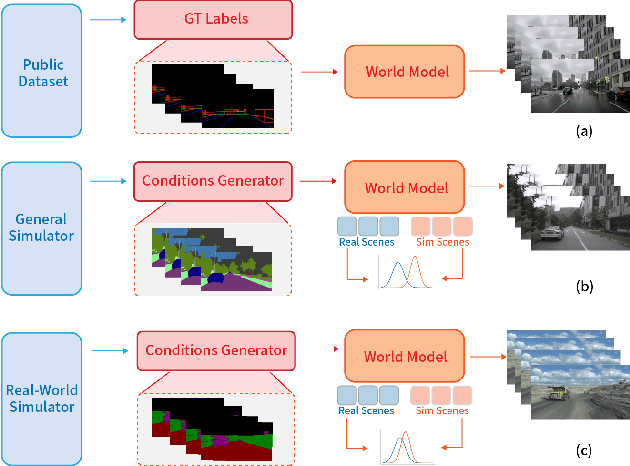
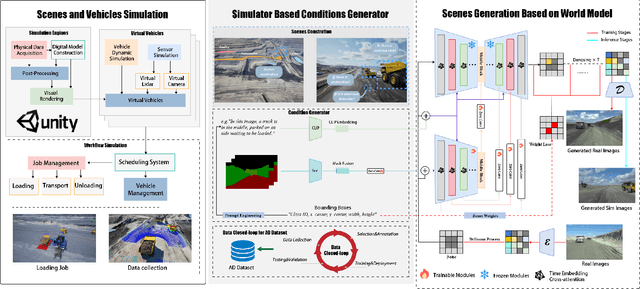
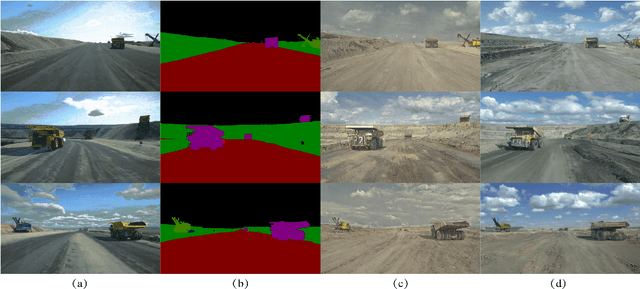
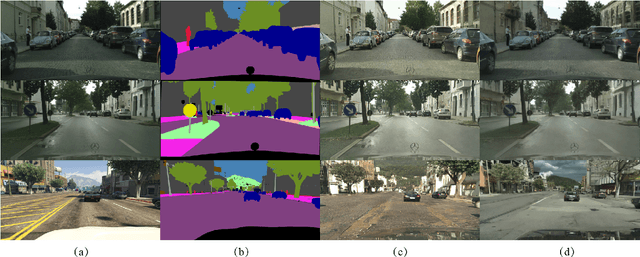
With the rapid advancement of autonomous driving technology, a lack of data has become a major obstacle to enhancing perception model accuracy. Researchers are now exploring controllable data generation using world models to diversify datasets. However, previous work has been limited to studying image generation quality on specific public datasets. There is still relatively little research on how to build data generation engines for real-world application scenes to achieve large-scale data generation for challenging scenes. In this paper, a simulator-conditioned scene generation engine based on world model is proposed. By constructing a simulation system consistent with real-world scenes, simulation data and labels, which serve as the conditions for data generation in the world model, for any scenes can be collected. It is a novel data generation pipeline by combining the powerful scene simulation capabilities of the simulation engine with the robust data generation capabilities of the world model. In addition, a benchmark with proportionally constructed virtual and real data, is provided for exploring the capabilities of world models in real-world scenes. Quantitative results show that these generated images significantly improve downstream perception models performance. Finally, we explored the generative performance of the world model in urban autonomous driving scenarios. All the data and code will be available at https://github.com/Li-Zn-H/SimWorld.