 Add to Chrome
 Add to Firefox
 Add to Edge
Adaptive ship-radiated noise recognition with learnable fine-grained wavelet transform
May 31, 2023
Analyzing the ocean acoustic environment is a tricky task. Background noise and variable channel transmission environment make it complicated to implement accurate ship-radiated noise recognition. Existing recognition systems are weak in addressing the variable underwater environment, thus leading to disappointing performance in practical application. In order to keep the recognition system robust in various underwater environments, this work proposes an adaptive generalized recognition system - AGNet (Adaptive Generalized Network). By converting fixed wavelet parameters into fine-grained learnable parameters, AGNet learns the characteristics of underwater sound at different frequencies. Its flexible and fine-grained design is conducive to capturing more background acoustic information (e.g., background noise, underwater transmission channel). To utilize the implicit information in wavelet spectrograms, AGNet adopts the convolutional neural network with parallel convolution attention modules as the classifier. Experiments reveal that our AGNet outperforms all baseline methods on several underwater acoustic datasets, and AGNet could benefit more from transfer learning. Moreover, AGNet shows robust performance against various interference factors.

Learning Music Sequence Representation from Text Supervision
May 31, 2023Music representation learning is notoriously difficult for its complex human-related concepts contained in the sequence of numerical signals. To excavate better MUsic SEquence Representation from labeled audio, we propose a novel text-supervision pre-training method, namely MUSER. MUSER adopts an audio-spectrum-text tri-modal contrastive learning framework, where the text input could be any form of meta-data with the help of text templates while the spectrum is derived from an audio sequence. Our experiments reveal that MUSER could be more flexibly adapted to downstream tasks compared with the current data-hungry pre-training method, and it only requires 0.056% of pre-training data to achieve the state-of-the-art performance.
Underwater-Art: Expanding Information Perspectives With Text Templates For Underwater Acoustic Target Recognition
May 31, 2023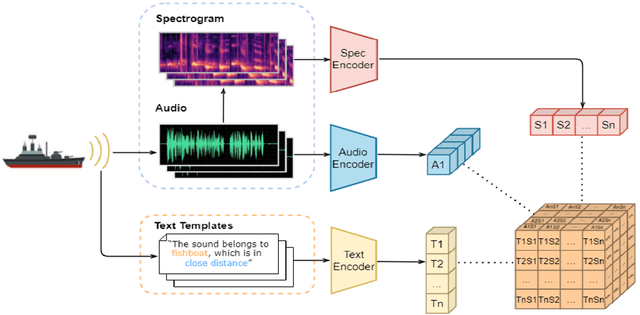
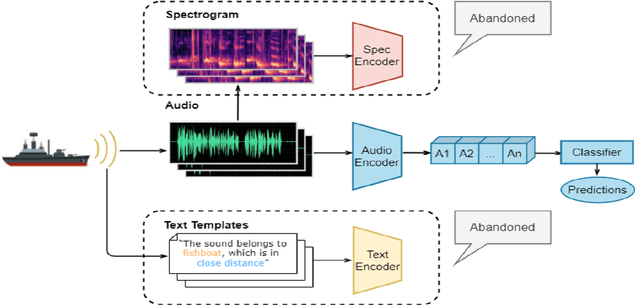
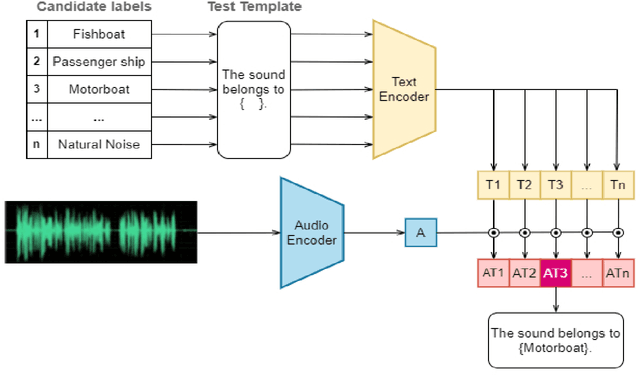
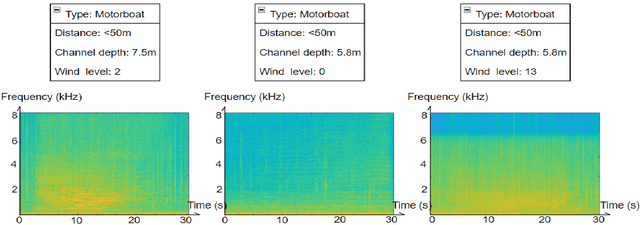
Underwater acoustic target recognition is an intractable task due to the complex acoustic source characteristics and sound propagation patterns. Limited by insufficient data and narrow information perspective, recognition models based on deep learning seem far from satisfactory in practical underwater scenarios. Although underwater acoustic signals are severely influenced by distance, channel depth, or other factors, annotations of relevant information are often non-uniform, incomplete, and hard to use. In our work, we propose to implement Underwater Acoustic Recognition based on Templates made up of rich relevant information (hereinafter called "UART"). We design templates to integrate relevant information from different perspectives into descriptive natural language. UART adopts an audio-spectrogram-text tri-modal contrastive learning framework, which endows UART with the ability to guide the learning of acoustic representations by descriptive natural language. Our experiments reveal that UART has better recognition capability and generalization performance than traditional paradigms. Furthermore, the pre-trained UART model could provide superior prior knowledge for the recognition model in the scenario without any auxiliary annotation.
Advancing underwater acoustic target recognition via adaptive data pruning and smoothness-inducing regularization
Apr 24, 2023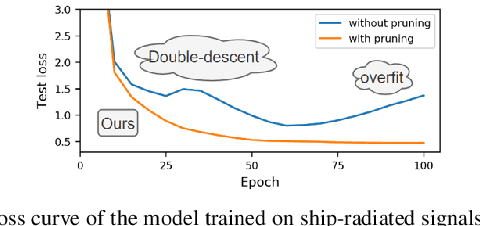
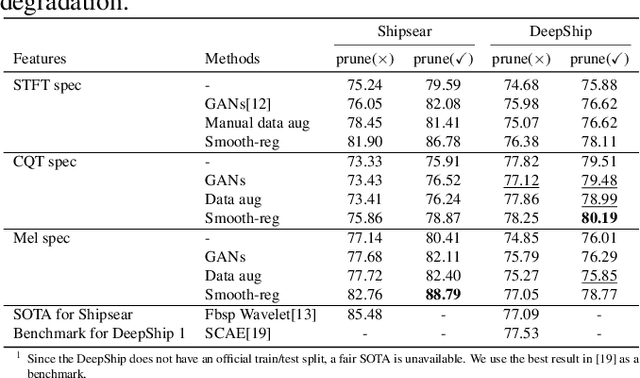
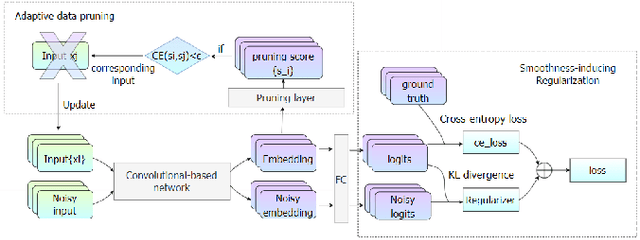
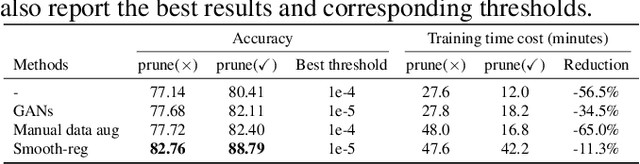
Underwater acoustic recognition for ship-radiated signals has high practical application value due to the ability to recognize non-line-of-sight targets. However, due to the difficulty of data acquisition, the collected signals are scarce in quantity and mainly composed of mechanical periodic noise. According to the experiments, we observe that the repeatability of periodic signals leads to a double-descent phenomenon, which indicates a significant local bias toward repeated samples. To address this issue, we propose a strategy based on cross-entropy to prune excessively similar segments in training data. Furthermore, to compensate for the reduction of training data, we generate noisy samples and apply smoothness-inducing regularization based on KL divergence to mitigate overfitting. Experiments show that our proposed data pruning and regularization strategy can bring stable benefits and our framework significantly outperforms the state-of-the-art in low-resource scenarios.
NPS: A Framework for Accurate Program Sampling Using Graph Neural Network
Apr 18, 2023With the end of Moore's Law, there is a growing demand for rapid architectural innovations in modern processors, such as RISC-V custom extensions, to continue performance scaling. Program sampling is a crucial step in microprocessor design, as it selects representative simulation points for workload simulation. While SimPoint has been the de-facto approach for decades, its limited expressiveness with Basic Block Vector (BBV) requires time-consuming human tuning, often taking months, which impedes fast innovation and agile hardware development. This paper introduces Neural Program Sampling (NPS), a novel framework that learns execution embeddings using dynamic snapshots of a Graph Neural Network. NPS deploys AssemblyNet for embedding generation, leveraging an application's code structures and runtime states. AssemblyNet serves as NPS's graph model and neural architecture, capturing a program's behavior in aspects such as data computation, code path, and data flow. AssemblyNet is trained with a data prefetch task that predicts consecutive memory addresses. In the experiments, NPS outperforms SimPoint by up to 63%, reducing the average error by 38%. Additionally, NPS demonstrates strong robustness with increased accuracy, reducing the expensive accuracy tuning overhead. Furthermore, NPS shows higher accuracy and generality than the state-of-the-art GNN approach in code behavior learning, enabling the generation of high-quality execution embeddings.
SpatialFormer: Semantic and Target Aware Attentions for Few-Shot Learning
Mar 15, 2023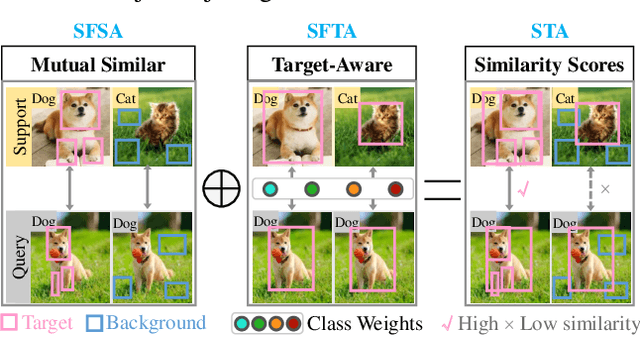

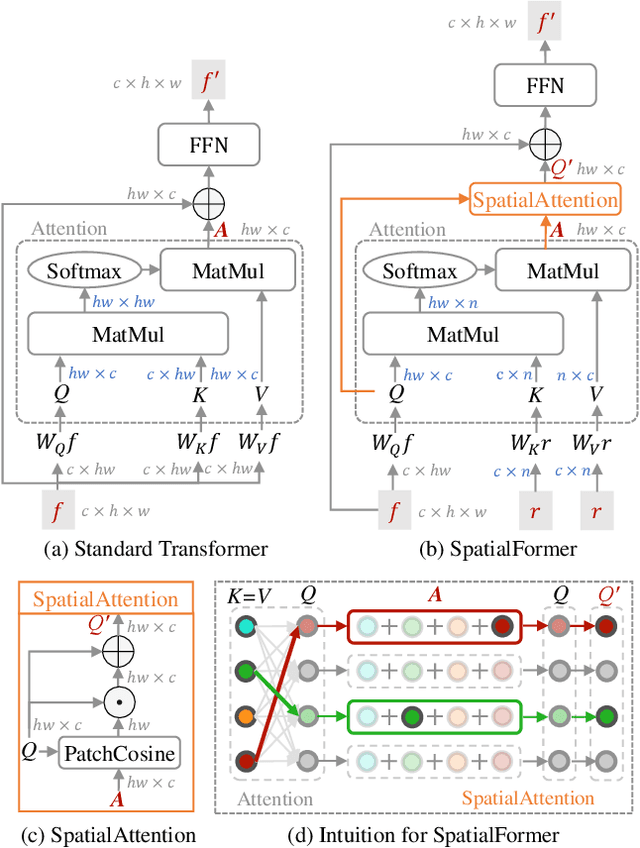
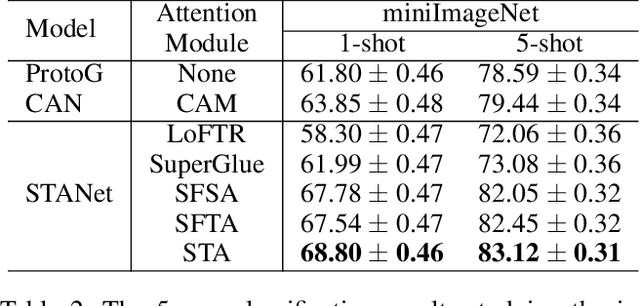
Recent Few-Shot Learning (FSL) methods put emphasis on generating a discriminative embedding features to precisely measure the similarity between support and query sets. Current CNN-based cross-attention approaches generate discriminative representations via enhancing the mutually semantic similar regions of support and query pairs. However, it suffers from two problems: CNN structure produces inaccurate attention map based on local features, and mutually similar backgrounds cause distraction. To alleviate these problems, we design a novel SpatialFormer structure to generate more accurate attention regions based on global features. Different from the traditional Transformer modeling intrinsic instance-level similarity which causes accuracy degradation in FSL, our SpatialFormer explores the semantic-level similarity between pair inputs to boost the performance. Then we derive two specific attention modules, named SpatialFormer Semantic Attention (SFSA) and SpatialFormer Target Attention (SFTA), to enhance the target object regions while reduce the background distraction. Particularly, SFSA highlights the regions with same semantic information between pair features, and SFTA finds potential foreground object regions of novel feature that are similar to base categories. Extensive experiments show that our methods are effective and achieve new state-of-the-art results on few-shot classification benchmarks.
High-Resolution GAN Inversion for Degraded Images in Large Diverse Datasets
Feb 07, 2023The last decades are marked by massive and diverse image data, which shows increasingly high resolution and quality. However, some images we obtained may be corrupted, affecting the perception and the application of downstream tasks. A generic method for generating a high-quality image from the degraded one is in demand. In this paper, we present a novel GAN inversion framework that utilizes the powerful generative ability of StyleGAN-XL for this problem. To ease the inversion challenge with StyleGAN-XL, Clustering \& Regularize Inversion (CRI) is proposed. Specifically, the latent space is firstly divided into finer-grained sub-spaces by clustering. Instead of initializing the inversion with the average latent vector, we approximate a centroid latent vector from the clusters, which generates an image close to the input image. Then, an offset with a regularization term is introduced to keep the inverted latent vector within a certain range. We validate our CRI scheme on multiple restoration tasks (i.e., inpainting, colorization, and super-resolution) of complex natural images, and show preferable quantitative and qualitative results. We further demonstrate our technique is robust in terms of data and different GAN models. To our best knowledge, we are the first to adopt StyleGAN-XL for generating high-quality natural images from diverse degraded inputs. Code is available at https://github.com/Booooooooooo/CRI.
Weakly Supervised Semantic Segmentation for Large-Scale Point Cloud
Dec 09, 2022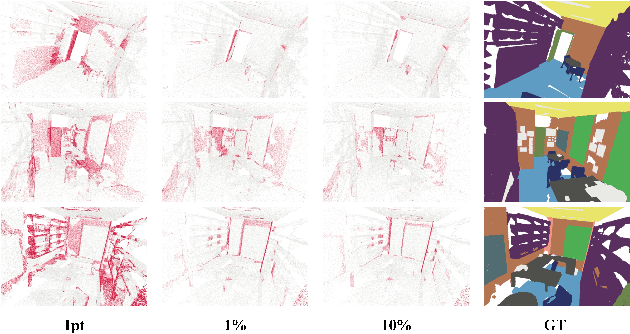
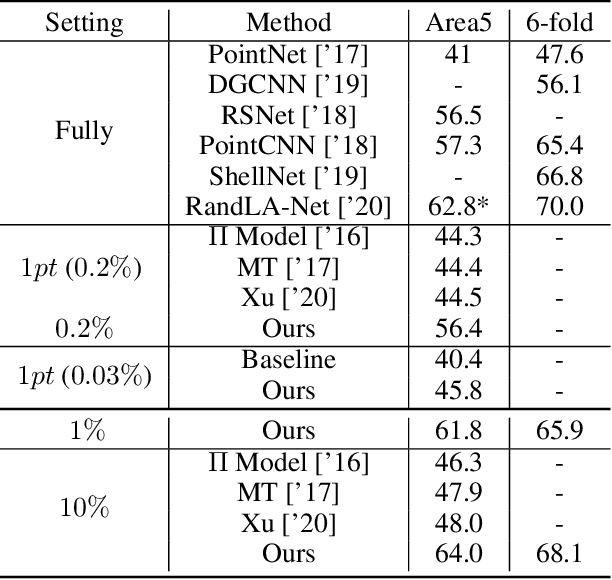

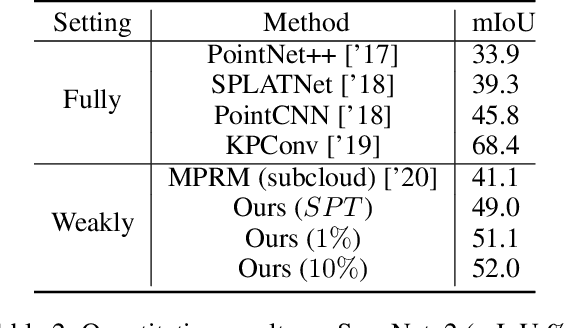
Existing methods for large-scale point cloud semantic segmentation require expensive, tedious and error-prone manual point-wise annotations. Intuitively, weakly supervised training is a direct solution to reduce the cost of labeling. However, for weakly supervised large-scale point cloud semantic segmentation, too few annotations will inevitably lead to ineffective learning of network. We propose an effective weakly supervised method containing two components to solve the above problem. Firstly, we construct a pretext task, \textit{i.e.,} point cloud colorization, with a self-supervised learning to transfer the learned prior knowledge from a large amount of unlabeled point cloud to a weakly supervised network. In this way, the representation capability of the weakly supervised network can be improved by the guidance from a heterogeneous task. Besides, to generate pseudo label for unlabeled data, a sparse label propagation mechanism is proposed with the help of generated class prototypes, which is used to measure the classification confidence of unlabeled point. Our method is evaluated on large-scale point cloud datasets with different scenarios including indoor and outdoor. The experimental results show the large gain against existing weakly supervised and comparable results to fully supervised methods\footnote{Code based on mindspore: https://github.com/dmcv-ecnu/MindSpore\_ModelZoo/tree/main/WS3\_MindSpore}.
Global Meets Local: Effective Multi-Label Image Classification via Category-Aware Weak Supervision
Nov 23, 2022Multi-label image classification, which can be categorized into label-dependency and region-based methods, is a challenging problem due to the complex underlying object layouts. Although region-based methods are less likely to encounter issues with model generalizability than label-dependency methods, they often generate hundreds of meaningless or noisy proposals with non-discriminative information, and the contextual dependency among the localized regions is often ignored or over-simplified. This paper builds a unified framework to perform effective noisy-proposal suppression and to interact between global and local features for robust feature learning. Specifically, we propose category-aware weak supervision to concentrate on non-existent categories so as to provide deterministic information for local feature learning, restricting the local branch to focus on more high-quality regions of interest. Moreover, we develop a cross-granularity attention module to explore the complementary information between global and local features, which can build the high-order feature correlation containing not only global-to-local, but also local-to-local relations. Both advantages guarantee a boost in the performance of the whole network. Extensive experiments on two large-scale datasets (MS-COCO and VOC 2007) demonstrate that our framework achieves superior performance over state-of-the-art methods.
* 12 pages, 10 figures, published in ACMMM 2022
Transforming RIS-Assisted Passive Beamforming from Tedious to Simple: A Relaxation Algorithm for Rician Channel
Nov 22, 2022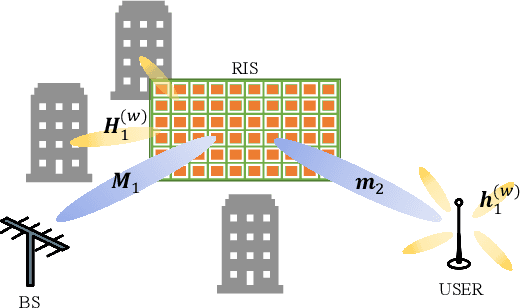
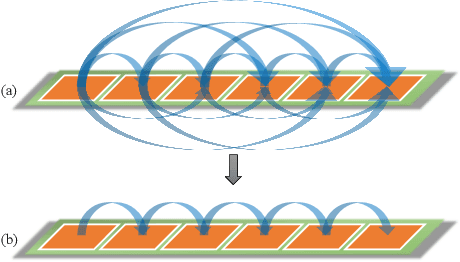
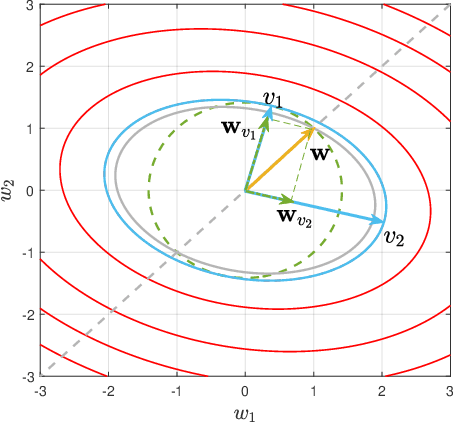
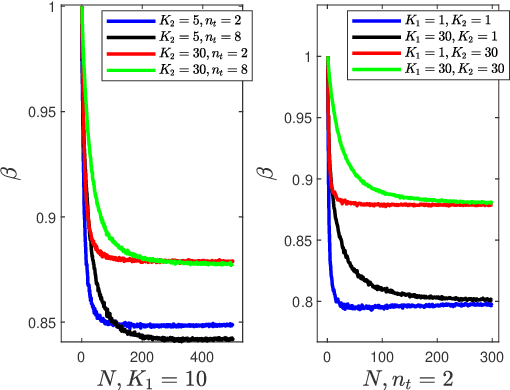
This paper investigates the problem of maximizing the signal-to-noise ratio (SNR) in reconfigurable intelligent surface (RIS)-assisted MISO communication systems. The problem will be reformulated as a complex quadratic form problem with unit circle constraints. We proved that the SNR maximizing problem has a closed-form global optimal solution when it is a rank-one problem, whereas the former researchers regarded it as an optimization problem. Moreover, We propose a relaxation algorithm (RA) that relaxes the constraints to that of Rayleigh's quotient problem and then projects the solution back, where the SNR obtained by RA achieves much the same SNR as the upper bound but with significantly low time consumption. Then we asymptotically analyze its performance when the transmitter antennas n_t and the number of units of RIS N grow large together, with N/n_t -> c. Finally, our numerical simulations show that RA achieves over 98% of the performance of the upper bound and takes below 1% time consumption of manifold optimization (MO) and 0.1% of semidefinite relaxation (SDR).