 Add to Chrome
 Add to Firefox
 Add to Edge
Decoding Multimodal Cues: Unveiling the Implicit Meaning Behind Hateful Videos
Jun 10, 2026
Hateful videos have become prevalent on online platforms, highlighting an urgent need for effective detection. However, existing studies primarily focus on binary classification and fail to provide contextual rationales that reveal the implicit meanings behind these judgments, significantly undermining model explainability. To fill this gap, we aim to achieve explainable hateful video detection, enabling models to provide contextual rationales that integrate relevant evidence and logical reasoning alongside decisions. This approach can comprehensively enhance the understanding of video content and the explainability of the decision-making process. We first introduce two datasets, Ex-HateMM and Ex-ImpliHateVid, for explainable hateful video detection. Each dataset provides fine-grained annotations of multimodal harmful elements, along with contextual rationales. We then propose an Information Augmentation and Reasoning Enhancement (IARE) framework designed for explainable detection. The framework employs an information augmentation phase that leverages the multimodal chain-of-thought to integrate harmful elements, thereby enriching rationale evidence. Additionally, IARE incorporates a reasoning enhancement phase, in which Direct Preference Optimization guides the model toward correct reasoning paths and away from incorrect ones, thereby improving the logical coherence of its justifications. We conduct extensive experiments on the two datasets, comparing multiple baselines with our proposed IARE framework. The results demonstrate that IARE achieves state-of-the-art performance while also generating accurate rationales.

Don't Click the Bait: Title Debiasing News Recommendation via Cross-Field Contrastive Learning
Aug 16, 2024


News recommendation emerges as a primary means for users to access content of interest from the vast amount of news. The title clickbait extensively exists in news domain and increases the difficulty for news recommendation to offer satisfactory services for users. Fortunately, we find that news abstract, as a critical field of news, aligns cohesively with the news authenticity. To this end, we propose a Title Debiasing News Recommendation with Cross-field Contrastive learning (TDNR-C2) to overcome the title bias by incorporating news abstract. Specifically, a multi-field knowledge extraction module is devised to extract multi-view knowledge about news from various fields. Afterwards, we present a cross-field contrastive learning module to conduct bias removal via contrasting learned knowledge from title and abstract fileds. Experimental results on a real-world dataset demonstrate the superiority of the proposed TDNR-C2 over existing state-of-the-art methods. Further analysis also indicates the significance of news abstract for title debiasing.
Enhancing Textual Personality Detection toward Social Media: Integrating Long-term and Short-term Perspectives
Apr 23, 2024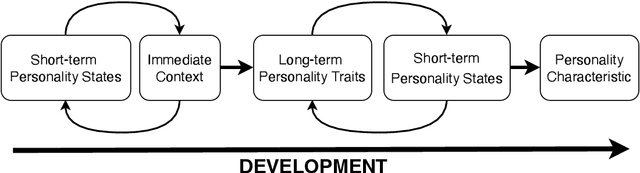
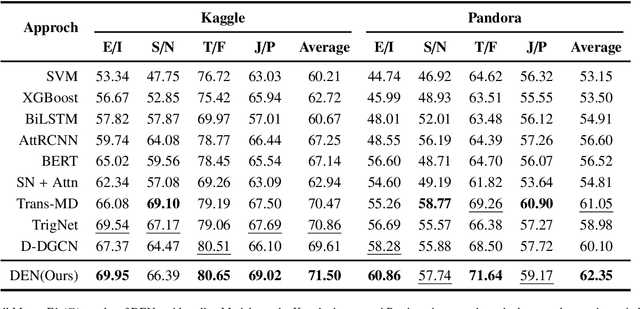
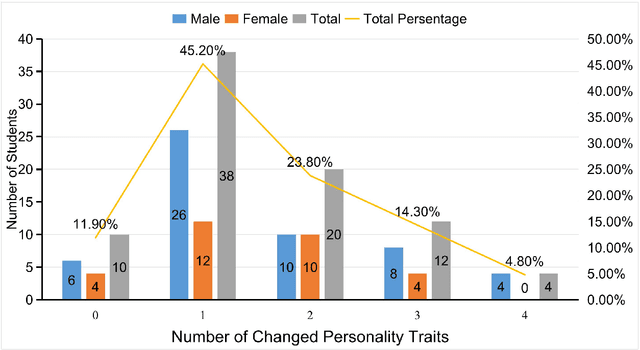
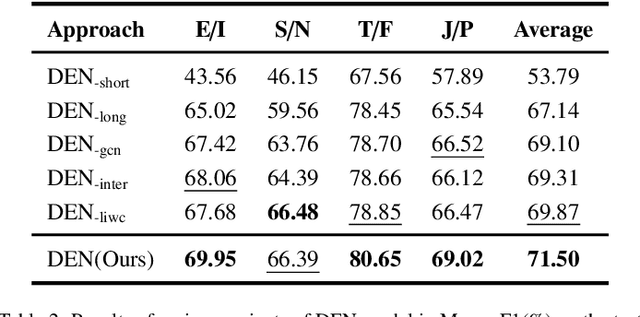
Textual personality detection aims to identify personality characteristics by analyzing user-generated content toward social media platforms. Numerous psychological literature highlighted that personality encompasses both long-term stable traits and short-term dynamic states. However, existing studies often concentrate only on either long-term or short-term personality representations, without effectively combining both aspects. This limitation hinders a comprehensive understanding of individuals' personalities, as both stable traits and dynamic states are vital. To bridge this gap, we propose a Dual Enhanced Network(DEN) to jointly model users' long-term and short-term personality for textual personality detection. In DEN, a Long-term Personality Encoding is devised to effectively model long-term stable personality traits. Short-term Personality Encoding is presented to capture short-term dynamic personality states. The Bi-directional Interaction component facilitates the integration of both personality aspects, allowing for a comprehensive representation of the user's personality. Experimental results on two personality detection datasets demonstrate the effectiveness of the DEN model and the benefits of considering both the dynamic and stable nature of personality characteristics for textual personality detection.
FineRec:Exploring Fine-grained Sequential Recommendation
Apr 19, 2024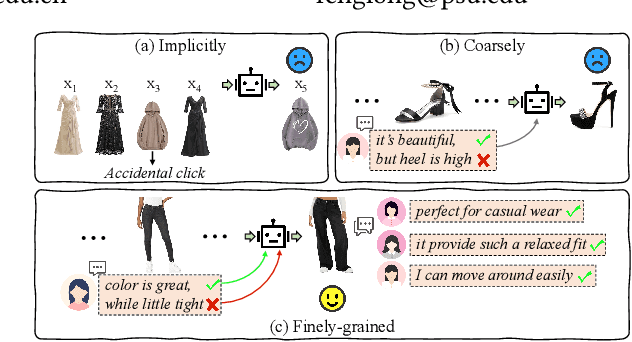


Sequential recommendation is dedicated to offering items of interest for users based on their history behaviors. The attribute-opinion pairs, expressed by users in their reviews for items, provide the potentials to capture user preferences and item characteristics at a fine-grained level. To this end, we propose a novel framework FineRec that explores the attribute-opinion pairs of reviews to finely handle sequential recommendation. Specifically, we utilize a large language model to extract attribute-opinion pairs from reviews. For each attribute, a unique attribute-specific user-opinion-item graph is created, where corresponding opinions serve as the edges linking heterogeneous user and item nodes. To tackle the diversity of opinions, we devise a diversity-aware convolution operation to aggregate information within the graphs, enabling attribute-specific user and item representation learning. Ultimately, we present an interaction-driven fusion mechanism to integrate attribute-specific user/item representations across all attributes for generating recommendations. Extensive experiments conducted on several realworld datasets demonstrate the superiority of our FineRec over existing state-of-the-art methods. Further analysis also verifies the effectiveness of our fine-grained manner in handling the task.