 Add to Chrome
 Add to Firefox
 Add to Edge
Achieving Text-based Person Retrieval with Any Granularity
Jul 23, 2026
Text-based person retrieval faces a critical but under-explored challenge: the inherent uncertainty of query granularity in real-world scenarios. This paper introduces a new paradigm, Text-based Person Retrieval with Any Granularity, and provides a systematic solution. First, we formalize a five-level granularity spectrum and construct UFine6926-MG, a high-quality multi-grained dataset annotated comprehensively at all granularities via a novel Multi-grained Text Annotation Engine. Second, acknowledging that coarse queries naturally correspond to multiple valid candidates, we propose MG-Eval, a holistic evaluation benchmark with progressively detailed texts and cross-identity labels that reflect real-world semantics, alongside tailored evaluation metrics and protocols. Third, after a comprehensive diagnosis reveals the systemic limitations of existing research, we propose the Cross-modal Multi-grained Aligning and Matching (CMAM) framework. CMAM achieves granularity-aware retrieval through: 1) orthogonal-expert perception to disentangle granularity-specific features; 2) probabilistic alignment to model many-to-many matches under query uncertainty; and 3) granularity-consistent reasoning to steer feature learning via joint cross-modal granularity verification. Experiments demonstrate that CMAM significantly outperforms state-of-the-art methods across all granularity levels. This work establishes a foundational benchmark and a robust baseline, paving the way for more practical person retrieval systems.
* TPAMI-2026 Accepted Paper

ReID5o: Achieving Omni Multi-modal Person Re-identification in a Single Model
Jun 11, 2025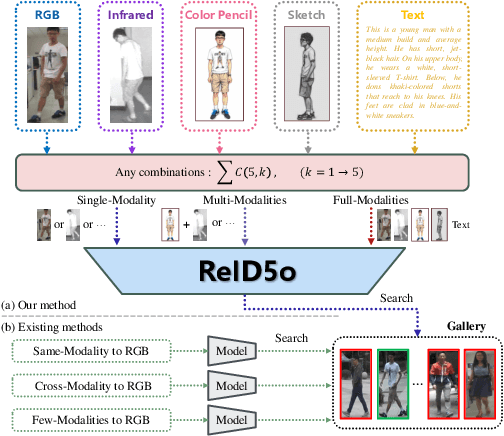
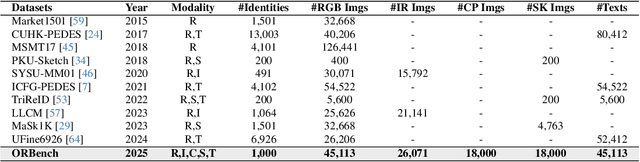
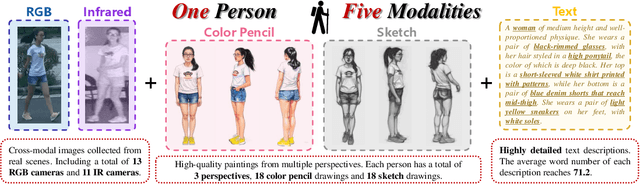
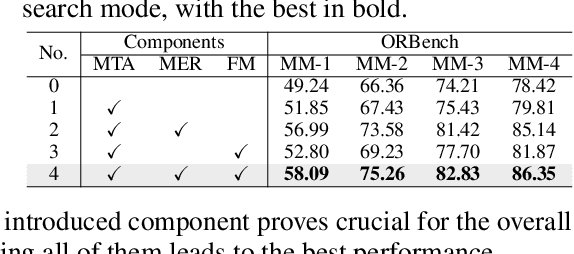
In real-word scenarios, person re-identification (ReID) expects to identify a person-of-interest via the descriptive query, regardless of whether the query is a single modality or a combination of multiple modalities. However, existing methods and datasets remain constrained to limited modalities, failing to meet this requirement. Therefore, we investigate a new challenging problem called Omni Multi-modal Person Re-identification (OM-ReID), which aims to achieve effective retrieval with varying multi-modal queries. To address dataset scarcity, we construct ORBench, the first high-quality multi-modal dataset comprising 1,000 unique identities across five modalities: RGB, infrared, color pencil, sketch, and textual description. This dataset also has significant superiority in terms of diversity, such as the painting perspectives and textual information. It could serve as an ideal platform for follow-up investigations in OM-ReID. Moreover, we propose ReID5o, a novel multi-modal learning framework for person ReID. It enables synergistic fusion and cross-modal alignment of arbitrary modality combinations in a single model, with a unified encoding and multi-expert routing mechanism proposed. Extensive experiments verify the advancement and practicality of our ORBench. A wide range of possible models have been evaluated and compared on it, and our proposed ReID5o model gives the best performance. The dataset and code will be made publicly available at https://github.com/Zplusdragon/ReID5o_ORBench.