 Add to Chrome
 Add to Firefox
 Add to Edge
VC-Tooler: Learning Compositional and Adaptive Visual Tool Use
Aug 03, 2026
Agentic multimodal reasoning extends passive image understanding by allowing VLMs to actively acquire and refine visual evidence through visual tool interactions. Effective visual tool use requires three capabilities: grounding tool calls in visual context, composing tools across multiple steps, and adapting reasoning to tool-returned observations. However, existing approaches largely focus on grounding within fixed tool spaces and rigid invocation patterns, leaving composition and adaptation insufficiently addressed. We present VC-Tooler, which learns visual tool use as a compositional and adaptive capability. To this end, we first build a trajectory bank through a hierarchical synthesis pipeline covering three capability levels: single-tool grounding, multi-tool composition, and diverse tool contexts and interfaces. We then train the model in two stages: a supervised cold start that establishes these capabilities, followed by reinforcement learning that encourages accurate, efficient, and context-aware visual tool use. VC-Tooler achieves state-of-the-art performance among open-source models on both general-purpose and agentic benchmarks, including $95.8\%$ on V* and $35.3\%$ on VTC-Bench, and shows promising transfer under richer tool settings at inference time. Project page: https://w1zheng.github.io/VC-Tooler

Synthetic-to-Real Translation for Class-Agnostic Motion Prediction
Jul 07, 2026Motion understanding is critical for ensuring safety and robustness in autonomous driving systems, driving increasing interest in motion prediction. A key challenge in this domain is the high cost associated with acquiring real-world motion labels. It is therefore ideal if we could transfer motion knowledge from synthetic data to real data. In this context, we explore the potential of synthetic-to-real translation for motion prediction (SRMP). However, the most used naive motion regression methods are notably sensitive to the synthetic-to-real domain shift, resulting in unreliable knowledge translation. To address this, we propose a novel approach integrating a motion knowledge translation framework with two key components: (1) objectness-aware motion prediction, which explicitly models the joint distribution of motion patterns and objectness priors to improve domain-invariant feature learning, and (2) objectness-aided motion enhancement, a motion label refinement mechanism that leverages learned objectness priors to filter motion noise. Furthermore, we present a physically-based pipeline for generating Motion4D, the first synthetic 4D LiDAR dataset tailored for SRMP research, addressing the lack of synthetic motion datasets. Experimental results demonstrate that our approach effectively bridges the domain gaps and yields superior performance on real scenes.
Through the Lens of Contrast: Self-Improving Visual Reasoning in VLMs
Mar 03, 2026Reasoning has emerged as a key capability of large language models. In linguistic tasks, this capability can be enhanced by self-improving techniques that refine reasoning paths for subsequent finetuning. However, extending these language-based self-improving approaches to vision language models (VLMs) presents a unique challenge:~visual hallucinations in reasoning paths cannot be effectively verified or rectified. Our solution starts with a key observation about visual contrast: when presented with a contrastive VQA pair, i.e., two visually similar images with synonymous questions, VLMs identify relevant visual cues more precisely. Motivated by this observation, we propose Visual Contrastive Self-Taught Reasoner (VC-STaR), a novel self-improving framework that leverages visual contrast to mitigate hallucinations in model-generated rationales. We collect a diverse suite of VQA datasets, curate contrastive pairs according to multi-modal similarity, and generate rationales using VC-STaR. Consequently, we obtain a new visual reasoning dataset, VisCoR-55K, which is then used to boost the reasoning capability of various VLMs through supervised finetuning. Extensive experiments show that VC-STaR not only outperforms existing self-improving approaches but also surpasses models finetuned on the SoTA visual reasoning datasets, demonstrating that the inherent contrastive ability of VLMs can bootstrap their own visual reasoning. Project at: https://github.com/zhiyupan42/VC-STaR.
Semi-Supervised High Dynamic Range Image Reconstructing via Bi-Level Uncertain Area Masking
Nov 17, 2025Reconstructing high dynamic range (HDR) images from low dynamic range (LDR) bursts plays an essential role in the computational photography. Impressive progress has been achieved by learning-based algorithms which require LDR-HDR image pairs. However, these pairs are hard to obtain, which motivates researchers to delve into the problem of annotation-efficient HDR image reconstructing: how to achieve comparable performance with limited HDR ground truths (GTs). This work attempts to address this problem from the view of semi-supervised learning where a teacher model generates pseudo HDR GTs for the LDR samples without GTs and a student model learns from pseudo GTs. Nevertheless, the confirmation bias, i.e., the student may learn from the artifacts in pseudo HDR GTs, presents an impediment. To remove this impediment, an uncertainty-based masking process is proposed to discard unreliable parts of pseudo GTs at both pixel and patch levels, then the trusted areas can be learned from by the student. With this novel masking process, our semi-supervised HDR reconstructing method not only outperforms previous annotation-efficient algorithms, but also achieves comparable performance with up-to-date fully-supervised methods by using only 6.7% HDR GTs.
iControl3D: An Interactive System for Controllable 3D Scene Generation
Aug 03, 2024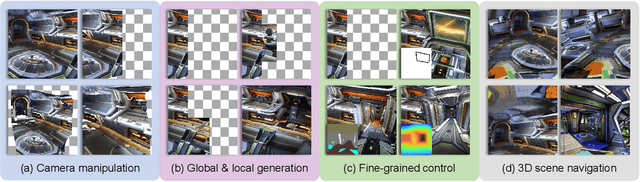
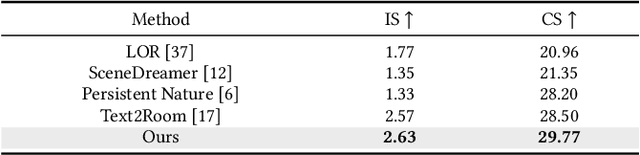
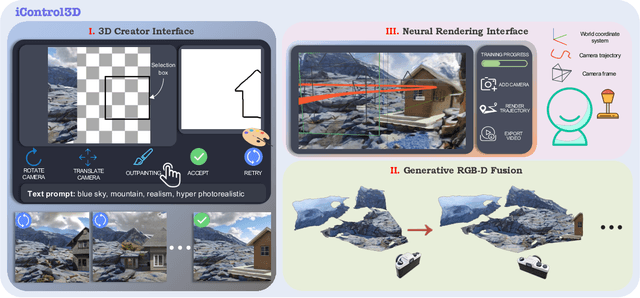

3D content creation has long been a complex and time-consuming process, often requiring specialized skills and resources. While recent advancements have allowed for text-guided 3D object and scene generation, they still fall short of providing sufficient control over the generation process, leading to a gap between the user's creative vision and the generated results. In this paper, we present iControl3D, a novel interactive system that empowers users to generate and render customizable 3D scenes with precise control. To this end, a 3D creator interface has been developed to provide users with fine-grained control over the creation process. Technically, we leverage 3D meshes as an intermediary proxy to iteratively merge individual 2D diffusion-generated images into a cohesive and unified 3D scene representation. To ensure seamless integration of 3D meshes, we propose to perform boundary-aware depth alignment before fusing the newly generated mesh with the existing one in 3D space. Additionally, to effectively manage depth discrepancies between remote content and foreground, we propose to model remote content separately with an environment map instead of 3D meshes. Finally, our neural rendering interface enables users to build a radiance field of their scene online and navigate the entire scene. Extensive experiments have been conducted to demonstrate the effectiveness of our system. The code will be made available at https://github.com/xingyi-li/iControl3D.
Pseudo-Labeling by Multi-Policy Viewfinder Network for Image Cropping
Jul 02, 2024
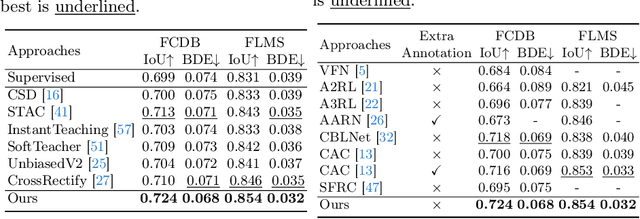
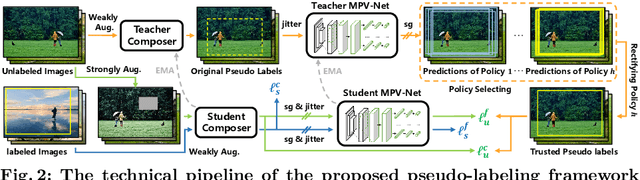

Automatic image cropping models predict reframing boxes to enhance image aesthetics. Yet, the scarcity of labeled data hinders the progress of this task. To overcome this limitation, we explore the possibility of utilizing both labeled and unlabeled data together to expand the scale of training data for image cropping models. This idea can be implemented in a pseudo-labeling way: producing pseudo labels for unlabeled data by a teacher model and training a student model with these pseudo labels. However, the student may learn from teacher's mistakes. To address this issue, we propose the multi-policy viewfinder network (MPV-Net) that offers diverse refining policies to rectify the mistakes in original pseudo labels from the teacher. The most reliable policy is selected to generate trusted pseudo labels. The reliability of policies is evaluated via the robustness against box jittering. The efficacy of our method can be evaluated by the improvement compared to the supervised baseline which only uses labeled data. Notably, our MPV-Net outperforms off-the-shelf pseudo-labeling methods, yielding the most substantial improvement over the supervised baseline. Furthermore, our approach achieves state-of-the-art results on both the FCDB and FLMS datasets, signifying the superiority of our approach.
Instance Consistency Regularization for Semi-Supervised 3D Instance Segmentation
Jun 24, 2024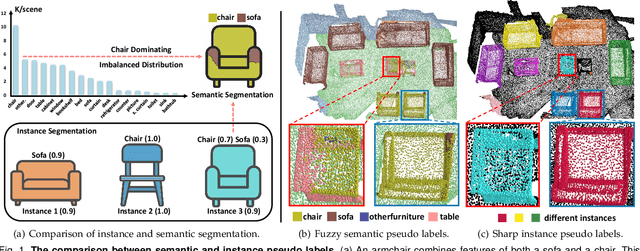

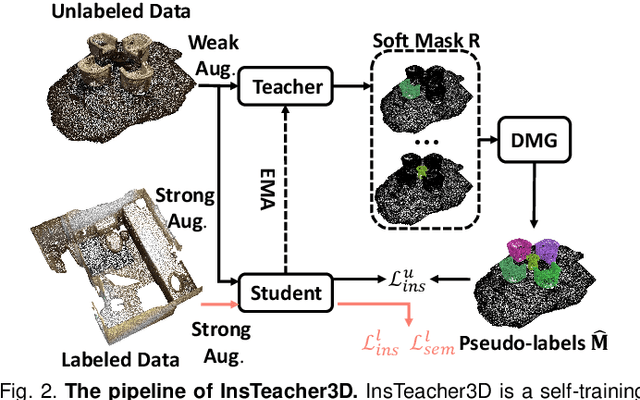

Large-scale datasets with point-wise semantic and instance labels are crucial to 3D instance segmentation but also expensive. To leverage unlabeled data, previous semi-supervised 3D instance segmentation approaches have explored self-training frameworks, which rely on high-quality pseudo labels for consistency regularization. They intuitively utilize both instance and semantic pseudo labels in a joint learning manner. However, semantic pseudo labels contain numerous noise derived from the imbalanced category distribution and natural confusion of similar but distinct categories, which leads to severe collapses in self-training. Motivated by the observation that 3D instances are non-overlapping and spatially separable, we ask whether we can solely rely on instance consistency regularization for improved semi-supervised segmentation. To this end, we propose a novel self-training network InsTeacher3D to explore and exploit pure instance knowledge from unlabeled data. We first build a parallel base 3D instance segmentation model DKNet, which distinguishes each instance from the others via discriminative instance kernels without reliance on semantic segmentation. Based on DKNet, we further design a novel instance consistency regularization framework to generate and leverage high-quality instance pseudo labels. Experimental results on multiple large-scale datasets show that the InsTeacher3D significantly outperforms prior state-of-the-art semi-supervised approaches. Code is available: https://github.com/W1zheng/InsTeacher3D.
Self-Supervised Class-Agnostic Motion Prediction with Spatial and Temporal Consistency Regularizations
Mar 21, 2024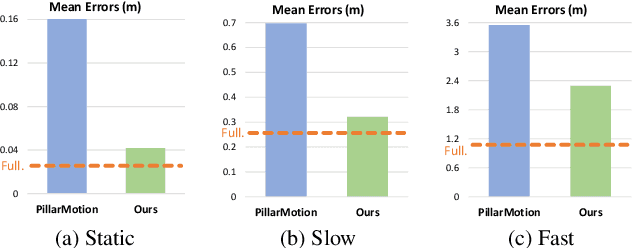
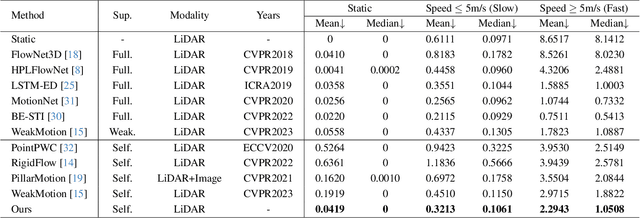
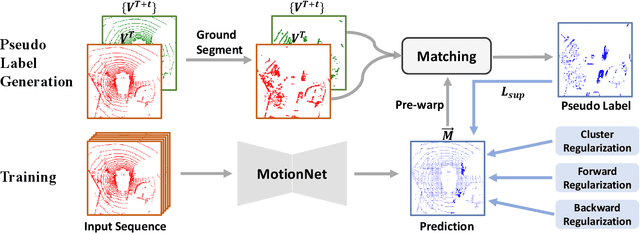
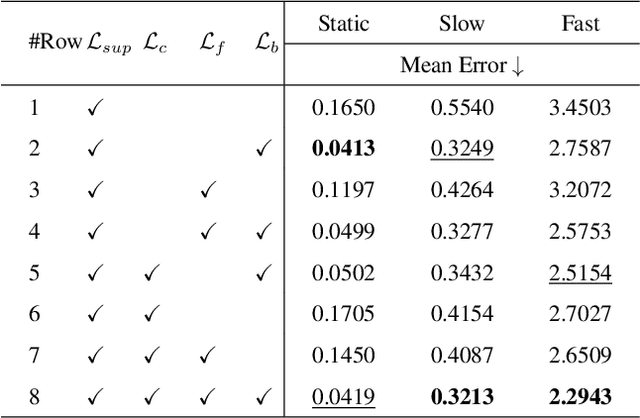
The perception of motion behavior in a dynamic environment holds significant importance for autonomous driving systems, wherein class-agnostic motion prediction methods directly predict the motion of the entire point cloud. While most existing methods rely on fully-supervised learning, the manual labeling of point cloud data is laborious and time-consuming. Therefore, several annotation-efficient methods have been proposed to address this challenge. Although effective, these methods rely on weak annotations or additional multi-modal data like images, and the potential benefits inherent in the point cloud sequence are still underexplored. To this end, we explore the feasibility of self-supervised motion prediction with only unlabeled LiDAR point clouds. Initially, we employ an optimal transport solver to establish coarse correspondences between current and future point clouds as the coarse pseudo motion labels. Training models directly using such coarse labels leads to noticeable spatial and temporal prediction inconsistencies. To mitigate these issues, we introduce three simple spatial and temporal regularization losses, which facilitate the self-supervised training process effectively. Experimental results demonstrate the significant superiority of our approach over the state-of-the-art self-supervised methods.
S-DyRF: Reference-Based Stylized Radiance Fields for Dynamic Scenes
Mar 13, 2024
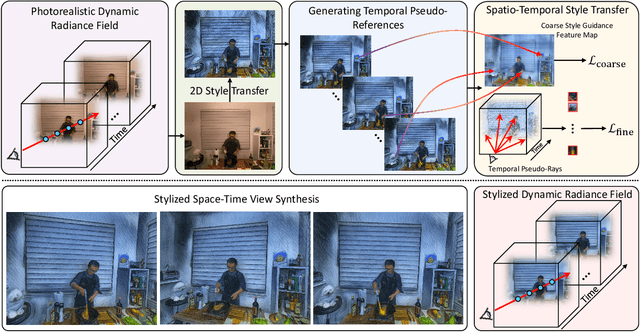

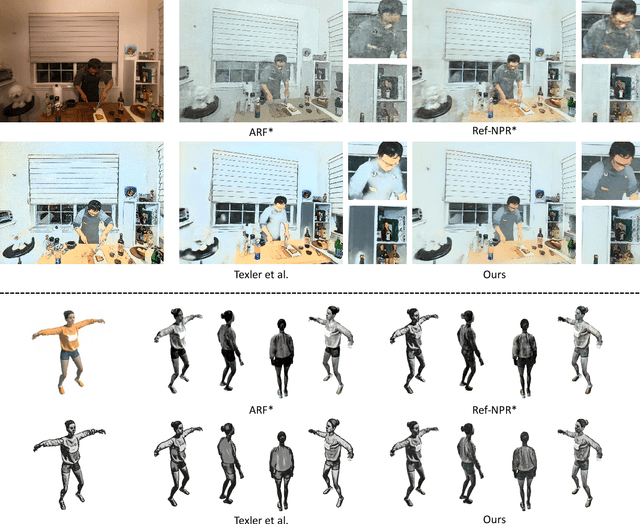
Current 3D stylization methods often assume static scenes, which violates the dynamic nature of our real world. To address this limitation, we present S-DyRF, a reference-based spatio-temporal stylization method for dynamic neural radiance fields. However, stylizing dynamic 3D scenes is inherently challenging due to the limited availability of stylized reference images along the temporal axis. Our key insight lies in introducing additional temporal cues besides the provided reference. To this end, we generate temporal pseudo-references from the given stylized reference. These pseudo-references facilitate the propagation of style information from the reference to the entire dynamic 3D scene. For coarse style transfer, we enforce novel views and times to mimic the style details present in pseudo-references at the feature level. To preserve high-frequency details, we create a collection of stylized temporal pseudo-rays from temporal pseudo-references. These pseudo-rays serve as detailed and explicit stylization guidance for achieving fine style transfer. Experiments on both synthetic and real-world datasets demonstrate that our method yields plausible stylized results of space-time view synthesis on dynamic 3D scenes.
Semi-Supervised Class-Agnostic Motion Prediction with Pseudo Label Regeneration and BEVMix
Dec 14, 2023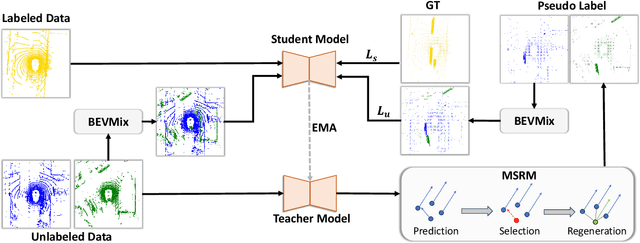
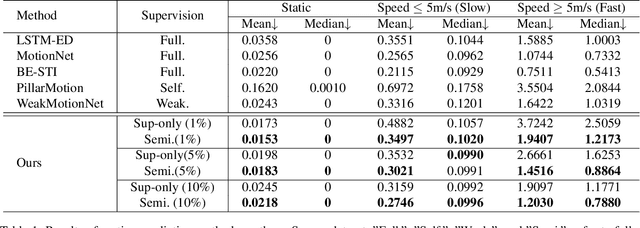
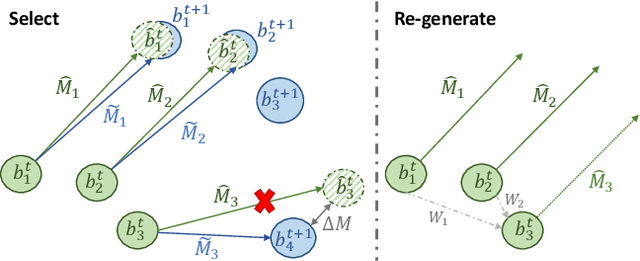
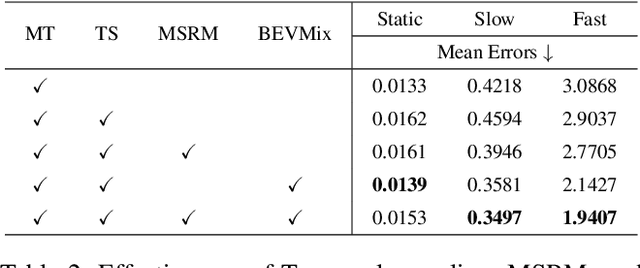
Class-agnostic motion prediction methods aim to comprehend motion within open-world scenarios, holding significance for autonomous driving systems. However, training a high-performance model in a fully-supervised manner always requires substantial amounts of manually annotated data, which can be both expensive and time-consuming to obtain. To address this challenge, our study explores the potential of semi-supervised learning (SSL) for class-agnostic motion prediction. Our SSL framework adopts a consistency-based self-training paradigm, enabling the model to learn from unlabeled data by generating pseudo labels through test-time inference. To improve the quality of pseudo labels, we propose a novel motion selection and re-generation module. This module effectively selects reliable pseudo labels and re-generates unreliable ones. Furthermore, we propose two data augmentation strategies: temporal sampling and BEVMix. These strategies facilitate consistency regularization in SSL. Experiments conducted on nuScenes demonstrate that our SSL method can surpass the self-supervised approach by a large margin by utilizing only a tiny fraction of labeled data. Furthermore, our method exhibits comparable performance to weakly and some fully supervised methods. These results highlight the ability of our method to strike a favorable balance between annotation costs and performance. Code will be available at https://github.com/kwwcv/SSMP.