 Add to Chrome
 Add to Firefox
 Add to Edge
OmniCap-IF: Benchmarking and Improving Instruction Following Abilities for Omni-Video Captioning
Jun 07, 2026
While Omni-modal Large Language Models (OLLMs) have demonstrated impressive capabilities in jointly processing audio and visual streams, their ability to strictly adhere to complex, multi-faceted user instructions remains largely unexplored. Existing benchmarks primarily focus on holistic video understanding or text-only instruction following, failing to capture the intricate interplay between modalities and user constraints. To bridge this gap, we introduce OmniCap-IF, the first comprehensive benchmark specifically designed to evaluate instruction-following capabilities in omni-modal captioning. OmniCap-IF incorporates a systematic framework that assesses captions on two dimensions: format correctness and content correctness. Our benchmark encompasses 50 distinct constraint types across pure visual, pure audio, and audio-visual modalities, while integrating Temporal Grounding to assess spatio-temporal precision. Extensive evaluations of prominent models on 1,920 high-quality samples reveal significant performance disparities. Furthermore, our analysis uncovers a critical "format-content tradeoff", demonstrating that increasing formatting complexity directly degrades models' omni-modal reasoning abilities. Finally, to advance the field, we curate a 54K instruction-tuning dataset, OmniCap-IF-54K and present OmniCaptioner-IF, which achieves notable improvements in both complex instruction adherence and general omni-modal captioning performance.

CLASP: Closed-loop Asynchronous Spatial Perception for Open-vocabulary Desktop Object Grasping
Apr 13, 2026Robot grasping of desktop object is widely used in intelligent manufacturing, logistics, and agriculture.Although vision-language models (VLMs) show strong potential for robotic manipulation, their deployment in low-level grasping faces key challenges: scarce high-quality multimodal demonstrations, spatial hallucination caused by weak geometric grounding, and the fragility of open-loop execution in dynamic environments. To address these challenges, we propose Closed-Loop Asynchronous Spatial Perception(CLASP), a novel asynchronous closed-loop framework that integrates multimodal perception, logical reasoning, and state-reflective feedback. First, we design a Dual-Pathway Hierarchical Perception module that decouples high-level semantic intent from geometric grounding. The design guides the output of the inference model and the definite action tuples, reducing spatial illusions. Second, an Asynchronous Closed-Loop Evaluator is implemented to compare pre- and post-execution states, providing text-based diagnostic feedback to establish a robust error-correction loop and improving the vulnerability of traditional open-loop execution in dynamic environments. Finally, we design a scalable multi-modal data engine that automatically synthesizes high-quality spatial annotations and reasoning templates from real and synthetic scenes without human teleoperation. Extensive experiments demonstrate that our approach significantly outperforms existing baselines, achieving an 87.0% overall success rate. Notably, the proposed framework exhibits remarkable generalization across diverse objects, bridging the sim-to-real gap and providing exceptional robustness in geometrically challenging categories and cluttered scenarios.
T2AV-Compass: Towards Unified Evaluation for Text-to-Audio-Video Generation
Dec 24, 2025Text-to-Audio-Video (T2AV) generation aims to synthesize temporally coherent video and semantically synchronized audio from natural language, yet its evaluation remains fragmented, often relying on unimodal metrics or narrowly scoped benchmarks that fail to capture cross-modal alignment, instruction following, and perceptual realism under complex prompts. To address this limitation, we present T2AV-Compass, a unified benchmark for comprehensive evaluation of T2AV systems, consisting of 500 diverse and complex prompts constructed via a taxonomy-driven pipeline to ensure semantic richness and physical plausibility. Besides, T2AV-Compass introduces a dual-level evaluation framework that integrates objective signal-level metrics for video quality, audio quality, and cross-modal alignment with a subjective MLLM-as-a-Judge protocol for instruction following and realism assessment. Extensive evaluation of 11 representative T2AVsystems reveals that even the strongest models fall substantially short of human-level realism and cross-modal consistency, with persistent failures in audio realism, fine-grained synchronization, instruction following, etc. These results indicate significant improvement room for future models and highlight the value of T2AV-Compass as a challenging and diagnostic testbed for advancing text-to-audio-video generation.
ARise: Towards Knowledge-Augmented Reasoning via Risk-Adaptive Search
Apr 15, 2025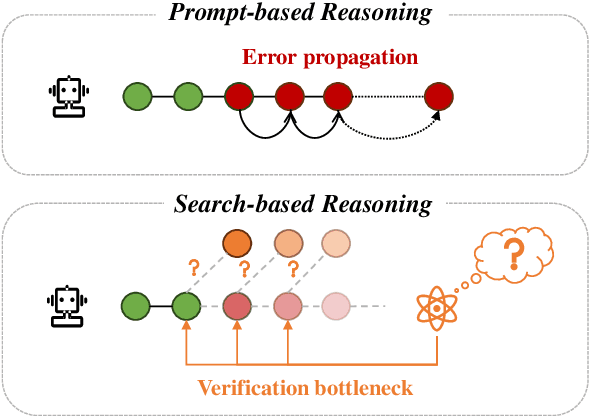
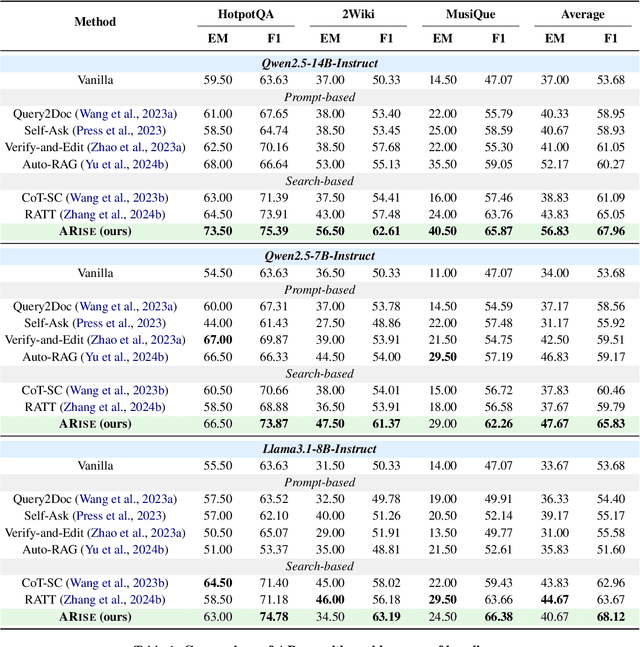
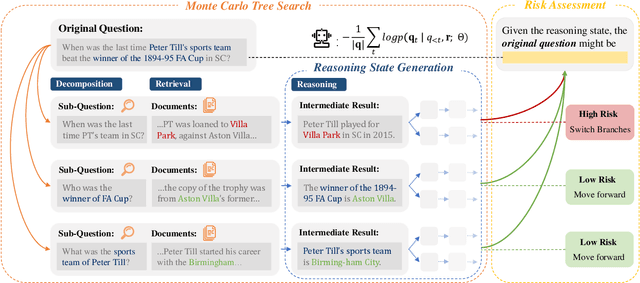
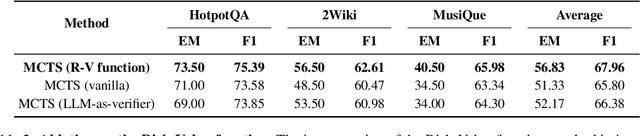
Large language models (LLMs) have demonstrated impressive capabilities and are receiving increasing attention to enhance their reasoning through scaling test--time compute. However, their application in open--ended, knowledge--intensive, complex reasoning scenarios is still limited. Reasoning--oriented methods struggle to generalize to open--ended scenarios due to implicit assumptions of complete world knowledge. Meanwhile, knowledge--augmented reasoning (KAR) methods fail to address two core challenges: 1) error propagation, where errors in early steps cascade through the chain, and 2) verification bottleneck, where the explore--exploit tradeoff arises in multi--branch decision processes. To overcome these limitations, we introduce ARise, a novel framework that integrates risk assessment of intermediate reasoning states with dynamic retrieval--augmented generation (RAG) within a Monte Carlo tree search paradigm. This approach enables effective construction and optimization of reasoning plans across multiple maintained hypothesis branches. Experimental results show that ARise significantly outperforms the state--of--the--art KAR methods by up to 23.10%, and the latest RAG-equipped large reasoning models by up to 25.37%.