 Add to Chrome
 Add to Firefox
 Add to Edge
Quark Medical Alignment: A Holistic Multi-Dimensional Alignment and Collaborative Optimization Paradigm
Feb 12, 2026
While reinforcement learning for large language model alignment has progressed rapidly in recent years, transferring these paradigms to high-stakes medical question answering reveals a fundamental paradigm mismatch. Reinforcement Learning from Human Feedback relies on preference annotations that are prohibitively expensive and often fail to reflect the absolute correctness of medical facts. Reinforcement Learning from Verifiable Rewards lacks effective automatic verifiers and struggles to handle complex clinical contexts. Meanwhile, medical alignment requires the simultaneous optimization of correctness, safety, and compliance, yet multi-objective heterogeneous reward signals are prone to scale mismatch and optimization conflicts.To address these challenges, we propose a robust medical alignment paradigm. We first construct a holistic multi-dimensional medical alignment matrix that decomposes alignment objectives into four categories: fundamental capabilities, expert knowledge, online feedback, and format specifications. Within each category, we establish a closed loop of where observable metrics inform attributable diagnosis, which in turn drives optimizable rewards, thereby providing fine-grained, high-resolution supervision signals for subsequent iterative optimization. To resolve gradient domination and optimization instability problem caused by heterogeneous signals, we further propose a unified optimization mechanism. This mechanism employs Reference-Frozen Normalization to align reward scales and implements a Tri-Factor Adaptive Dynamic Weighting strategy to achieve collaborative optimization that is weakness-oriented, risk-prioritized, and redundancy-reducing. Experimental results demonstrate the effectiveness of our proposed paradigm in real-world medical scenario evaluations, establishing a new paradigm for complex alignment in vertical domains.

GraphicsDreamer: Image to 3D Generation with Physical Consistency
Dec 18, 2024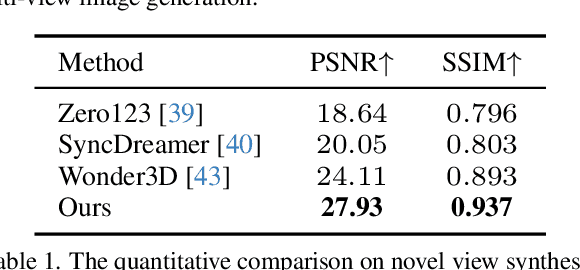
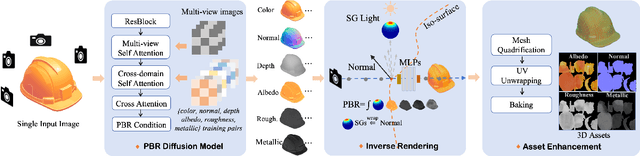
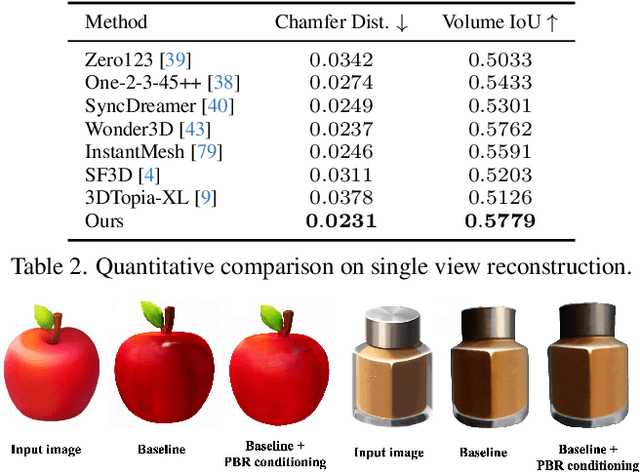

Recently, the surge of efficient and automated 3D AI-generated content (AIGC) methods has increasingly illuminated the path of transforming human imagination into complex 3D structures. However, the automated generation of 3D content is still significantly lags in industrial application. This gap exists because 3D modeling demands high-quality assets with sharp geometry, exquisite topology, and physically based rendering (PBR), among other criteria. To narrow the disparity between generated results and artists' expectations, we introduce GraphicsDreamer, a method for creating highly usable 3D meshes from single images. To better capture the geometry and material details, we integrate the PBR lighting equation into our cross-domain diffusion model, concurrently predicting multi-view color, normal, depth images, and PBR materials. In the geometry fusion stage, we continue to enforce the PBR constraints, ensuring that the generated 3D objects possess reliable texture details, supporting realistic relighting. Furthermore, our method incorporates topology optimization and fast UV unwrapping capabilities, allowing the 3D products to be seamlessly imported into graphics engines. Extensive experiments demonstrate that our model can produce high quality 3D assets in a reasonable time cost compared to previous methods.
Human Activity Recognition with Low-Resolution Infrared Array Sensor Using Semi-supervised Cross-domain Neural Networks for Indoor Environment
Mar 05, 2024Low-resolution infrared-based human activity recognition (HAR) attracted enormous interests due to its low-cost and private. In this paper, a novel semi-supervised crossdomain neural network (SCDNN) based on 8 $\times$ 8 low-resolution infrared sensor is proposed for accurately identifying human activity despite changes in the environment at a low-cost. The SCDNN consists of feature extractor, domain discriminator and label classifier. In the feature extractor, the unlabeled and minimal labeled target domain data are trained for domain adaptation to achieve a mapping of the source domain and target domain data. The domain discriminator employs the unsupervised learning to migrate data from the source domain to the target domain. The label classifier obtained from training the source domain data improves the recognition of target domain activities due to the semi-supervised learning utilized in training the target domain data. Experimental results show that the proposed method achieves 92.12\% accuracy for recognition of activities in the target domain by migrating the source and target domains. The proposed approach adapts superior to cross-domain scenarios compared to the existing deep learning methods, and it provides a low-cost yet highly adaptable solution for cross-domain scenarios.