 Add to Chrome
 Add to Firefox
 Add to Edge
Quark Medical Alignment: A Holistic Multi-Dimensional Alignment and Collaborative Optimization Paradigm
Feb 12, 2026
While reinforcement learning for large language model alignment has progressed rapidly in recent years, transferring these paradigms to high-stakes medical question answering reveals a fundamental paradigm mismatch. Reinforcement Learning from Human Feedback relies on preference annotations that are prohibitively expensive and often fail to reflect the absolute correctness of medical facts. Reinforcement Learning from Verifiable Rewards lacks effective automatic verifiers and struggles to handle complex clinical contexts. Meanwhile, medical alignment requires the simultaneous optimization of correctness, safety, and compliance, yet multi-objective heterogeneous reward signals are prone to scale mismatch and optimization conflicts.To address these challenges, we propose a robust medical alignment paradigm. We first construct a holistic multi-dimensional medical alignment matrix that decomposes alignment objectives into four categories: fundamental capabilities, expert knowledge, online feedback, and format specifications. Within each category, we establish a closed loop of where observable metrics inform attributable diagnosis, which in turn drives optimizable rewards, thereby providing fine-grained, high-resolution supervision signals for subsequent iterative optimization. To resolve gradient domination and optimization instability problem caused by heterogeneous signals, we further propose a unified optimization mechanism. This mechanism employs Reference-Frozen Normalization to align reward scales and implements a Tri-Factor Adaptive Dynamic Weighting strategy to achieve collaborative optimization that is weakness-oriented, risk-prioritized, and redundancy-reducing. Experimental results demonstrate the effectiveness of our proposed paradigm in real-world medical scenario evaluations, establishing a new paradigm for complex alignment in vertical domains.

ForensicHub: A Unified Benchmark & Codebase for All-Domain Fake Image Detection and Localization
May 16, 2025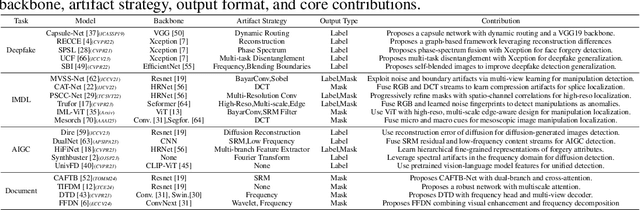
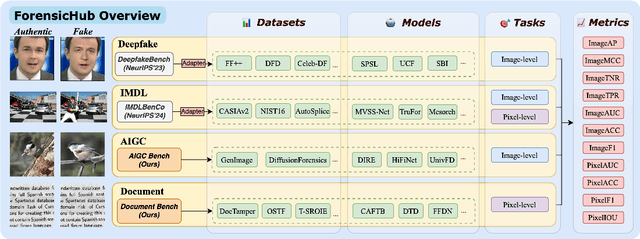
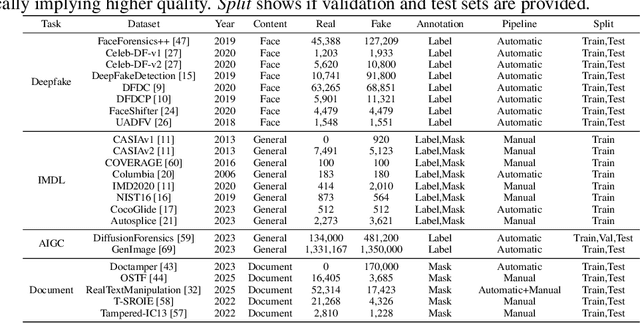
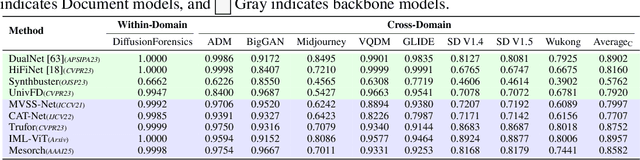
The field of Fake Image Detection and Localization (FIDL) is highly fragmented, encompassing four domains: deepfake detection (Deepfake), image manipulation detection and localization (IMDL), artificial intelligence-generated image detection (AIGC), and document image manipulation localization (Doc). Although individual benchmarks exist in some domains, a unified benchmark for all domains in FIDL remains blank. The absence of a unified benchmark results in significant domain silos, where each domain independently constructs its datasets, models, and evaluation protocols without interoperability, preventing cross-domain comparisons and hindering the development of the entire FIDL field. To close the domain silo barrier, we propose ForensicHub, the first unified benchmark & codebase for all-domain fake image detection and localization. Considering drastic variations on dataset, model, and evaluation configurations across all domains, as well as the scarcity of open-sourced baseline models and the lack of individual benchmarks in some domains, ForensicHub: i) proposes a modular and configuration-driven architecture that decomposes forensic pipelines into interchangeable components across datasets, transforms, models, and evaluators, allowing flexible composition across all domains; ii) fully implements 10 baseline models, 6 backbones, 2 new benchmarks for AIGC and Doc, and integrates 2 existing benchmarks of DeepfakeBench and IMDLBenCo through an adapter-based design; iii) conducts indepth analysis based on the ForensicHub, offering 8 key actionable insights into FIDL model architecture, dataset characteristics, and evaluation standards. ForensicHub represents a significant leap forward in breaking the domain silos in the FIDL field and inspiring future breakthroughs.