 Add to Chrome
 Add to Firefox
 Add to Edge
How In-Context Learning Emerges from Training on Unstructured Data: On the Role of Co-Occurrence, Positional Information, and Noise Structures
May 31, 2024
Large language models (LLMs) like transformers have impressive in-context learning (ICL) capabilities; they can generate predictions for new queries based on input-output sequences in prompts without parameter updates. While many theories have attempted to explain ICL, they often focus on structured training data similar to ICL tasks, such as regression. In practice, however, these models are trained in an unsupervised manner on unstructured text data, which bears little resemblance to ICL tasks. To this end, we investigate how ICL emerges from unsupervised training on unstructured data. The key observation is that ICL can arise simply by modeling co-occurrence information using classical language models like continuous bag of words (CBOW), which we theoretically prove and empirically validate. Furthermore, we establish the necessity of positional information and noise structure to generalize ICL to unseen data. Finally, we present instances where ICL fails and provide theoretical explanations; they suggest that the ICL ability of LLMs to identify certain tasks can be sensitive to the structure of the training data.

Addressing Discretization-Induced Bias in Demographic Prediction
May 27, 2024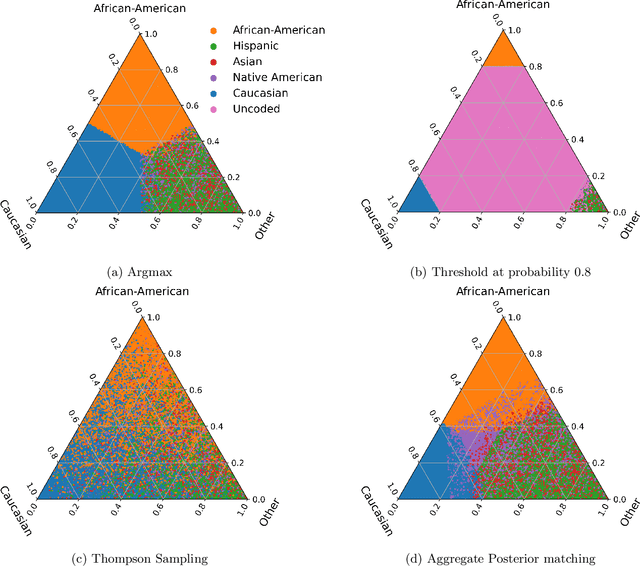
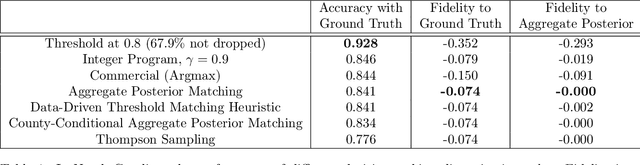
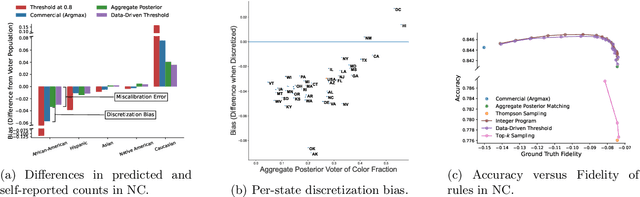
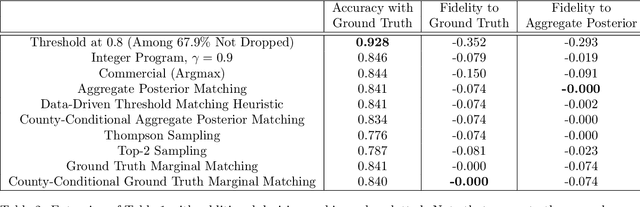
Racial and other demographic imputation is necessary for many applications, especially in auditing disparities and outreach targeting in political campaigns. The canonical approach is to construct continuous predictions -- e.g., based on name and geography -- and then to $\textit{discretize}$ the predictions by selecting the most likely class (argmax). We study how this practice produces $\textit{discretization bias}$. In particular, we show that argmax labeling, as used by a prominent commercial voter file vendor to impute race/ethnicity, results in a substantial under-count of African-American voters, e.g., by 28.2% points in North Carolina. This bias can have substantial implications in downstream tasks that use such labels. We then introduce a $\textit{joint optimization}$ approach -- and a tractable $\textit{data-driven thresholding}$ heuristic -- that can eliminate this bias, with negligible individual-level accuracy loss. Finally, we theoretically analyze discretization bias, show that calibrated continuous models are insufficient to eliminate it, and that an approach such as ours is necessary. Broadly, we warn researchers and practitioners against discretizing continuous demographic predictions without considering downstream consequences.
PatentGPT: A Large Language Model for Intellectual Property
Apr 30, 2024


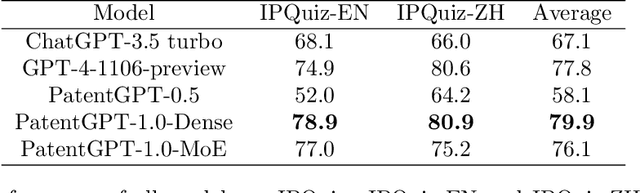
In recent years, large language models have attracted significant attention due to their exceptional performance across a multitude of natural language process tasks, and have been widely applied in various fields. However, the application of large language models in the Intellectual Property (IP) space is challenging due to the strong need for specialized knowledge, privacy protection, processing of extremely long text in this field. In this technical report, we present for the first time a low-cost, standardized procedure for training IP-oriented LLMs, meeting the unique requirements of the IP domain. Using this standard process, we have trained the PatentGPT series models based on open-source pretrained models. By evaluating them on the open-source IP-oriented benchmark MOZIP, our domain-specific LLMs outperforms GPT-4, indicating the effectiveness of the proposed training procedure and the expertise of the PatentGPT models in the IP demain. What is impressive is that our model significantly outperformed GPT-4 on the 2019 China Patent Agent Qualification Examination by achieving a score of 65, reaching the level of human experts. Additionally, the PatentGPT model, which utilizes the SMoE architecture, achieves performance comparable to that of GPT-4 in the IP domain and demonstrates a better cost-performance ratio on long-text tasks, potentially serving as an alternative to GPT-4 within the IP domain.
Causal Inference for Human-Language Model Collaboration
Mar 30, 2024In this paper, we examine the collaborative dynamics between humans and language models (LMs), where the interactions typically involve LMs proposing text segments and humans editing or responding to these proposals. Productive engagement with LMs in such scenarios necessitates that humans discern effective text-based interaction strategies, such as editing and response styles, from historical human-LM interactions. This objective is inherently causal, driven by the counterfactual `what-if' question: how would the outcome of collaboration change if humans employed a different text editing/refinement strategy? A key challenge in answering this causal inference question is formulating an appropriate causal estimand: the conventional average treatment effect (ATE) estimand is inapplicable to text-based treatments due to their high dimensionality. To address this concern, we introduce a new causal estimand -- Incremental Stylistic Effect (ISE) -- which characterizes the average impact of infinitesimally shifting a text towards a specific style, such as increasing formality. We establish the conditions for the non-parametric identification of ISE. Building on this, we develop CausalCollab, an algorithm designed to estimate the ISE of various interaction strategies in dynamic human-LM collaborations. Our empirical investigations across three distinct human-LM collaboration scenarios reveal that CausalCollab effectively reduces confounding and significantly improves counterfactual estimation over a set of competitive baselines.
On the Challenges and Opportunities in Generative AI
Feb 28, 2024The field of deep generative modeling has grown rapidly and consistently over the years. With the availability of massive amounts of training data coupled with advances in scalable unsupervised learning paradigms, recent large-scale generative models show tremendous promise in synthesizing high-resolution images and text, as well as structured data such as videos and molecules. However, we argue that current large-scale generative AI models do not sufficiently address several fundamental issues that hinder their widespread adoption across domains. In this work, we aim to identify key unresolved challenges in modern generative AI paradigms that should be tackled to further enhance their capabilities, versatility, and reliability. By identifying these challenges, we aim to provide researchers with valuable insights for exploring fruitful research directions, thereby fostering the development of more robust and accessible generative AI solutions.
Multi-Domain Causal Representation Learning via Weak Distributional Invariances
Oct 09, 2023Causal representation learning has emerged as the center of action in causal machine learning research. In particular, multi-domain datasets present a natural opportunity for showcasing the advantages of causal representation learning over standard unsupervised representation learning. While recent works have taken crucial steps towards learning causal representations, they often lack applicability to multi-domain datasets due to over-simplifying assumptions about the data; e.g. each domain comes from a different single-node perfect intervention. In this work, we relax these assumptions and capitalize on the following observation: there often exists a subset of latents whose certain distributional properties (e.g., support, variance) remain stable across domains; this property holds when, for example, each domain comes from a multi-node imperfect intervention. Leveraging this observation, we show that autoencoders that incorporate such invariances can provably identify the stable set of latents from the rest across different settings.
Imputing Brain Measurements Across Data Sets via Graph Neural Networks
Aug 19, 2023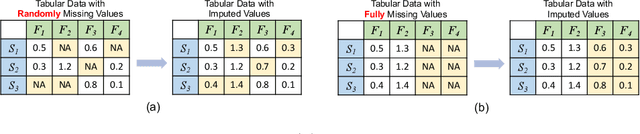
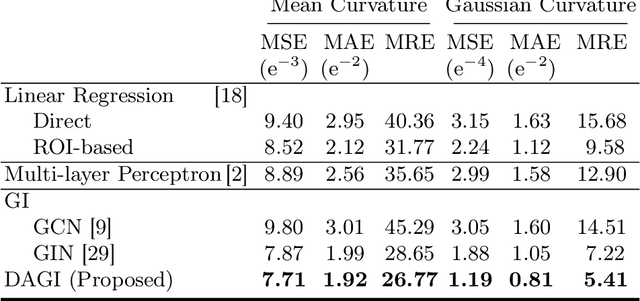


Publicly available data sets of structural MRIs might not contain specific measurements of brain Regions of Interests (ROIs) that are important for training machine learning models. For example, the curvature scores computed by Freesurfer are not released by the Adolescent Brain Cognitive Development (ABCD) Study. One can address this issue by simply reapplying Freesurfer to the data set. However, this approach is generally computationally and labor intensive (e.g., requiring quality control). An alternative is to impute the missing measurements via a deep learning approach. However, the state-of-the-art is designed to estimate randomly missing values rather than entire measurements. We therefore propose to re-frame the imputation problem as a prediction task on another (public) data set that contains the missing measurements and shares some ROI measurements with the data sets of interest. A deep learning model is then trained to predict the missing measurements from the shared ones and afterwards is applied to the other data sets. Our proposed algorithm models the dependencies between ROI measurements via a graph neural network (GNN) and accounts for demographic differences in brain measurements (e.g. sex) by feeding the graph encoding into a parallel architecture. The architecture simultaneously optimizes a graph decoder to impute values and a classifier in predicting demographic factors. We test the approach, called Demographic Aware Graph-based Imputation (DAGI), on imputing those missing Freesurfer measurements of ABCD (N=3760) by training the predictor on those publicly released by the National Consortium on Alcohol and Neurodevelopment in Adolescence (NCANDA, N=540)...
The Multi-modality Cell Segmentation Challenge: Towards Universal Solutions
Aug 10, 2023Cell segmentation is a critical step for quantitative single-cell analysis in microscopy images. Existing cell segmentation methods are often tailored to specific modalities or require manual interventions to specify hyperparameters in different experimental settings. Here, we present a multi-modality cell segmentation benchmark, comprising over 1500 labeled images derived from more than 50 diverse biological experiments. The top participants developed a Transformer-based deep-learning algorithm that not only exceeds existing methods, but can also be applied to diverse microscopy images across imaging platforms and tissue types without manual parameter adjustments. This benchmark and the improved algorithm offer promising avenues for more accurate and versatile cell analysis in microscopy imaging.
Rethinking Medical Report Generation: Disease Revealing Enhancement with Knowledge Graph
Jul 24, 2023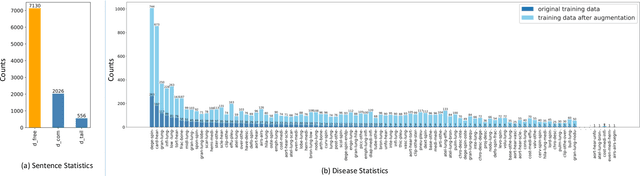
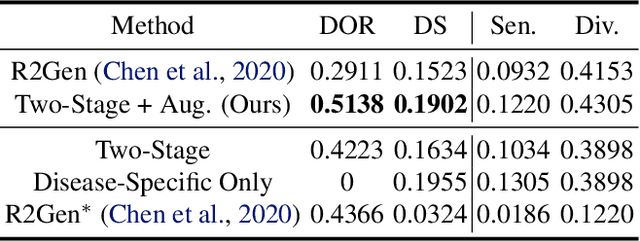
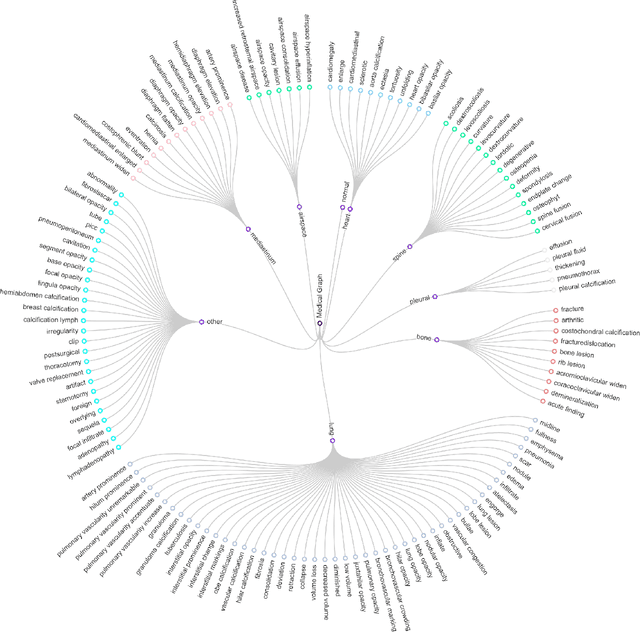
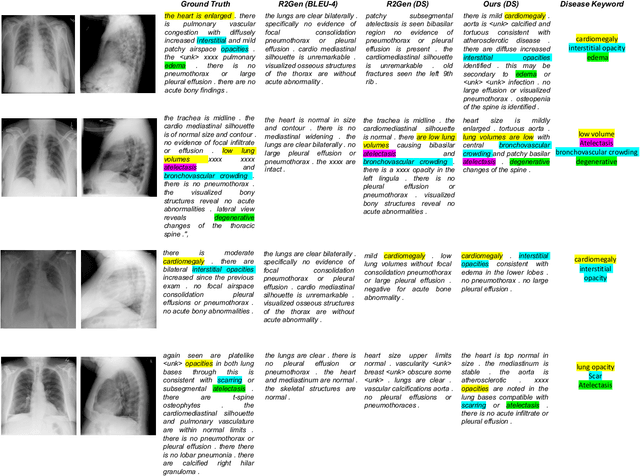
Knowledge Graph (KG) plays a crucial role in Medical Report Generation (MRG) because it reveals the relations among diseases and thus can be utilized to guide the generation process. However, constructing a comprehensive KG is labor-intensive and its applications on the MRG process are under-explored. In this study, we establish a complete KG on chest X-ray imaging that includes 137 types of diseases and abnormalities. Based on this KG, we find that the current MRG data sets exhibit a long-tailed problem in disease distribution. To mitigate this problem, we introduce a novel augmentation strategy that enhances the representation of disease types in the tail-end of the distribution. We further design a two-stage MRG approach, where a classifier is first trained to detect whether the input images exhibit any abnormalities. The classified images are then independently fed into two transformer-based generators, namely, ``disease-specific generator" and ``disease-free generator" to generate the corresponding reports. To enhance the clinical evaluation of whether the generated reports correctly describe the diseases appearing in the input image, we propose diverse sensitivity (DS), a new metric that checks whether generated diseases match ground truth and measures the diversity of all generated diseases. Results show that the proposed two-stage generation framework and augmentation strategies improve DS by a considerable margin, indicating a notable reduction in the long-tailed problem associated with under-represented diseases.
Bidirectional Attention as a Mixture of Continuous Word Experts
Jul 08, 2023Bidirectional attention $\unicode{x2013}$ composed of self-attention with positional encodings and the masked language model (MLM) objective $\unicode{x2013}$ has emerged as a key component of modern large language models (LLMs). Despite its empirical success, few studies have examined its statistical underpinnings: What statistical model is bidirectional attention implicitly fitting? What sets it apart from its non-attention predecessors? We explore these questions in this paper. The key observation is that fitting a single-layer single-head bidirectional attention, upon reparameterization, is equivalent to fitting a continuous bag of words (CBOW) model with mixture-of-experts (MoE) weights. Further, bidirectional attention with multiple heads and multiple layers is equivalent to stacked MoEs and a mixture of MoEs, respectively. This statistical viewpoint reveals the distinct use of MoE in bidirectional attention, which aligns with its practical effectiveness in handling heterogeneous data. It also suggests an immediate extension to categorical tabular data, if we view each word location in a sentence as a tabular feature. Across empirical studies, we find that this extension outperforms existing tabular extensions of transformers in out-of-distribution (OOD) generalization. Finally, this statistical perspective of bidirectional attention enables us to theoretically characterize when linear word analogies are present in its word embeddings. These analyses show that bidirectional attention can require much stronger assumptions to exhibit linear word analogies than its non-attention predecessors.