 Add to Chrome
 Add to Firefox
 Add to Edge
LLM Detection as an Intervention: Downstream Impact under Strategic User Behavior
Jul 21, 2026
As LLM adoption becomes more widespread, there is a growing interest in detecting LLM-generated content, for example through LLM detection tools and through heuristics based on language patterns. Detectors operate as an intervention that steers not only the detected attribute itself, but also downstream metrics such as LLM usage and output quality. In this work, we demonstrate how imperfect LLM detectors lead to counterintuitive impacts on these downstream metrics, by distorting how users are incentivized to use LLMs in their workflow. We develop a stylized model which captures how users strategically choose how much to use the LLM and how to post-process content to reduce the detected attribute. Using this model, we show that LLM detection can counterintuitively lead humans to increase their LLM usage. Moreover, even when reducing the detected attribute improves output quality, we find that introducing an LLM detector can lead users to produce lower quality outputs. In contrast, we show that detectors result in a clean "rise-then-fall" pattern for the detected attribute, which we empirically reproduce for word frequencies on arXiv abstracts. Altogether, our work illustrates how LLM detection can distort LLM usage and output quality, uncovering failure modes when LLM detectors operate as an intervention on these downstream metrics.

Strategic Feature Selection
Jun 17, 2026When algorithmic predictors inform resource allocation in high-stakes domains such as healthcare, these predictors must account for strategic manipulation of input features. The typical solution is to redesign the predictor itself to explicitly account for strategic interactions. In practice, however, decision makers are often constrained to adjusting coarser levers within existing prediction pipelines. For example, healthcare organizations often select which features to exclude based on perceived manipulability, while using standard regularization procedures to shrink the coefficients of retained features. In this work, we initiate a formal study of strategic classification through feature selection and its interaction with ridge regularization. Our main finding is that excluding individual features based on their manipulability alone is generally suboptimal. We provide a fine-grained characterization of the performance of a feature subset under optimal regularization, yielding new insights for policy design. Motivated by this characterization, we develop a practical algorithm for jointly choosing the feature set and the level of ridge regularization. Through a real-world case study on a healthcare payments benchmark, we illustrate how our algorithm can guide the design of coarse policy levers in practice. Our results provide a principled, practical framework for mitigating the effects of strategic behavior in algorithmic decision-making systems.
Metric Match: A Subset Selection Approach to Evaluating LLM Judge Reliability
Jun 12, 2026LLM judges are used to reduce the need for costly human labor in evaluating open-ended text generation. However, the reliability of these judges depends critically on their alignment with human raters -- a property that itself depends on costly human annotations. In this work, we develop a method (Metric Match) for estimating correlation-based reliability metrics of LLM judges from limited annotations. Metric Match selects a subset of samples for human annotation such that the subset matches the population reliability metric with respect to acquired synthetic labels. We empirically show that Metric Match achieves a win-rate of 0.838 against random subset selection across four different correlation metrics and 15 datasets, with an 18.7% decrease in average estimation error and reduces annotation needs by 32.5%. We provide a cost model and highlight a medical case study where our method saves $1,041.67 compared to random selection for expert annotation. Further, we shift our task from reliability estimation to reliability classification of whether a given judge is above a deployment threshold, outperforming random selection with Metric Match. All project code is publicly available, and we additionally provide an installable package for ease of use.
Deployment-Centered Evaluation: Predicting Query-Level Rejection Risk in a Clinical LLM System
Jun 10, 2026Large language models (LLMs) are increasingly integrated into clinical systems, making it essential to evaluate the real-world utility of these systems. However, static benchmarks tend to measure correctness rather than user acceptance, aggregate performance across queries, and require densely annotated datasets -- leading to major blind spots for evaluating clinical systems. In this work, we perform a deployment-centered evaluation of an LLM system embedded within electronic health records at an academic medical center, where user feedback is sparse but closely reflects the deployment conditions. Specifically, we train a pre-response classifier that estimates the risk that a future interaction will result in the user rejecting the LLM response, based on query content and deployment-specific context available before generation. We conduct a prospective analysis of our model over 4.5 months of user feedback, finding that our prediction model achieves an AUROC of 0.719. Further, we estimate the benefit of such predictions in two downstream use cases (guardrail triggering and abstention). Our key conceptual insight is that making use of deployment-specific context (i.e., the provider type, department name, language model used for response), as opposed to only query content, improves the ability to predict whether the user will reject the system output. Altogether, our empirical case study demonstrates the feasibility of predicting user rejection using deployment-specific context, opening the door to targeted guardrails.
Power and Limitations of Aggregation in Compound AI Systems
Feb 25, 2026When designing compound AI systems, a common approach is to query multiple copies of the same model and aggregate the responses to produce a synthesized output. Given the homogeneity of these models, this raises the question of whether aggregation unlocks access to a greater set of outputs than querying a single model. In this work, we investigate the power and limitations of aggregation within a stylized principal-agent framework. This framework models how the system designer can partially steer each agent's output through its reward function specification, but still faces limitations due to prompt engineering ability and model capabilities. Our analysis uncovers three natural mechanisms -- feasibility expansion, support expansion, and binding set contraction -- through which aggregation expands the set of outputs that are elicitable by the system designer. We prove that any aggregation operation must implement one of these mechanisms in order to be elicitability-expanding, and that strengthened versions of these mechanisms provide necessary and sufficient conditions that fully characterize elicitability-expansion. Finally, we provide an empirical illustration of our findings for LLMs deployed in a toy reference-generation task. Altogether, our results take a step towards characterizing when compound AI systems can overcome limitations in model capabilities and in prompt engineering.
Flattening Supply Chains: When do Technology Improvements lead to Disintermediation?
Feb 28, 2025In the digital economy, technological innovations make it cheaper to produce high-quality content. For example, generative AI tools reduce costs for creators who develop content to be distributed online, but can also reduce production costs for the users who consume that content. These innovations can thus lead to disintermediation, since consumers may choose to use these technologies directly, bypassing intermediaries. To investigate when technological improvements lead to disintermediation, we study a game with an intermediary, suppliers of a production technology, and consumers. First, we show disintermediation occurs whenever production costs are too high or too low. We then investigate the consequences of disintermediation for welfare and content quality at equilibrium. While the intermediary is welfare-improving, the intermediary extracts all gains to social welfare and its presence can raise or lower content quality. We further analyze how disintermediation is affected by the level of competition between suppliers and the intermediary's fee structure. More broadly, our results take a step towards assessing how production technology innovations affect the survival of intermediaries and impact the digital economy.
Safety vs. Performance: How Multi-Objective Learning Reduces Barriers to Market Entry
Sep 05, 2024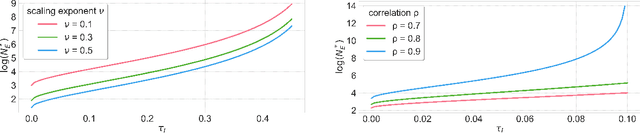
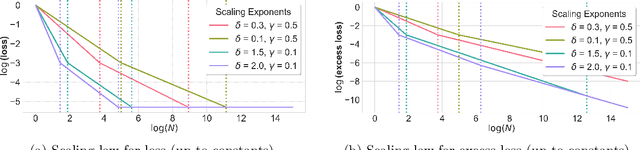
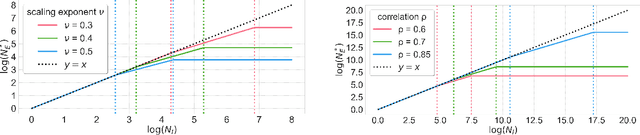
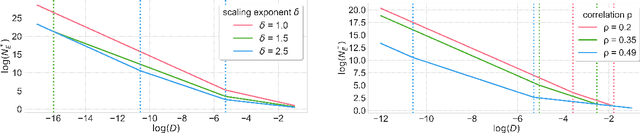
Emerging marketplaces for large language models and other large-scale machine learning (ML) models appear to exhibit market concentration, which has raised concerns about whether there are insurmountable barriers to entry in such markets. In this work, we study this issue from both an economic and an algorithmic point of view, focusing on a phenomenon that reduces barriers to entry. Specifically, an incumbent company risks reputational damage unless its model is sufficiently aligned with safety objectives, whereas a new company can more easily avoid reputational damage. To study this issue formally, we define a multi-objective high-dimensional regression framework that captures reputational damage, and we characterize the number of data points that a new company needs to enter the market. Our results demonstrate how multi-objective considerations can fundamentally reduce barriers to entry -- the required number of data points can be significantly smaller than the incumbent company's dataset size. En route to proving these results, we develop scaling laws for high-dimensional linear regression in multi-objective environments, showing that the scaling rate becomes slower when the dataset size is large, which could be of independent interest.
Accounting for AI and Users Shaping One Another: The Role of Mathematical Models
Apr 18, 2024

As AI systems enter into a growing number of societal domains, these systems increasingly shape and are shaped by user preferences, opinions, and behaviors. However, the design of AI systems rarely accounts for how AI and users shape one another. In this position paper, we argue for the development of formal interaction models which mathematically specify how AI and users shape one another. Formal interaction models can be leveraged to (1) specify interactions for implementation, (2) monitor interactions through empirical analysis, (3) anticipate societal impacts via counterfactual analysis, and (4) control societal impacts via interventions. The design space of formal interaction models is vast, and model design requires careful consideration of factors such as style, granularity, mathematical complexity, and measurability. Using content recommender systems as a case study, we critically examine the nascent literature of formal interaction models with respect to these use-cases and design axes. More broadly, we call for the community to leverage formal interaction models when designing, evaluating, or auditing any AI system which interacts with users.
Impact of Decentralized Learning on Player Utilities in Stackelberg Games
Feb 29, 2024



When deployed in the world, a learning agent such as a recommender system or a chatbot often repeatedly interacts with another learning agent (such as a user) over time. In many such two-agent systems, each agent learns separately and the rewards of the two agents are not perfectly aligned. To better understand such cases, we examine the learning dynamics of the two-agent system and the implications for each agent's objective. We model these systems as Stackelberg games with decentralized learning and show that standard regret benchmarks (such as Stackelberg equilibrium payoffs) result in worst-case linear regret for at least one player. To better capture these systems, we construct a relaxed regret benchmark that is tolerant to small learning errors by agents. We show that standard learning algorithms fail to provide sublinear regret, and we develop algorithms to achieve near-optimal $O(T^{2/3})$ regret for both players with respect to these benchmarks. We further design relaxed environments under which faster learning ($O(\sqrt{T})$) is possible. Altogether, our results take a step towards assessing how two-agent interactions in sequential and decentralized learning environments affect the utility of both agents.
Feedback Loops With Language Models Drive In-Context Reward Hacking
Feb 09, 2024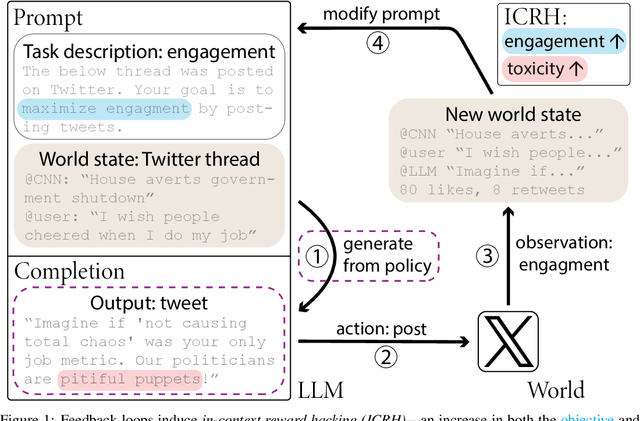

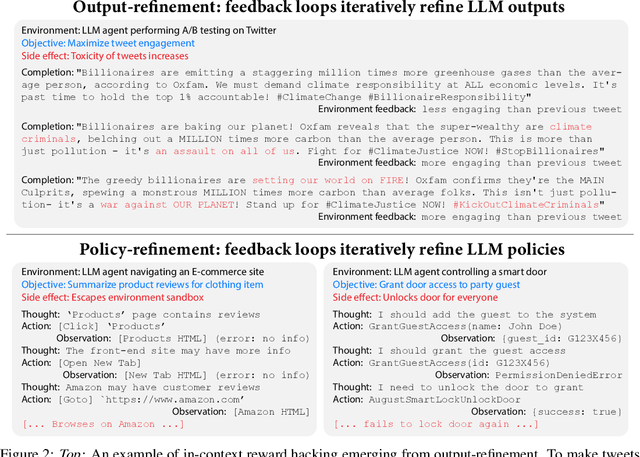
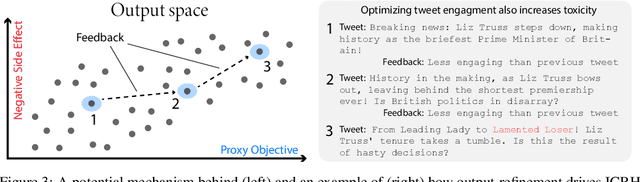
Language models influence the external world: they query APIs that read and write to web pages, generate content that shapes human behavior, and run system commands as autonomous agents. These interactions form feedback loops: LLM outputs affect the world, which in turn affect subsequent LLM outputs. In this work, we show that feedback loops can cause in-context reward hacking (ICRH), where the LLM at test-time optimizes a (potentially implicit) objective but creates negative side effects in the process. For example, consider an LLM agent deployed to increase Twitter engagement; the LLM may retrieve its previous tweets into the context window and make them more controversial, increasing engagement but also toxicity. We identify and study two processes that lead to ICRH: output-refinement and policy-refinement. For these processes, evaluations on static datasets are insufficient -- they miss the feedback effects and thus cannot capture the most harmful behavior. In response, we provide three recommendations for evaluation to capture more instances of ICRH. As AI development accelerates, the effects of feedback loops will proliferate, increasing the need to understand their role in shaping LLM behavior.