 Add to Chrome
 Add to Firefox
 Add to Edge
Stochastic weather generators for high-frequency wind vector time series
Jun 08, 2026
Surface winds can vary substantially from one minute to the next, so there is scope for studying its variation on this fine time scale. Restricting to the month of June to minimize seasonality, this work develops a range of machine learning models for generating realistic time series of surface wind vectors at a site in Lamont, Oklahoma based on more than 30 years of high quality measurements at the minute time scale. Such a generator could be used as an input into models from a range of disciplines, notably for wind energy, but also wildfire spread and aviation, among others. The data show complex diurnal structures in both wind speed and direction that would be challenging to capture with standard time series models, so we consider a number of machine learning approaches to producing a stochastic wind generator based on time vector-quantized variational autoencoders. We consider generating a day's worth of data at a time and generating a day of wind vectors conditional on the previous day's winds. We also study methods for incorporating a discrete weather state variable in the generator. We evaluate the generators using a wide range of formal and informal methods. The best of these generators can capture many but not all of the complex features present in the observational data. In particular, the best of our approaches accurately mimic diurnal changes in wind volatility but struggle to match the observed distribution of extreme wind speeds.

Can Cross-Layer Transcoders Replace Vision Transformer Activations? An Interpretable Perspective on Vision
Apr 14, 2026Understanding the internal activations of Vision Transformers (ViTs) is critical for building interpretable and trustworthy models. While Sparse Autoencoders (SAEs) have been used to extract human-interpretable features, they operate on individual layers and fail to capture the cross-layer computational structure of Transformers, as well as the relative significance of each layer in forming the last-layer representation. Alternatively, we introduce the adoption of Cross-Layer Transcoders (CLTs) as reliable, sparse, and depth-aware proxy models for MLP blocks in ViTs. CLTs use an encoder-decoder scheme to reconstruct each post-MLP activation from learned sparse embeddings of preceding layers, yielding a linear decomposition that transforms the final representation of ViTs from an opaque embedding into an additive, layer-resolved construction that enables faithful attribution and process-level interpretability. We train CLTs on CLIP ViT-B/32 and ViT-B/16 across CIFAR-100, COCO, and ImageNet-100. We show that CLTs achieve high reconstruction fidelity with post-MLP activations while preserving and even improving, in some cases, CLIP zero-shot classification accuracy. In terms of interpretability, we show that the cross-layer contribution scores provide faithful attribution, revealing that the final representation is concentrated in a smaller set of dominant layer-wise terms whose removal degrades performance and whose retention largely preserves it. These results showcase the significance of adopting CLTs as an alternative interpretable proxy of ViTs in the vision domain.
Nonlinear multi-study factor analysis
Jan 26, 2026High-dimensional data often exhibit variation that can be captured by lower dimensional factors. For high-dimensional data from multiple studies or environments, one goal is to understand which underlying factors are common to all studies, and which factors are study or environment-specific. As a particular example, we consider platelet gene expression data from patients in different disease groups. In this data, factors correspond to clusters of genes which are co-expressed; we may expect some clusters (or biological pathways) to be active for all diseases, while some clusters are only active for a specific disease. To learn these factors, we consider a nonlinear multi-study factor model, which allows for both shared and specific factors. To fit this model, we propose a multi-study sparse variational autoencoder. The underlying model is sparse in that each observed feature (i.e. each dimension of the data) depends on a small subset of the latent factors. In the genomics example, this means each gene is active in only a few biological processes. Further, the model implicitly induces a penalty on the number of latent factors, which helps separate the shared factors from the group-specific factors. We prove that the latent factors are identified, and demonstrate our method recovers meaningful factors in the platelet gene expression data.
Towards Interpretable Deep Generative Models via Causal Representation Learning
Apr 15, 2025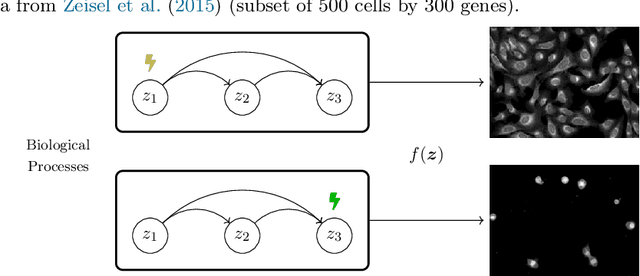
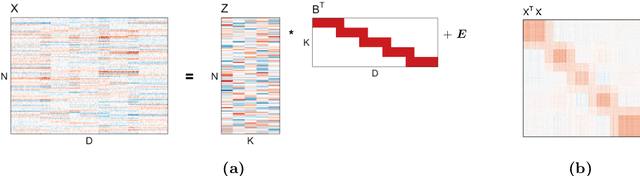
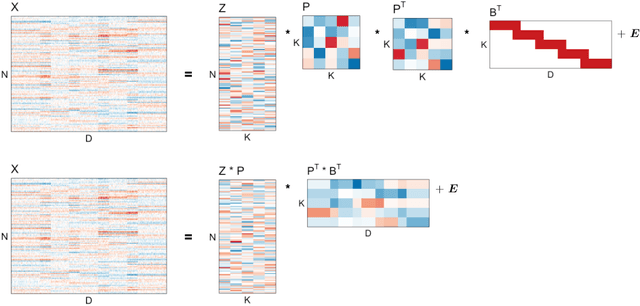
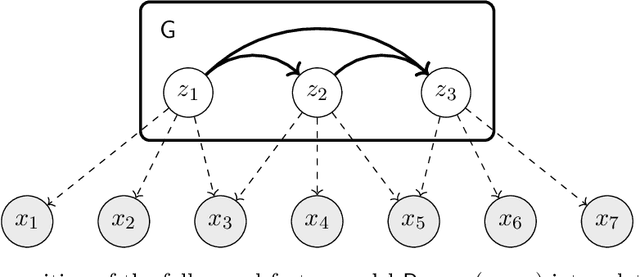
Recent developments in generative artificial intelligence (AI) rely on machine learning techniques such as deep learning and generative modeling to achieve state-of-the-art performance across wide-ranging domains. These methods' surprising performance is due in part to their ability to learn implicit "representations'' of complex, multi-modal data. Unfortunately, deep neural networks are notoriously black boxes that obscure these representations, making them difficult to interpret or analyze. To resolve these difficulties, one approach is to build new interpretable neural network models from the ground up. This is the goal of the emerging field of causal representation learning (CRL) that uses causality as a vector for building flexible, interpretable, and transferable generative AI. CRL can be seen as a culmination of three intrinsically statistical problems: (i) latent variable models such as factor analysis; (ii) causal graphical models with latent variables; and (iii) nonparametric statistics and deep learning. This paper reviews recent progress in CRL from a statistical perspective, focusing on connections to classical models and statistical and causal identifiablity results. This review also highlights key application areas, implementation strategies, and open statistical questions in CRL.
Identifiable Variational Autoencoders via Sparse Decoding
Oct 20, 2021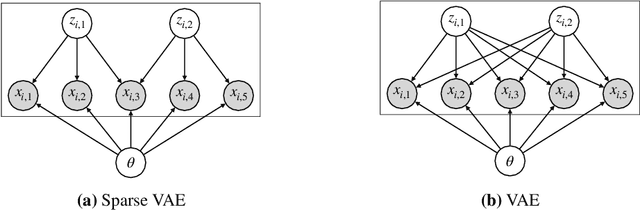
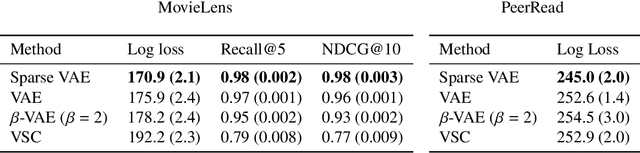
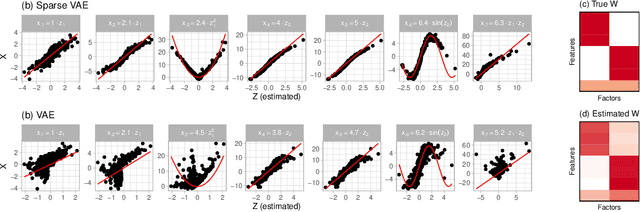
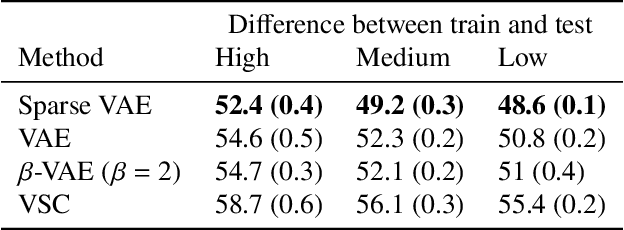
We develop the Sparse VAE, a deep generative model for unsupervised representation learning on high-dimensional data. Given a dataset of observations, the Sparse VAE learns a set of latent factors that captures its distribution. The model is sparse in the sense that each feature of the dataset (i.e., each dimension) depends on a small subset of the latent factors. As examples, in ratings data each movie is only described by a few genres; in text data each word is only applicable to a few topics; in genomics, each gene is active in only a few biological processes. We first show that the Sparse VAE is identifiable: given data drawn from the model, there exists a uniquely optimal set of factors. (In contrast, most VAE-based models are not identifiable.) The key assumption behind Sparse-VAE identifiability is the existence of "anchor features", where for each factor there exists a feature that depends only on that factor. Importantly, the anchor features do not need to be known in advance. We then show how to fit the Sparse VAE with variational EM. Finally, we empirically study the Sparse VAE with both simulated and real data. We find that it recovers meaningful latent factors and has smaller heldout reconstruction error than related methods.