 Add to Chrome
 Add to Firefox
 Add to Edge
Kimi K3: Open Frontier Intelligence
Jul 27, 2026
We introduce Kimi K3, a 2.8T parameter Mixture-of-Experts model with 104 billion activated parameters, native vision capabilities, and a 1-million-token context window. Kimi K3 is built on Kimi Delta Attention and Attention Residuals, which improve information flow across sequence length and model depth. Together with Stable LatentMoE, which effectively activates 16 of 896 routed experts per token, and refined training and data recipes, these advances yield an approximately 2.5x improvement in overall scaling efficiency over Kimi K2. Post-training highlights reinforcement learning across general, agentic, and coding domains and multiple reasoning-effort levels, enabling compositional generalization and robust long-horizon execution. At 2.8T scale, Kimi K3 is supported by infrastructure advances in multiple areas: algorithm-system co-design for KDA, perfectly balanced expert-parallel training with efficient memory management, million-token agentic RL with persistent rollout and sandbox states, and deployment innovations. Extensive evaluations show that Kimi K3 achieves frontier-level performance across long-horizon coding, agentic, knowledge, reasoning, and vision tasks. While its overall performance still trails the most powerful proprietary models, namely Claude Fable 5 and GPT-5.6 Sol, Kimi K3 consistently outperforms other open and proprietary models evaluated in our suite. We release the full Kimi K3 model weights to facilitate future research and accelerate the broader deployment and adoption of frontier intelligence.

FoodMonitor: Benchmarking MLLMs for Explainable Compliance Analysis
May 23, 2026As AI-powered compliance monitoring becomes increasingly important in public governance and industrial safety, the ability to provide verifiable evidence and traceable accountability signals is essential. However, existing video anomaly detection datasets focus on event-level binary classification, lacking the rule-driven, explainable analysis required for real-world compliance scenarios. We introduce FoodMonitor, a benchmark for explainable compliance analysis in commercial kitchen surveillance. FoodMonitor comprises 477 video clips with 3,307 violation annotations across a dual-channel design covering both person-level and environment-level violations. Each annotation specifies which rule was violated, what non-compliant behavior occurred, and who committed it with frame-level bounding boxes. We establish a unified evaluation protocol with a two-stage matching mechanism that separately assesses spatial localization and semantic understanding, along with a composite metric ($C_{\text{score}}$) that balances environment and person detection performance. Systematic evaluation of several state-of-the-art multimodal large language models reveals that the best-performing model achieves only 0.360 $C_{\text{score}}$, with spatial localization and fine-grained rule understanding emerging as the primary bottlenecks. Our analysis identifies two distinct failure modes: localization-dominated errors and semantics-dominated errors, providing diagnostic insights for future model development.
Robust Spatiotemporal Motion Planning for Multi-Agent Autonomous Racing via Topological Gap Identification and Accelerated MPC
Mar 10, 2026High-speed multi-agent autonomous racing demands robust spatiotemporal planning and precise control under strict computational limits. Current methods often oversimplify interactions or abandon strict kinematic constraints. We resolve this by proposing a Topological Gap Identification and Accelerated MPC framework. By predicting opponent behaviors via SGPs, our method constructs dynamic occupancy corridors to robustly select optimal overtaking gaps. We ensure strict kinematic feasibility using a Linear Time-Varying MPC powered by a customized Pseudo-Transient Continuation (PTC) solver for high-frequency execution. Experimental results on the F1TENTH platform show that our method significantly outperforms state-of-the-art baselines: it reduces total maneuver time by 51.6% in sequential scenarios, consistently maintains an overtaking success rate exceeding 81% in dense bottlenecks, and lowers average computational latency by 20.3%, pushing the boundaries of safe and high-speed autonomous racing.
Vision-Augmented On-Track System Identification for Autonomous Racing via Attention-Based Priors and Iterative Neural Correction
Mar 10, 2026Operating autonomous vehicles at the absolute limits of handling requires precise, real-time identification of highly non-linear tire dynamics. However, traditional online optimization methods suffer from "cold-start" initialization failures and struggle to model high-frequency transient dynamics. To address these bottlenecks, this paper proposes a novel vision-augmented, iterative system identification framework. First, a lightweight CNN (MobileNetV3) translates visual road textures into a continuous heuristic friction prior, providing a robust "warm-start" for parameter optimization. Next, a S4 model captures complex temporal dynamic residuals, circumventing the memory and latency limitations of traditional MLPs and RNNs. Finally, a derivative-free Nelder-Mead algorithm iteratively extracts physically interpretable Pacejka tire parameters via a hybrid virtual simulation. Co-simulation in CarSim demonstrates that the lightweight vision backbone reduces friction estimation error by 76.1 using 85 fewer FLOPs, accelerating cold-start convergence by 71.4. Furthermore, the S4-augmented framework improves parameter extraction accuracy and decreases lateral force RMSE by over 60 by effectively capturing complex vehicle dynamics, demonstrating superior performance compared to conventional neural architectures.
BrainRVQ: A High-Fidelity EEG Foundation Model via Dual-Domain Residual Quantization and Hierarchical Autoregression
Feb 18, 2026Developing foundation models for electroencephalography (EEG) remains challenging due to the signal's low signal-to-noise ratio and complex spectro-temporal non-stationarity. Existing approaches often overlook the hierarchical latent structure inherent in neural dynamics, leading to suboptimal reconstruction of fine-grained information. In this work, we propose BrainRVQ, a general-purpose EEG foundation model pre-trained on a large-scale corpus of clinical EEG data. Unlike standard masked modeling, BrainRVQ features a Dual-Domain Residual Vector Quantization (DD-RVQ) tokenizer that disentangles temporal waveforms and spectral patterns into hierarchical discrete codes. We further introduce a hierarchical autoregressive pre-training objective that learns to reconstruct these codes in a coarse-to-fine manner, utilizing an importance-guided curriculum masking strategy to prioritize information-rich neural events over background noise. Extensive experiments across 8 diverse downstream datasets demonstrate that BrainRVQ consistently outperforms state-of-the-art baselines, validating its effectiveness in learning robust and generalizable neural representations. Our code and model weights are available:https://github.com/keqicmz/BrainRVQ
Kimi K2.5: Visual Agentic Intelligence
Feb 02, 2026We introduce Kimi K2.5, an open-source multimodal agentic model designed to advance general agentic intelligence. K2.5 emphasizes the joint optimization of text and vision so that two modalities enhance each other. This includes a series of techniques such as joint text-vision pre-training, zero-vision SFT, and joint text-vision reinforcement learning. Building on this multimodal foundation, K2.5 introduces Agent Swarm, a self-directed parallel agent orchestration framework that dynamically decomposes complex tasks into heterogeneous sub-problems and executes them concurrently. Extensive evaluations show that Kimi K2.5 achieves state-of-the-art results across various domains including coding, vision, reasoning, and agentic tasks. Agent Swarm also reduces latency by up to $4.5\times$ over single-agent baselines. We release the post-trained Kimi K2.5 model checkpoint to facilitate future research and real-world applications of agentic intelligence.
Kimi K2: Open Agentic Intelligence
Jul 28, 2025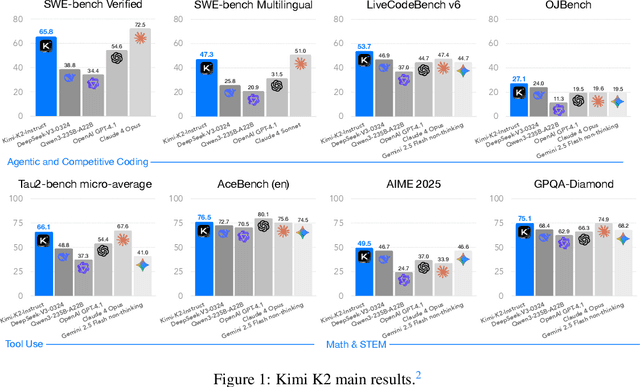
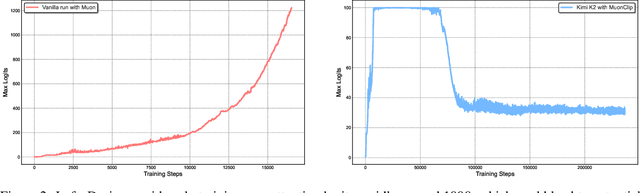
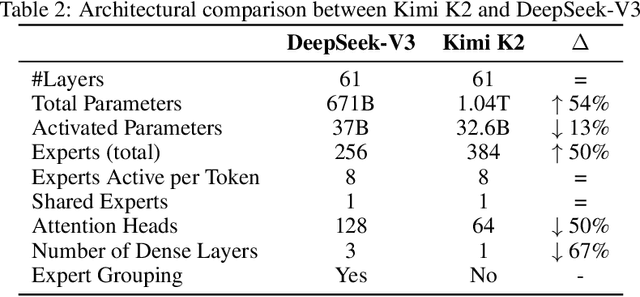
We introduce Kimi K2, a Mixture-of-Experts (MoE) large language model with 32 billion activated parameters and 1 trillion total parameters. We propose the MuonClip optimizer, which improves upon Muon with a novel QK-clip technique to address training instability while enjoying the advanced token efficiency of Muon. Based on MuonClip, K2 was pre-trained on 15.5 trillion tokens with zero loss spike. During post-training, K2 undergoes a multi-stage post-training process, highlighted by a large-scale agentic data synthesis pipeline and a joint reinforcement learning (RL) stage, where the model improves its capabilities through interactions with real and synthetic environments. Kimi K2 achieves state-of-the-art performance among open-source non-thinking models, with strengths in agentic capabilities. Notably, K2 obtains 66.1 on Tau2-Bench, 76.5 on ACEBench (En), 65.8 on SWE-Bench Verified, and 47.3 on SWE-Bench Multilingual -- surpassing most open and closed-sourced baselines in non-thinking settings. It also exhibits strong capabilities in coding, mathematics, and reasoning tasks, with a score of 53.7 on LiveCodeBench v6, 49.5 on AIME 2025, 75.1 on GPQA-Diamond, and 27.1 on OJBench, all without extended thinking. These results position Kimi K2 as one of the most capable open-source large language models to date, particularly in software engineering and agentic tasks. We release our base and post-trained model checkpoints to facilitate future research and applications of agentic intelligence.
A Geography-Inspired and Self-Adaptive Clustering Algorithm: A Study in Channel Measurement
Apr 29, 2025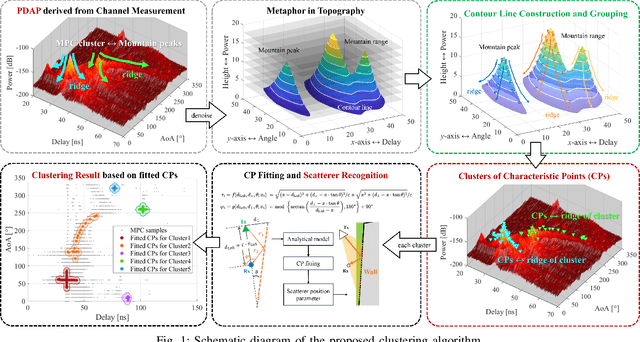
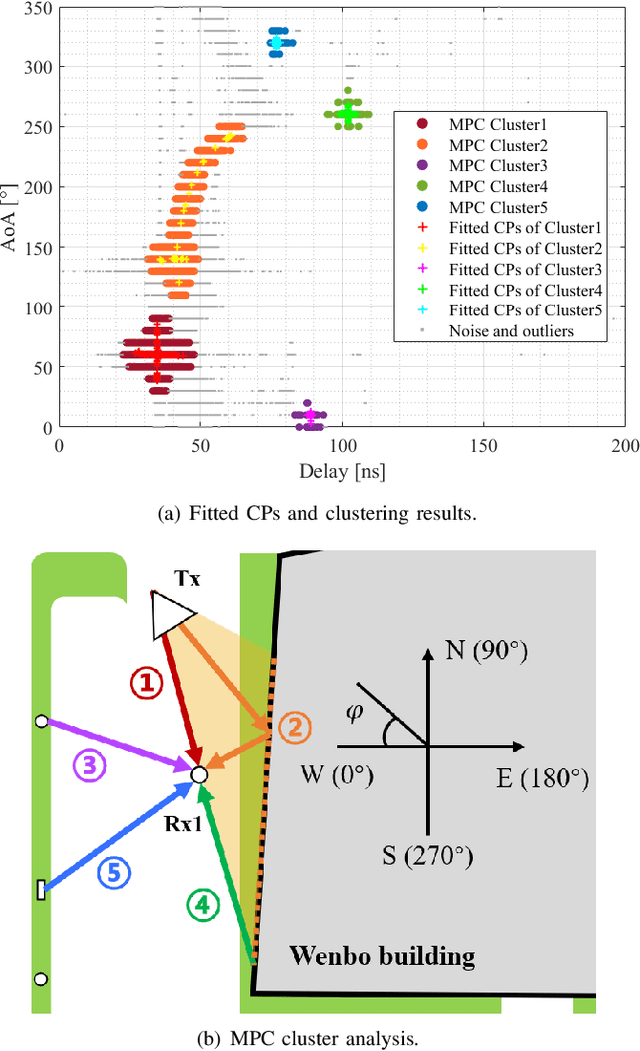
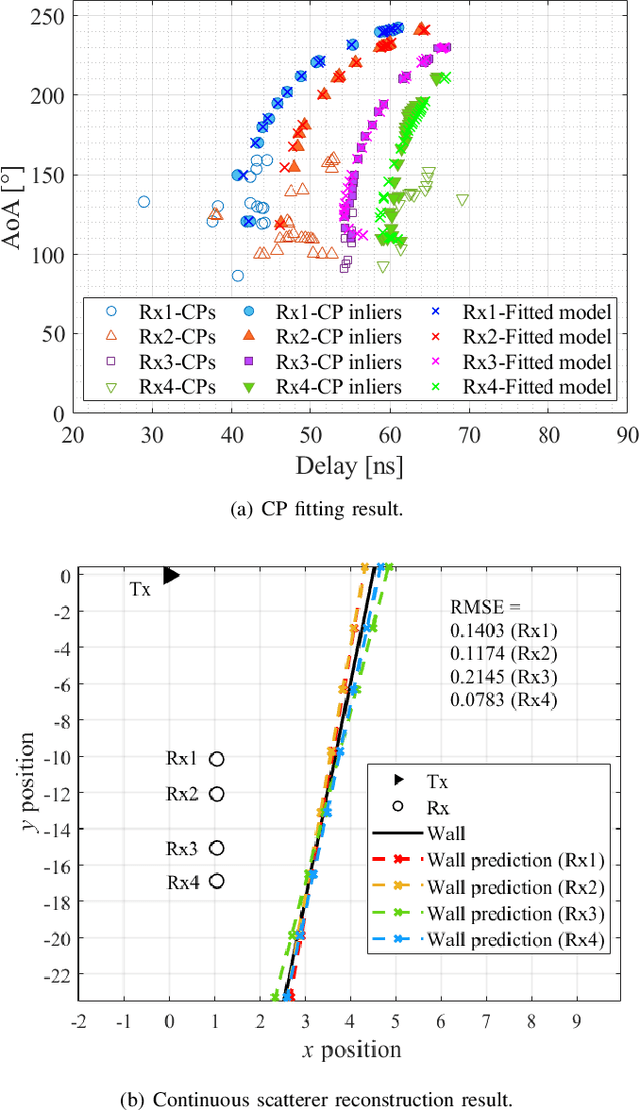
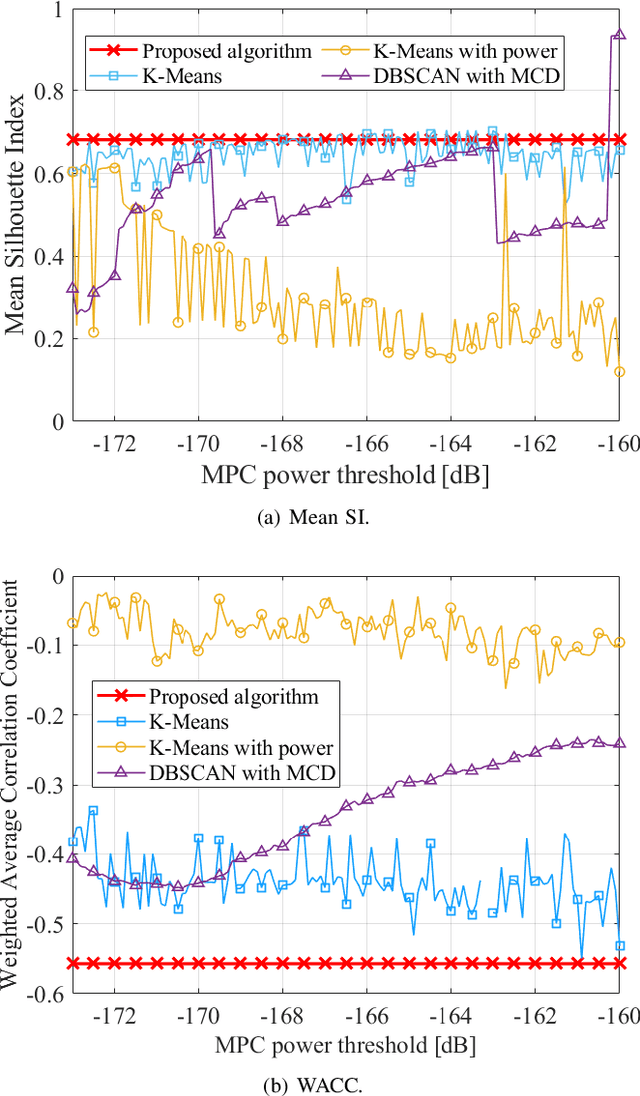
The phenomenon that multi-path components (MPCs) arrive in clusters has been verified by channel measurements, and is widely adopted by cluster-based channel models. As a crucial intermediate processing step, MPC clustering bridges raw data in channel measurement and cluster characteristics for channel modeling. In this paper, a physical-interpretable and self-adaptive MPC clustering algorithm is proposed, which can locate both single-point and wide-spread scatterers without prior knowledge. Inspired by the concept in geography, a novel metaphor that interprets features of MPC attributes in the power-delay-angle profile (PDAP) as topographic concepts is developed. In light of the interpretation, the proposed algorithm disassembles the PDAP by constructing contour lines and identifying characteristic points that indicate the skeleton of MPC clusters, which are fitted by analytical models that associate MPCs with physical scatterer locations. Besides, a new clustering performance index, the power gradient consistency index, is proposed. Calculated as the weighted Spearman correlation coefficient between the power and the distance to the center, the index captures the intrinsic property of MPC clusters that the dominant high-power path is surrounded by lower-power paths. The performance of the proposed algorithm is analyzed and compared with the counterparts of conventional clustering algorithms based on the channel measurement conducted in an outdoor scenario. The proposed algorithm performs better in average Silhouette index and weighted Spearman correlation coefficient, and the average root mean square error (RMSE) of the estimated scatterer location is 0.1 m.
Kimi-VL Technical Report
Apr 10, 2025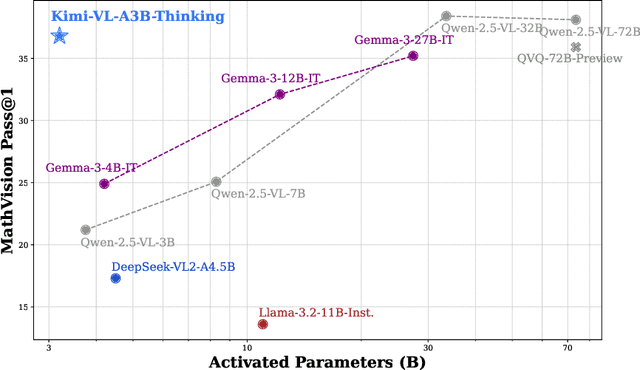
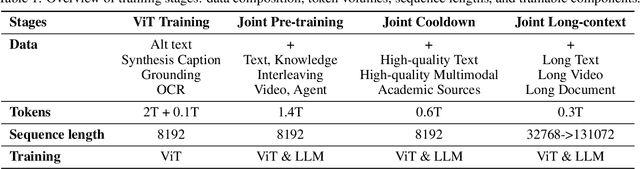
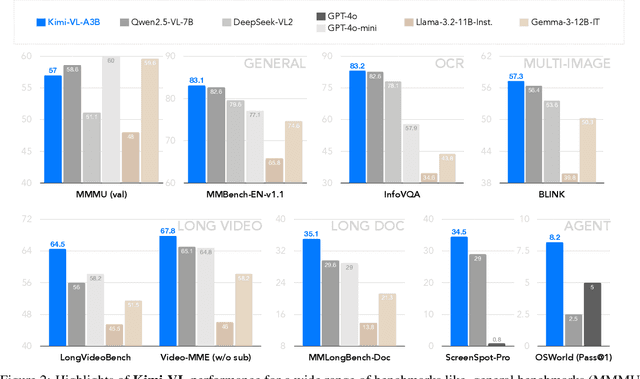

We present Kimi-VL, an efficient open-source Mixture-of-Experts (MoE) vision-language model (VLM) that offers advanced multimodal reasoning, long-context understanding, and strong agent capabilities - all while activating only 2.8B parameters in its language decoder (Kimi-VL-A3B). Kimi-VL demonstrates strong performance across challenging domains: as a general-purpose VLM, Kimi-VL excels in multi-turn agent tasks (e.g., OSWorld), matching flagship models. Furthermore, it exhibits remarkable capabilities across diverse challenging vision language tasks, including college-level image and video comprehension, OCR, mathematical reasoning, and multi-image understanding. In comparative evaluations, it effectively competes with cutting-edge efficient VLMs such as GPT-4o-mini, Qwen2.5-VL-7B, and Gemma-3-12B-IT, while surpassing GPT-4o in several key domains. Kimi-VL also advances in processing long contexts and perceiving clearly. With a 128K extended context window, Kimi-VL can process diverse long inputs, achieving impressive scores of 64.5 on LongVideoBench and 35.1 on MMLongBench-Doc. Its native-resolution vision encoder, MoonViT, further allows it to see and understand ultra-high-resolution visual inputs, achieving 83.2 on InfoVQA and 34.5 on ScreenSpot-Pro, while maintaining lower computational cost for common tasks. Building upon Kimi-VL, we introduce an advanced long-thinking variant: Kimi-VL-Thinking. Developed through long chain-of-thought (CoT) supervised fine-tuning (SFT) and reinforcement learning (RL), this model exhibits strong long-horizon reasoning capabilities. It achieves scores of 61.7 on MMMU, 36.8 on MathVision, and 71.3 on MathVista while maintaining the compact 2.8B activated LLM parameters, setting a new standard for efficient multimodal thinking models. Code and models are publicly accessible at https://github.com/MoonshotAI/Kimi-VL.
Ponder & Press: Advancing Visual GUI Agent towards General Computer Control
Dec 02, 2024Most existing GUI agents typically depend on non-vision inputs like HTML source code or accessibility trees, limiting their flexibility across diverse software environments and platforms. Current multimodal large language models (MLLMs), which excel at using vision to ground real-world objects, offer a potential alternative. However, they often struggle with accurately localizing GUI elements -- a critical requirement for effective GUI automation -- due to the semantic gap between real-world objects and GUI elements. In this work, we introduce Ponder & Press, a divide-and-conquer framework for general computer control using only visual input. Our approach combines an general-purpose MLLM as an 'interpreter', responsible for translating high-level user instructions into detailed action descriptions, with a GUI-specific MLLM as a 'locator' that precisely locates GUI elements for action placement. By leveraging a purely visual input, our agent offers a versatile, human-like interaction paradigm applicable to a wide range of applications. Ponder & Press locator outperforms existing models by +22.5% on the ScreenSpot GUI grounding benchmark. Both offline and interactive agent benchmarks across various GUI environments -- including web pages, desktop software, and mobile UIs -- demonstrate that Ponder & Press framework achieves state-of-the-art performance, highlighting the potential of visual GUI agents. Refer to the project homepage https://invinciblewyq.github.io/ponder-press-page/