 Add to Chrome
 Add to Firefox
 Add to Edge
Whose Posts Get Ranked: Identical-Text Exposure Gaps in Bluesky Custom Feeds
Aug 14, 2026
Bluesky lets users deploy custom feeds, independently operated recommendation algorithms that the platform serves alongside thousands of others. This paper investigates how evenly these feeds treat posts with the same text. To measure this, we take repeated snapshots of the Top-50 lists that 1,366 public feeds return, and we group posts with identical text, from different authors, that were created before the same list response and closely matched in age. Exposure diverges widely inside these matched sets, which span 250 feeds: in 33% of sets, one copy appears on the list while another does not. Fixed-effects regressions show that this divergence is associated with the author's history on the specific feed. Authors new to a feed receive less exposure for the same text (-0.061 in reciprocal-rank weight), while authors whose posts the feed has returned before receive more. A new author with more followers than the competing author still loses 74\% of head-to-head comparisons. Media and post-type features show no detectable association after multiple-comparison correction. These results are early evidence that access to many independent feeds is not enough to give identical texts equal exposure.

Predicting Custom-Feed Returns for New Bluesky Posts: A Prospective Study
Aug 14, 2026The conventional approach to cold-start recommendation addresses new users or newly introduced items. Bluesky custom feeds create a different setting: independently operated feeds filter content from a shared public stream. In this setting, newly published posts are the cold-start objects, while the feeds serve as candidates. We propose a cold-start routing task in which a newly ingested public post is the query and all rankable feeds in the monitored panel are ranked according to whether each will subsequently return it. We build a still-evolving collect-first, label-later benchmark dataset. The collected dataset covers a fixed panel of 5,000 monitored feeds and contains 17.804 million public posts, 1.865 million observable post--feed return records, and 625,083 valid feed polls. The labels record whether a post is observed among a feed's AppView Top-50 results in at least one poll during the 24 hours after publication. The current experiments use two disjoint 24-hour test folds, each paired with a 24-hour training window and separated by a 24-hour outcome-availability gap. Evaluation is conditional on the 602,186 test posts that have at least one positive observed label and satisfy the metric eligibility criteria; these posts account for 9.04% of all 6,661,658 test posts. Across the two folds, LambdaRank achieves the best equal-fold mean values among the evaluated models: 0.7361 for capped Recall@10, 0.6127 for NDCG@10, and 0.7749 for Hit@10.
Flex4DHuman: Flexible Multi-view Video Diffusion for 4D Human Reconstruction
Jun 11, 2026We present Flex4DHuman, a multi-view video diffusion model that transforms a monocular or sparse multi-view video of a dynamic subject into synchronized dense multi-view videos using only relative camera-pose conditioning. Unlike prior human-centric methods that rely on skeletons, depth maps, normals, or rendered target-view geometry, Flex4DHuman requires no explicit geometry priors and instead conditions generation through relative camera-pose positional encoding. The generated videos can be directly ingested by downstream reconstruction pipelines to create dynamic 4D Gaussian splats. Built on the Wan 2.1 1.3B text-to-video model, Flex4DHuman preserves the backbone architecture and encodes camera and view information through a five-axis positional encoding that extends spatio-temporal RoPE with view indices and continuous SE(3) relative camera geometry. A three-stage curriculum progressively trains the model for pose following, flexible reference-to-target view generation, and temporal rollout. To support temporal rollout, we train with clean historical target-view tokens. We also add multi-view captions to enable test-time text control. Combined with an off-the-shelf 4D Gaussian Splatting stage, our framework lifts monocular static-camera videos into dynamic 4D Gaussian splats. Experiments on DNA-Rendering and ActorsHQ show that Flex4DHuman surpasses prior state-of-the-art methods, while the same formulation generalizes to animal categories after mixed human-animal training. These capabilities make Flex4DHuman a practical step toward scalable 4D content creation from casual monocular videos for simulation, gaming, AR/VR, and video re-shooting.
The Tag is the Signal: URL-Agnostic Credibility Scoring for Messages on Telegram
Jan 19, 2026Telegram has become one of the leading platforms for disseminating misinformational messages. However, many existing pipelines still classify each message's credibility based on the reputation of its associated domain names or its lexical features. Such methods work well on traditional long-form news articles published by well-known sources, but high-risk posts on Telegram are short and URL-sparse, leading to failures for link-based and standard TF-IDF models. To this end, we propose the TAG2CRED pipeline, a method designed for such short, convoluted messages. Our model will directly score each post based on the tags assigned to the text. We designed a concise label system that covers the dimensions of theme, claim type, call to action, and evidence. The fine-tuned large language model (LLM) assigns tags to messages and then maps these tags to calibrated risk scores in the [0,1] interval through L2-regularized logistic regression. We evaluated 87,936 Telegram messages associated with Media Bias/Fact Check (MBFC), using URL masking and domain disjoint splits. The results showed that the ROC-AUC of the TAG2CRED model reached 0.871, the macro-F1 value was 0.787, and the Brier score was 0.167, outperforming the baseline TF-IDF (macro-F1 value 0.737, Brier score 0.248); at the same time, the number of features used in this model is much smaller, and the generalization ability on infrequent domains is stronger. The performance of the stacked ensemble model (TF-IDF + TAG2CRED + SBERT) was further improved over the baseline SBERT. ROC-AUC reached 0.901, and the macro-F1 value was 0.813 (Brier score 0.114). This indicates that style labels and lexical features may capture different but complementary dimensions of information risk.
DynamicRTL: RTL Representation Learning for Dynamic Circuit Behavior
Nov 12, 2025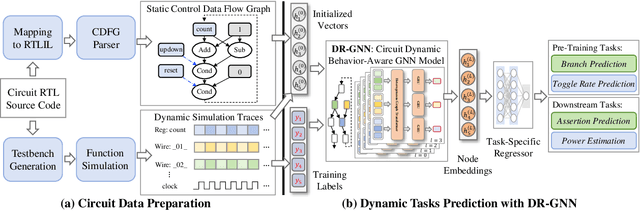
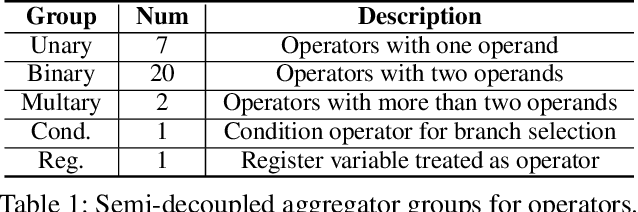
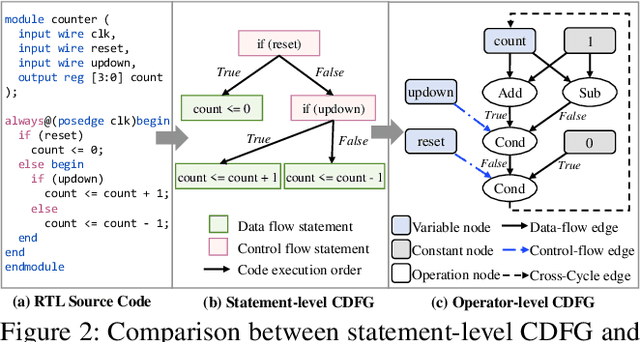

There is a growing body of work on using Graph Neural Networks (GNNs) to learn representations of circuits, focusing primarily on their static characteristics. However, these models fail to capture circuit runtime behavior, which is crucial for tasks like circuit verification and optimization. To address this limitation, we introduce DR-GNN (DynamicRTL-GNN), a novel approach that learns RTL circuit representations by incorporating both static structures and multi-cycle execution behaviors. DR-GNN leverages an operator-level Control Data Flow Graph (CDFG) to represent Register Transfer Level (RTL) circuits, enabling the model to capture dynamic dependencies and runtime execution. To train and evaluate DR-GNN, we build the first comprehensive dynamic circuit dataset, comprising over 6,300 Verilog designs and 63,000 simulation traces. Our results demonstrate that DR-GNN outperforms existing models in branch hit prediction and toggle rate prediction. Furthermore, its learned representations transfer effectively to related dynamic circuit tasks, achieving strong performance in power estimation and assertion prediction.
Time-Lapse Video-Based Embryo Grading via Complementary Spatial-Temporal Pattern Mining
Jun 05, 2025Artificial intelligence has recently shown promise in automated embryo selection for In-Vitro Fertilization (IVF). However, current approaches either address partial embryo evaluation lacking holistic quality assessment or target clinical outcomes inevitably confounded by extra-embryonic factors, both limiting clinical utility. To bridge this gap, we propose a new task called Video-Based Embryo Grading - the first paradigm that directly utilizes full-length time-lapse monitoring (TLM) videos to predict embryologists' overall quality assessments. To support this task, we curate a real-world clinical dataset comprising over 2,500 TLM videos, each annotated with a grading label indicating the overall quality of embryos. Grounded in clinical decision-making principles, we propose a Complementary Spatial-Temporal Pattern Mining (CoSTeM) framework that conceptually replicates embryologists' evaluation process. The CoSTeM comprises two branches: (1) a morphological branch using a Mixture of Cross-Attentive Experts layer and a Temporal Selection Block to select discriminative local structural features, and (2) a morphokinetic branch employing a Temporal Transformer to model global developmental trajectories, synergistically integrating static and dynamic determinants for grading embryos. Extensive experimental results demonstrate the superiority of our design. This work provides a valuable methodological framework for AI-assisted embryo selection. The dataset and source code will be publicly available upon acceptance.
Adaptive LiDAR Odometry and Mapping for Autonomous Agricultural Mobile Robots in Unmanned Farms
Dec 03, 2024Unmanned and intelligent agricultural systems are crucial for enhancing agricultural efficiency and for helping mitigate the effect of labor shortage. However, unlike urban environments, agricultural fields impose distinct and unique challenges on autonomous robotic systems, such as the unstructured and dynamic nature of the environment, the rough and uneven terrain, and the resulting non-smooth robot motion. To address these challenges, this work introduces an adaptive LiDAR odometry and mapping framework tailored for autonomous agricultural mobile robots operating in complex agricultural environments. The proposed framework consists of a robust LiDAR odometry algorithm based on dense Generalized-ICP scan matching, and an adaptive mapping module that considers motion stability and point cloud consistency for selective map updates. The key design principle of this framework is to prioritize the incremental consistency of the map by rejecting motion-distorted points and sparse dynamic objects, which in turn leads to high accuracy in odometry estimated from scan matching against the map. The effectiveness of the proposed method is validated via extensive evaluation against state-of-the-art methods on field datasets collected in real-world agricultural environments featuring various planting types, terrain types, and robot motion profiles. Results demonstrate that our method can achieve accurate odometry estimation and mapping results consistently and robustly across diverse agricultural settings, whereas other methods are sensitive to abrupt robot motion and accumulated drift in unstructured environments. Further, the computational efficiency of our method is competitive compared with other methods. The source code of the developed method and the associated field dataset are publicly available at https://github.com/UCR-Robotics/AG-LOAM.
Planar Reflection-Aware Neural Radiance Fields
Nov 07, 2024
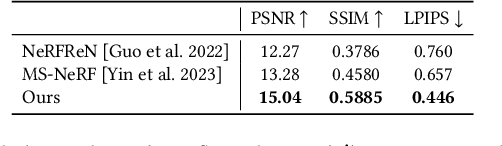


Neural Radiance Fields (NeRF) have demonstrated exceptional capabilities in reconstructing complex scenes with high fidelity. However, NeRF's view dependency can only handle low-frequency reflections. It falls short when handling complex planar reflections, often interpreting them as erroneous scene geometries and leading to duplicated and inaccurate scene representations. To address this challenge, we introduce a reflection-aware NeRF that jointly models planar reflectors, such as windows, and explicitly casts reflected rays to capture the source of the high-frequency reflections. We query a single radiance field to render the primary color and the source of the reflection. We propose a sparse edge regularization to help utilize the true sources of reflections for rendering planar reflections rather than creating a duplicate along the primary ray at the same depth. As a result, we obtain accurate scene geometry. Rendering along the primary ray results in a clean, reflection-free view, while explicitly rendering along the reflected ray allows us to reconstruct highly detailed reflections. Our extensive quantitative and qualitative evaluations of real-world datasets demonstrate our method's enhanced performance in accurately handling reflections.
On-the-Go Tree Detection and Geometric Traits Estimation with Ground Mobile Robots in Fruit Tree Groves
Apr 03, 2024

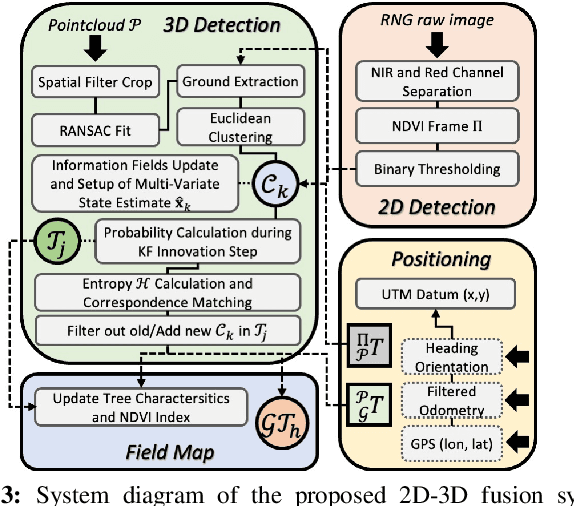

By-tree information gathering is an essential task in precision agriculture achieved by ground mobile sensors, but it can be time- and labor-intensive. In this paper we present an algorithmic framework to perform real-time and on-the-go detection of trees and key geometric characteristics (namely, width and height) with wheeled mobile robots in the field. Our method is based on the fusion of 2D domain-specific data (normalized difference vegetation index [NDVI] acquired via a red-green-near-infrared [RGN] camera) and 3D LiDAR point clouds, via a customized tree landmark association and parameter estimation algorithm. The proposed system features a multi-modal and entropy-based landmark correspondences approach, integrated into an underlying Kalman filter system to recognize the surrounding trees and jointly estimate their spatial and vegetation-based characteristics. Realistic simulated tests are used to evaluate our proposed algorithm's behavior in a variety of settings. Physical experiments in agricultural fields help validate our method's efficacy in acquiring accurate by-tree information on-the-go and in real-time by employing only onboard computational and sensing resources.
Multimodal Dataset for Localization, Mapping and Crop Monitoring in Citrus Tree Farms
Sep 29, 2023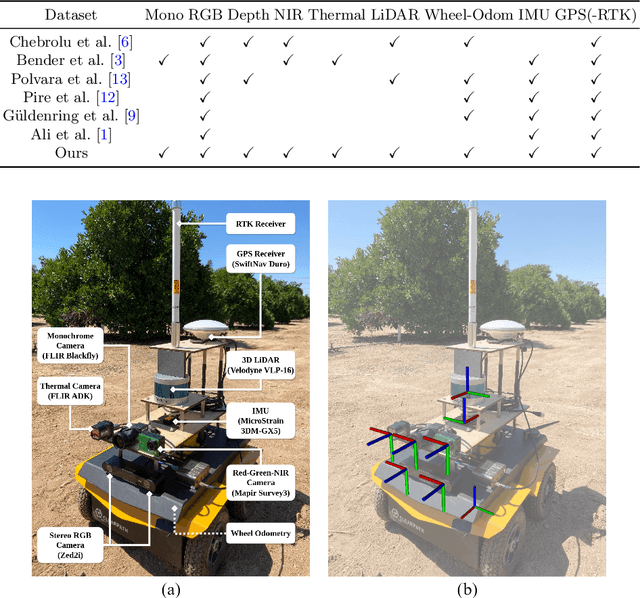
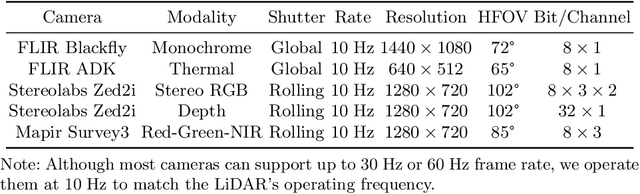
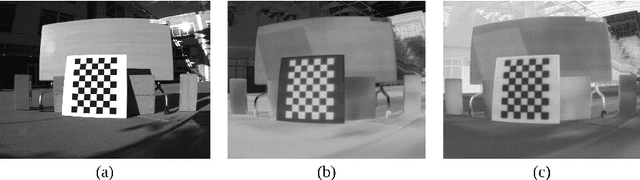
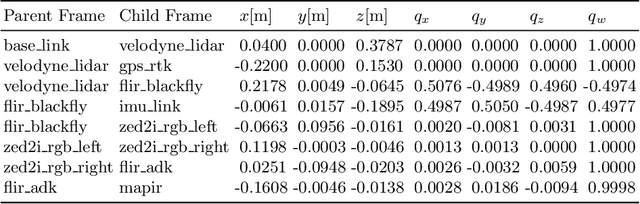
In this work we introduce the CitrusFarm dataset, a comprehensive multimodal sensory dataset collected by a wheeled mobile robot operating in agricultural fields. The dataset offers stereo RGB images with depth information, as well as monochrome, near-infrared and thermal images, presenting diverse spectral responses crucial for agricultural research. Furthermore, it provides a range of navigational sensor data encompassing wheel odometry, LiDAR, inertial measurement unit (IMU), and GNSS with Real-Time Kinematic (RTK) as the centimeter-level positioning ground truth. The dataset comprises seven sequences collected in three fields of citrus trees, featuring various tree species at different growth stages, distinctive planting patterns, as well as varying daylight conditions. It spans a total operation time of 1.7 hours, covers a distance of 7.5 km, and constitutes 1.3 TB of data. We anticipate that this dataset can facilitate the development of autonomous robot systems operating in agricultural tree environments, especially for localization, mapping and crop monitoring tasks. Moreover, the rich sensing modalities offered in this dataset can also support research in a range of robotics and computer vision tasks, such as place recognition, scene understanding, object detection and segmentation, and multimodal learning. The dataset, in conjunction with related tools and resources, is made publicly available at https://github.com/UCR-Robotics/Citrus-Farm-Dataset.