 Add to Chrome
 Add to Firefox
 Add to Edge
World Tracing: Generative Pixel-Aligned Geometry Beyond the Visible
Jun 11, 2026
Image-to-3D methods often trade off faithfulness and completeness: depth estimators are anchored to input pixels but stop at the visible surface, while image-to-3D models generate complete shapes that are often misaligned with the input. We introduce World Tracing, a generative pixel-aligned geometry representation that predicts 3D points aligned with observed pixels while completing geometry beyond the visible surface. For each input pixel, World Tracing predicts an ordered stack of camera-space 3D points, where the first layer represents the visible surface and subsequent layers represent front-to-back intersections with occluded surfaces. We instantiate this representation with a world-tracing diffusion transformer, WT-DiT, which treats multiple geometry layers as separate denoising tokens coupled through factorized and global attention. WT-DiT is trained with pixel-space flow matching and a mixed noise schedule that balances visible-surface reconstruction with occluded-geometry generation. World Tracing achieves strong performance on visible-surface reconstruction and complete geometry generation across object, scene, and dynamic benchmarks, outperforming both depth predictors and image-to-3D generators. It also preserves 2D-to-3D correspondence, enabling text-driven 3D scene editing, geometry-conditioned novel-view video synthesis, and training-free integration with textured-mesh generators.

Flex4DHuman: Flexible Multi-view Video Diffusion for 4D Human Reconstruction
Jun 11, 2026We present Flex4DHuman, a multi-view video diffusion model that transforms a monocular or sparse multi-view video of a dynamic subject into synchronized dense multi-view videos using only relative camera-pose conditioning. Unlike prior human-centric methods that rely on skeletons, depth maps, normals, or rendered target-view geometry, Flex4DHuman requires no explicit geometry priors and instead conditions generation through relative camera-pose positional encoding. The generated videos can be directly ingested by downstream reconstruction pipelines to create dynamic 4D Gaussian splats. Built on the Wan 2.1 1.3B text-to-video model, Flex4DHuman preserves the backbone architecture and encodes camera and view information through a five-axis positional encoding that extends spatio-temporal RoPE with view indices and continuous SE(3) relative camera geometry. A three-stage curriculum progressively trains the model for pose following, flexible reference-to-target view generation, and temporal rollout. To support temporal rollout, we train with clean historical target-view tokens. We also add multi-view captions to enable test-time text control. Combined with an off-the-shelf 4D Gaussian Splatting stage, our framework lifts monocular static-camera videos into dynamic 4D Gaussian splats. Experiments on DNA-Rendering and ActorsHQ show that Flex4DHuman surpasses prior state-of-the-art methods, while the same formulation generalizes to animal categories after mixed human-animal training. These capabilities make Flex4DHuman a practical step toward scalable 4D content creation from casual monocular videos for simulation, gaming, AR/VR, and video re-shooting.
Tactile DreamFusion: Exploiting Tactile Sensing for 3D Generation
Dec 09, 2024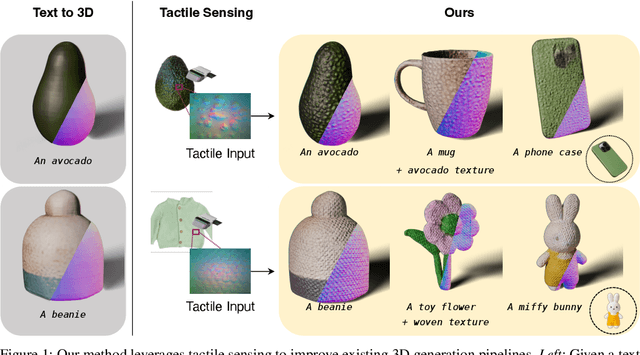
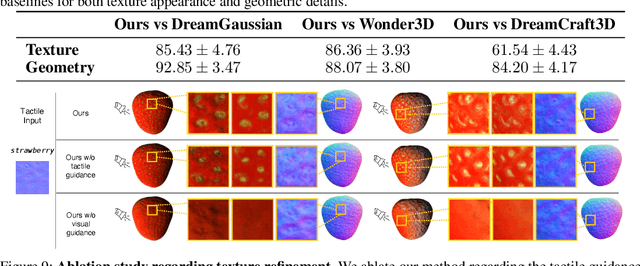
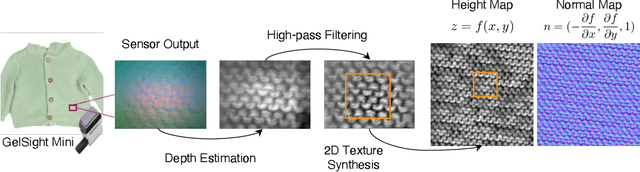
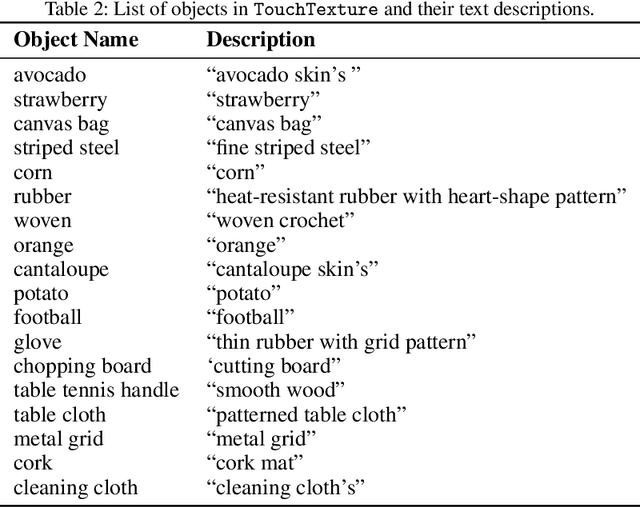
3D generation methods have shown visually compelling results powered by diffusion image priors. However, they often fail to produce realistic geometric details, resulting in overly smooth surfaces or geometric details inaccurately baked in albedo maps. To address this, we introduce a new method that incorporates touch as an additional modality to improve the geometric details of generated 3D assets. We design a lightweight 3D texture field to synthesize visual and tactile textures, guided by 2D diffusion model priors on both visual and tactile domains. We condition the visual texture generation on high-resolution tactile normals and guide the patch-based tactile texture refinement with a customized TextureDreambooth. We further present a multi-part generation pipeline that enables us to synthesize different textures across various regions. To our knowledge, we are the first to leverage high-resolution tactile sensing to enhance geometric details for 3D generation tasks. We evaluate our method in both text-to-3D and image-to-3D settings. Our experiments demonstrate that our method provides customized and realistic fine geometric textures while maintaining accurate alignment between two modalities of vision and touch.
Agent-to-Sim: Learning Interactive Behavior Models from Casual Longitudinal Videos
Oct 21, 2024We present Agent-to-Sim (ATS), a framework for learning interactive behavior models of 3D agents from casual longitudinal video collections. Different from prior works that rely on marker-based tracking and multiview cameras, ATS learns natural behaviors of animal and human agents non-invasively through video observations recorded over a long time-span (e.g., a month) in a single environment. Modeling 3D behavior of an agent requires persistent 3D tracking (e.g., knowing which point corresponds to which) over a long time period. To obtain such data, we develop a coarse-to-fine registration method that tracks the agent and the camera over time through a canonical 3D space, resulting in a complete and persistent spacetime 4D representation. We then train a generative model of agent behaviors using paired data of perception and motion of an agent queried from the 4D reconstruction. ATS enables real-to-sim transfer from video recordings of an agent to an interactive behavior simulator. We demonstrate results on pets (e.g., cat, dog, bunny) and human given monocular RGBD videos captured by a smartphone.
DressRecon: Freeform 4D Human Reconstruction from Monocular Video
Sep 30, 2024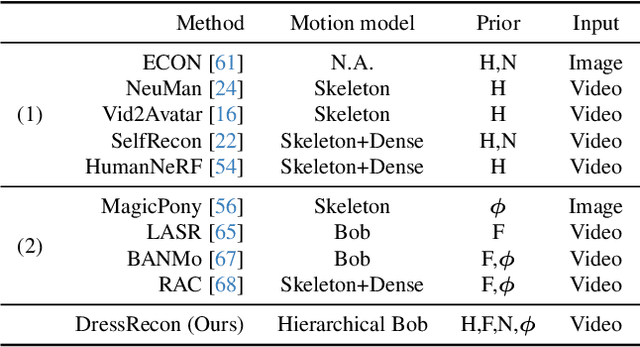
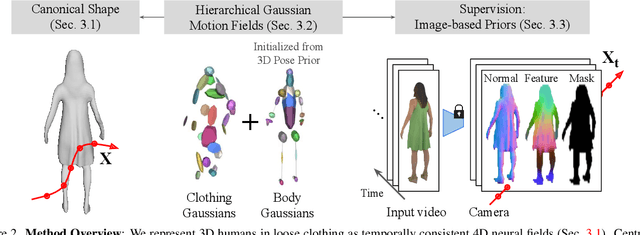
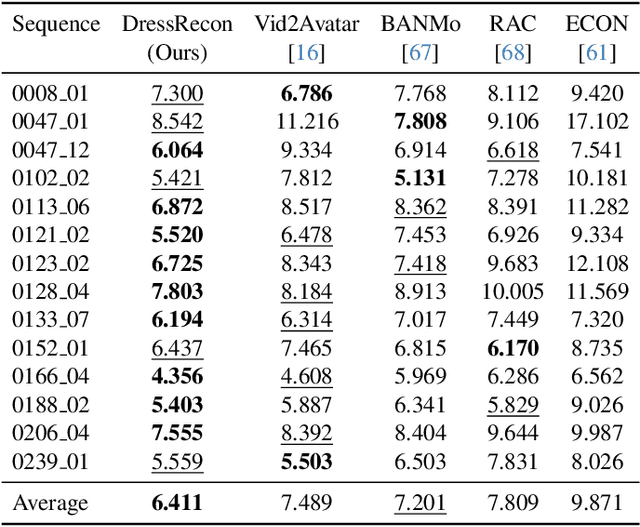

We present a method to reconstruct time-consistent human body models from monocular videos, focusing on extremely loose clothing or handheld object interactions. Prior work in human reconstruction is either limited to tight clothing with no object interactions, or requires calibrated multi-view captures or personalized template scans which are costly to collect at scale. Our key insight for high-quality yet flexible reconstruction is the careful combination of generic human priors about articulated body shape (learned from large-scale training data) with video-specific articulated "bag-of-bones" deformation (fit to a single video via test-time optimization). We accomplish this by learning a neural implicit model that disentangles body versus clothing deformations as separate motion model layers. To capture subtle geometry of clothing, we leverage image-based priors such as human body pose, surface normals, and optical flow during optimization. The resulting neural fields can be extracted into time-consistent meshes, or further optimized as explicit 3D Gaussians for high-fidelity interactive rendering. On datasets with highly challenging clothing deformations and object interactions, DressRecon yields higher-fidelity 3D reconstructions than prior art. Project page: https://jefftan969.github.io/dressrecon/
SplaTAM: Splat, Track & Map 3D Gaussians for Dense RGB-D SLAM
Dec 04, 2023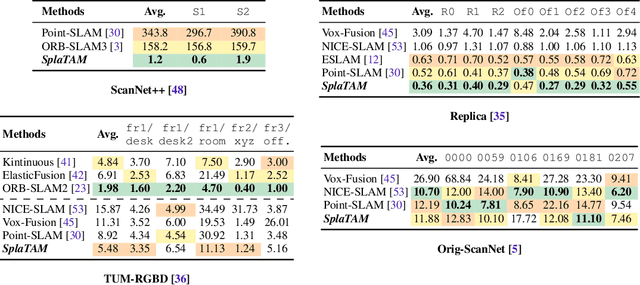
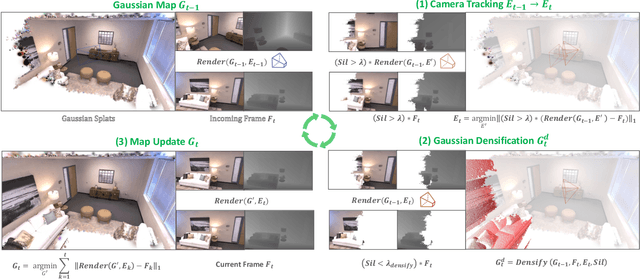
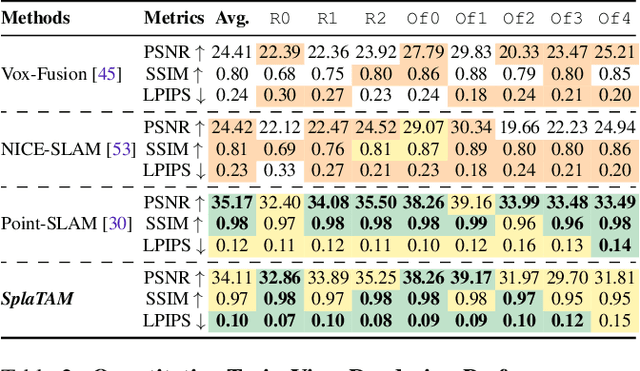
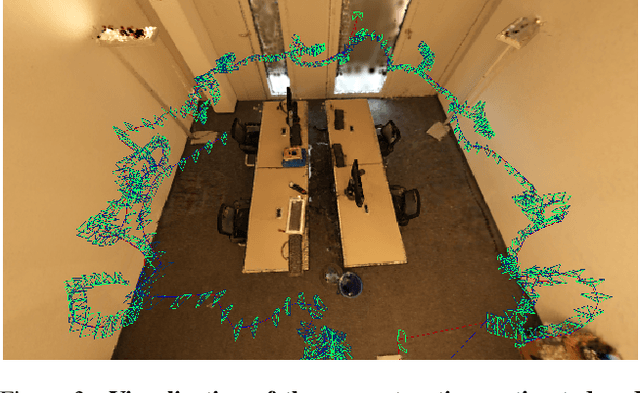
Dense simultaneous localization and mapping (SLAM) is pivotal for embodied scene understanding. Recent work has shown that 3D Gaussians enable high-quality reconstruction and real-time rendering of scenes using multiple posed cameras. In this light, we show for the first time that representing a scene by 3D Gaussians can enable dense SLAM using a single unposed monocular RGB-D camera. Our method, SplaTAM, addresses the limitations of prior radiance field-based representations, including fast rendering and optimization, the ability to determine if areas have been previously mapped, and structured map expansion by adding more Gaussians. We employ an online tracking and mapping pipeline while tailoring it to specifically use an underlying Gaussian representation and silhouette-guided optimization via differentiable rendering. Extensive experiments show that SplaTAM achieves up to 2X state-of-the-art performance in camera pose estimation, map construction, and novel-view synthesis, demonstrating its superiority over existing approaches, while allowing real-time rendering of a high-resolution dense 3D map.
Reconstructing Animatable Categories from Videos
May 10, 2023
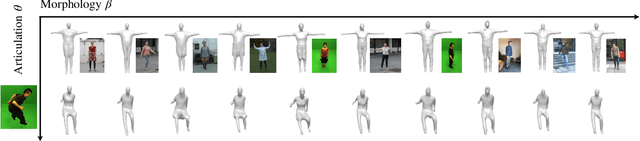


Building animatable 3D models is challenging due to the need for 3D scans, laborious registration, and manual rigging, which are difficult to scale to arbitrary categories. Recently, differentiable rendering provides a pathway to obtain high-quality 3D models from monocular videos, but these are limited to rigid categories or single instances. We present RAC that builds category 3D models from monocular videos while disentangling variations over instances and motion over time. Three key ideas are introduced to solve this problem: (1) specializing a skeleton to instances via optimization, (2) a method for latent space regularization that encourages shared structure across a category while maintaining instance details, and (3) using 3D background models to disentangle objects from the background. We show that 3D models of humans, cats, and dogs can be learned from 50-100 internet videos.
SLoMo: A General System for Legged Robot Motion Imitation from Casual Videos
Apr 27, 2023We present SLoMo: a first-of-its-kind framework for transferring skilled motions from casually captured "in the wild" video footage of humans and animals to legged robots. SLoMo works in three stages: 1) synthesize a physically plausible reconstructed key-point trajectory from monocular videos; 2) optimize a dynamically feasible reference trajectory for the robot offline that includes body and foot motion, as well as contact sequences that closely tracks the key points; 3) track the reference trajectory online using a general-purpose model-predictive controller on robot hardware. Traditional motion imitation for legged motor skills often requires expert animators, collaborative demonstrations, and/or expensive motion capture equipment, all of which limits scalability. Instead, SLoMo only relies on easy-to-obtain monocular video footage, readily available in online repositories such as YouTube. It converts videos into motion primitives that can be executed reliably by real-world robots. We demonstrate our approach by transferring the motions of cats, dogs, and humans to example robots including a quadruped (on hardware) and a humanoid (in simulation). To the best knowledge of the authors, this is the first attempt at a general-purpose motion transfer framework that imitates animal and human motions on legged robots directly from casual videos without artificial markers or labels.
Total-Recon: Deformable Scene Reconstruction for Embodied View Synthesis
Apr 24, 2023We explore the task of embodied view synthesis from monocular videos of deformable scenes. Given a minute-long RGBD video of people interacting with their pets, we render the scene from novel camera trajectories derived from in-scene motion of actors: (1) egocentric cameras that simulate the point of view of a target actor and (2) 3rd-person cameras that follow the actor. Building such a system requires reconstructing the root-body and articulated motion of each actor in the scene, as well as a scene representation that supports free-viewpoint synthesis. Longer videos are more likely to capture the scene from diverse viewpoints (which helps reconstruction) but are also more likely to contain larger motions (which complicates reconstruction). To address these challenges, we present Total-Recon, the first method to photorealistically reconstruct deformable scenes from long monocular RGBD videos. Crucially, to scale to long videos, our method hierarchically decomposes the scene motion into the motion of each object, which itself is decomposed into global root-body motion and local articulations. To quantify such "in-the-wild" reconstruction and view synthesis, we collect ground-truth data from a specialized stereo RGBD capture rig for 11 challenging videos, significantly outperforming prior art. Code, videos, and data can be found at https://andrewsonga.github.io/totalrecon .
3D-aware Conditional Image Synthesis
Feb 16, 2023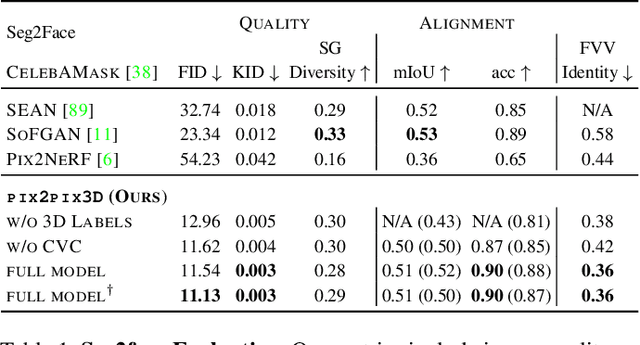

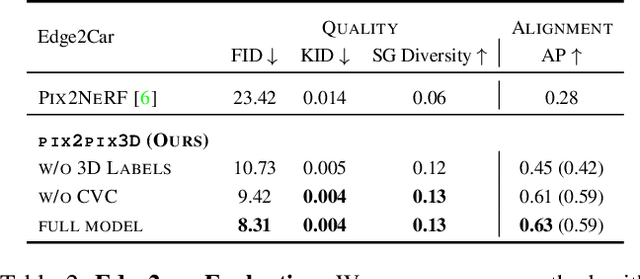
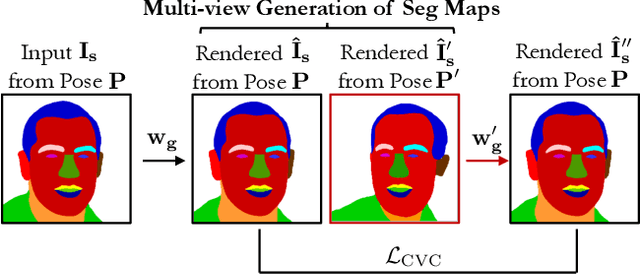
We propose pix2pix3D, a 3D-aware conditional generative model for controllable photorealistic image synthesis. Given a 2D label map, such as a segmentation or edge map, our model learns to synthesize a corresponding image from different viewpoints. To enable explicit 3D user control, we extend conditional generative models with neural radiance fields. Given widely-available monocular images and label map pairs, our model learns to assign a label to every 3D point in addition to color and density, which enables it to render the image and pixel-aligned label map simultaneously. Finally, we build an interactive system that allows users to edit the label map from any viewpoint and generate outputs accordingly.