 Add to Chrome
 Add to Firefox
 Add to Edge
Image Generators are Generalist Vision Learners
Apr 22, 2026
Recent works show that image and video generators exhibit zero-shot visual understanding behaviors, in a way reminiscent of how LLMs develop emergent capabilities of language understanding and reasoning from generative pretraining. While it has long been conjectured that the ability to create visual content implies an ability to understand it, there has been limited evidence that generative vision models have developed strong understanding capabilities. In this work, we demonstrate that image generation training serves a role similar to LLM pretraining, and lets models learn powerful and general visual representations that enable SOTA performance on various vision tasks. We introduce Vision Banana, a generalist model built by instruction-tuning Nano Banana Pro (NBP) on a mixture of its original training data alongside a small amount of vision task data. By parameterizing the output space of vision tasks as RGB images, we seamlessly reframe perception as image generation. Our generalist model, Vision Banana, achieves SOTA results on a variety of vision tasks involving both 2D and 3D understanding, beating or rivaling zero-shot domain-specialists, including Segment Anything Model 3 on segmentation tasks, and the Depth Anything series on metric depth estimation. We show that these results can be achieved with lightweight instruction-tuning without sacrificing the base model's image generation capabilities. The superior results suggest that image generation pretraining is a generalist vision learner. It also shows that image generation serves as a unified and universal interface for vision tasks, similar to text generation's role in language understanding and reasoning. We could be witnessing a major paradigm shift for computer vision, where generative vision pretraining takes a central role in building Foundational Vision Models for both generation and understanding.

Surg$Σ$: A Spectrum of Large-Scale Multimodal Data and Foundation Models for Surgical Intelligence
Mar 17, 2026Surgical intelligence has the potential to improve the safety and consistency of surgical care, yet most existing surgical AI frameworks remain task-specific and struggle to generalize across procedures and institutions. Although multimodal foundation models, particularly multimodal large language models, have demonstrated strong cross-task capabilities across various medical domains, their advancement in surgery remains constrained by the lack of large-scale, systematically curated multimodal data. To address this challenge, we introduce Surg$Σ$, a spectrum of large-scale multimodal data and foundation models for surgical intelligence. At the core of this framework lies Surg$Σ$-DB, a large-scale multimodal data foundation designed to support diverse surgical tasks. Surg$Σ$-DB consolidates heterogeneous surgical data sources (including open-source datasets, curated in-house clinical collections and web-source data) into a unified schema, aiming to improve label consistency and data standardization across heterogeneous datasets. Surg$Σ$-DB spans 6 clinical specialties and diverse surgical types, providing rich image- and video-level annotations across 18 practical surgical tasks covering understanding, reasoning, planning, and generation, at an unprecedented scale (over 5.98M conversations). Beyond conventional multimodal conversations, Surg$Σ$-DB incorporates hierarchical reasoning annotations, providing richer semantic cues to support deeper contextual understanding in complex surgical scenarios. We further provide empirical evidence through recently developed surgical foundation models built upon Surg$Σ$-DB, illustrating the practical benefits of large-scale multimodal annotations, unified semantic design, and structured reasoning annotations for improving cross-task generalization and interpretability.
Surg-R1: A Hierarchical Reasoning Foundation Model for Scalable and Interpretable Surgical Decision Support with Multi-Center Clinical Validation
Mar 12, 2026Surgical scene understanding demands not only accurate predictions but also interpretable reasoning that surgeons can verify against clinical expertise. However, existing surgical vision-language models generate predictions without reasoning chains, and general-purpose reasoning models fail on compositional surgical tasks without domain-specific knowledge. We present Surg-R1, a surgical Vision-Language Model that addresses this gap through hierarchical reasoning trained via a four-stage pipeline. Our approach introduces three key contributions: (1) a three-level reasoning hierarchy decomposing surgical interpretation into perceptual grounding, relational understanding, and contextual reasoning; (2) the largest surgical chain-of-thought dataset with 320,000 reasoning pairs; and (3) a four-stage training pipeline progressing from supervised fine-tuning to group relative policy optimization and iterative self-improvement. Evaluation on SurgBench, comprising six public benchmarks and six multi-center external validation datasets from five institutions, demonstrates that Surg-R1 achieves the highest Arena Score (64.9%) on public benchmarks versus Gemini 3.0 Pro (46.1%) and GPT-5.1 (37.9%), outperforming both proprietary reasoning models and specialized surgical VLMs on the majority of tasks spanning instrument localization, triplet recognition, phase recognition, action recognition, and critical view of safety assessment, with a 15.2 percentage point improvement over the strongest surgical baseline on external validation.
Gemini: A Family of Highly Capable Multimodal Models
Dec 19, 2023This report introduces a new family of multimodal models, Gemini, that exhibit remarkable capabilities across image, audio, video, and text understanding. The Gemini family consists of Ultra, Pro, and Nano sizes, suitable for applications ranging from complex reasoning tasks to on-device memory-constrained use-cases. Evaluation on a broad range of benchmarks shows that our most-capable Gemini Ultra model advances the state of the art in 30 of 32 of these benchmarks - notably being the first model to achieve human-expert performance on the well-studied exam benchmark MMLU, and improving the state of the art in every one of the 20 multimodal benchmarks we examined. We believe that the new capabilities of Gemini models in cross-modal reasoning and language understanding will enable a wide variety of use cases and we discuss our approach toward deploying them responsibly to users.
Interaction-Based Trajectory Prediction Over a Hybrid Traffic Graph
Sep 27, 2020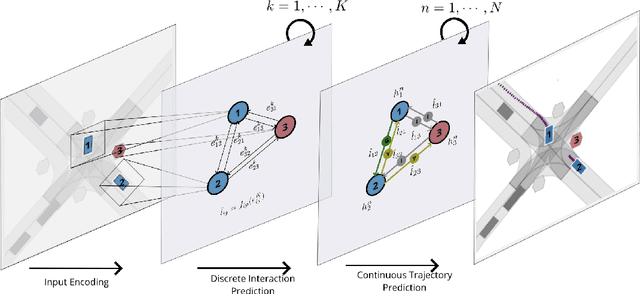
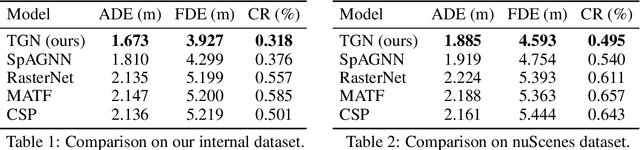
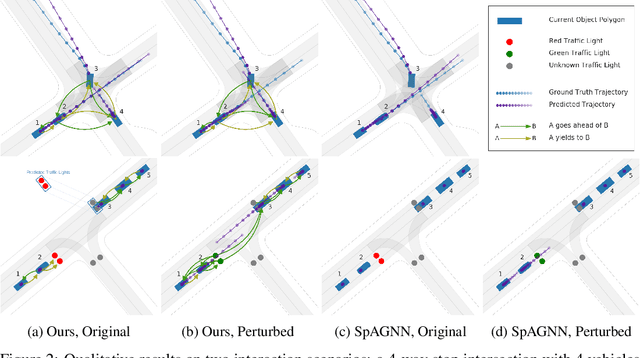
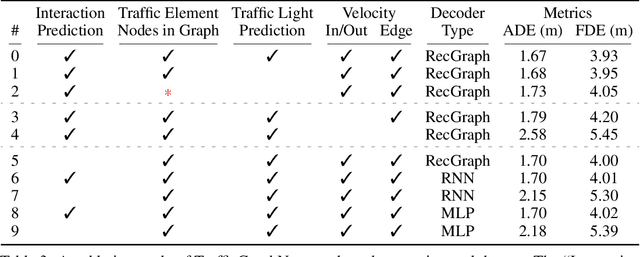
Behavior prediction of traffic actors is an essential component of any real-world self-driving system. Actors' long-term behaviors tend to be governed by their interactions with other actors or traffic elements (traffic lights, stop signs) in the scene. To capture this highly complex structure of interactions, we propose to use a hybrid graph whose nodes represent both the traffic actors as well as the static and dynamic traffic elements present in the scene. The different modes of temporal interaction (e.g., stopping and going) among actors and traffic elements are explicitly modeled by graph edges. This explicit reasoning about discrete interaction types not only helps in predicting future motion, but also enhances the interpretability of the model, which is important for safety-critical applications such as autonomous driving. We predict actors' trajectories and interaction types using a graph neural network, which is trained in a semi-supervised manner. We show that our proposed model, TrafficGraphNet, achieves state-of-the-art trajectory prediction accuracy while maintaining a high level of interpretability.
Joint Interaction and Trajectory Prediction for Autonomous Driving using Graph Neural Networks
Dec 17, 2019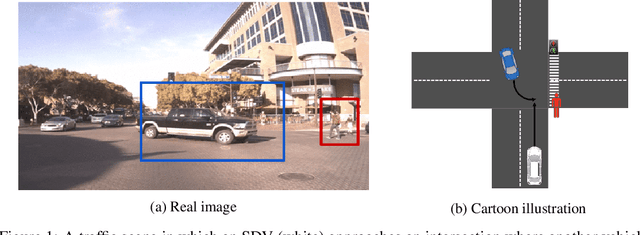
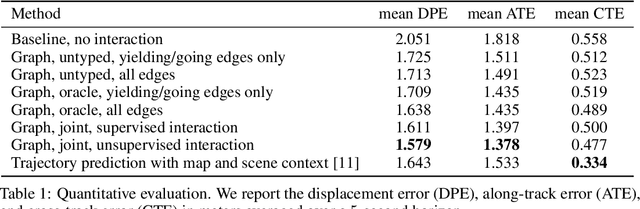
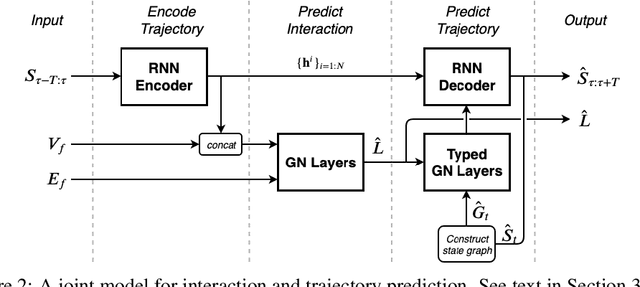
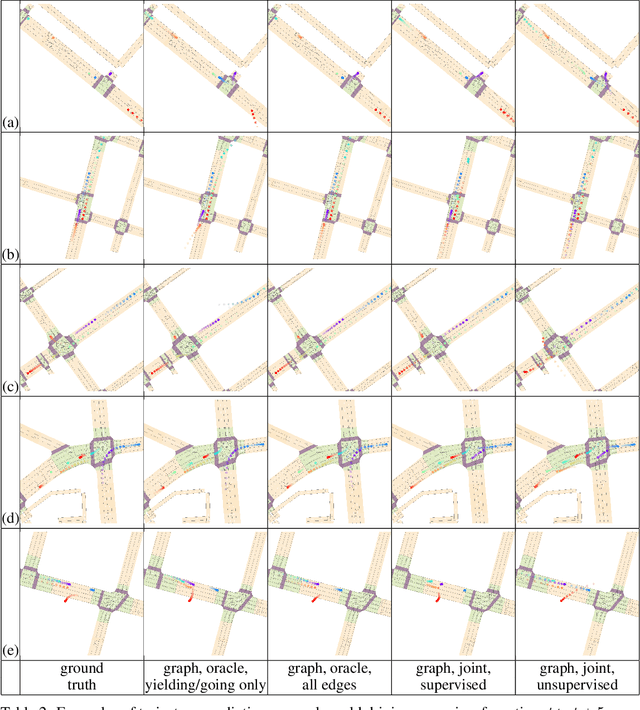
In this work, we aim to predict the future motion of vehicles in a traffic scene by explicitly modeling their pairwise interactions. Specifically, we propose a graph neural network that jointly predicts the discrete interaction modes and 5-second future trajectories for all agents in the scene. Our model infers an interaction graph whose nodes are agents and whose edges capture the long-term interaction intents among the agents. In order to train the model to recognize known modes of interaction, we introduce an auto-labeling function to generate ground truth interaction labels. Using a large-scale real-world driving dataset, we demonstrate that jointly predicting the trajectories along with the explicit interaction types leads to significantly lower trajectory error than baseline methods. Finally, we show through simulation studies that the learned interaction modes are semantically meaningful.