 Add to Chrome
 Add to Firefox
 Add to Edge
PilotTTS: A Disciplined Modular Recipe for Competitive Speech Synthesis
May 27, 2026
Building state-of-the-art text-to-speech (TTS) systems typically demands millions of hours of proprietary data and complex multi-stage architectures, creating substantial barriers for resource-constrained research teams. In this report, we present PilotTTS, a lightweight autoregressive TTS system that achieves competitive performance through minimalist architecture and rigorous data engineering. PilotTTS is trained on only 200K hours of data processed entirely with open-source tools. Specifically, our contributions are: (1) a reproducible multi-stage data processing pipeline covering quality assessment, label annotation, and filtering, and (2) a compact model architecture that employs Q-Former-based conditioning to decouple speaker identity from speaking style via cross-sample paired training. Within a unified framework, PilotTTS supports zero-shot voice cloning, emotion synthesis (11 categories), paralinguistic synthesis (4 categories), and Chinese dialect synthesis (14 dialects). On the Seed-TTS Eval benchmark, PilotTTS achieves the lowest WER of 1.50% on test-en, a CER of 0.87% on test-zh, and the highest speaker similarity on both test sets (0.862 and 0.815), outperforming systems trained on significantly larger datasets. We release the complete data pipeline recipe, pretrained weights, and code at https://github.com/AMAPVOICE/PilotTTS.

GrowLoop: Self-Evolving Conversation Evaluation Seeded by Human
May 26, 2026With the rapid advancement of large language models, evaluating human-likeness in open-ended conversation has become increasingly important. However, human-likeness is a form of tacit knowledge that humans perceive intuitively, yet the underlying criteria resist explicit formulation. Human judgments vary widely, with strong agreement on some cases and legitimate disagreement on others. Meanwhile, the criteria behind human judgments remain implicit, leaving no clear basis for constructing cases. Further, what counts as human-like is not static, but evolving with model capability and human expectations. Despite progress in evaluation methods such as expert-authored benchmarks, Reward Models, and self-evolving benchmarks, none addresses all three challenges simultaneously. Therefore, we propose GrowLoop, a self-evolving conversation evaluation system that continuously adapts as models advance and scenarios shift. With minimal human seed annotations as the first mover, LLM agents iteratively extract and refine evaluation rubrics through Heuristic Learning. Human-AI agreement is required where annotators converge, while only plausibility is expected where they diverge. Moreover, the Rubric-Case co-evolution mechanism enables continuous evolution, expanded through new seeds when the evaluation target moves. Applied to human-likeness evaluation in open-ended conversation, the generated rubrics not only substantially outperform existing methods in alignment with human judgments, but also uncover issues that annotators overlook. The resulting benchmark effectively discriminates models across capability tiers and reveals where they fall short, while generalizing to new scenarios and adapting as models advance. Our work shifts the benchmarking paradigm from manual updates or difficulty scaling to comprehensive, continuous self-evolution.
EchoMind: An Interrelated Multi-level Benchmark for Evaluating Empathetic Speech Language Models
Oct 26, 2025Speech Language Models (SLMs) have made significant progress in spoken language understanding. Yet it remains unclear whether they can fully perceive non lexical vocal cues alongside spoken words, and respond with empathy that aligns with both emotional and contextual factors. Existing benchmarks typically evaluate linguistic, acoustic, reasoning, or dialogue abilities in isolation, overlooking the integration of these skills that is crucial for human-like, emotionally intelligent conversation. We present EchoMind, the first interrelated, multi-level benchmark that simulates the cognitive process of empathetic dialogue through sequential, context-linked tasks: spoken-content understanding, vocal-cue perception, integrated reasoning, and response generation. All tasks share identical and semantically neutral scripts that are free of explicit emotional or contextual cues, and controlled variations in vocal style are used to test the effect of delivery independent of the transcript. EchoMind is grounded in an empathy-oriented framework spanning 3 coarse and 12 fine-grained dimensions, encompassing 39 vocal attributes, and evaluated using both objective and subjective metrics. Testing 12 advanced SLMs reveals that even state-of-the-art models struggle with high-expressive vocal cues, limiting empathetic response quality. Analyses of prompt strength, speech source, and ideal vocal cue recognition reveal persistent weaknesses in instruction-following, resilience to natural speech variability, and effective use of vocal cues for empathy. These results underscore the need for SLMs that integrate linguistic content with diverse vocal cues to achieve truly empathetic conversational ability.
TKN: Transformer-based Keypoint Prediction Network For Real-time Video Prediction
Mar 20, 2023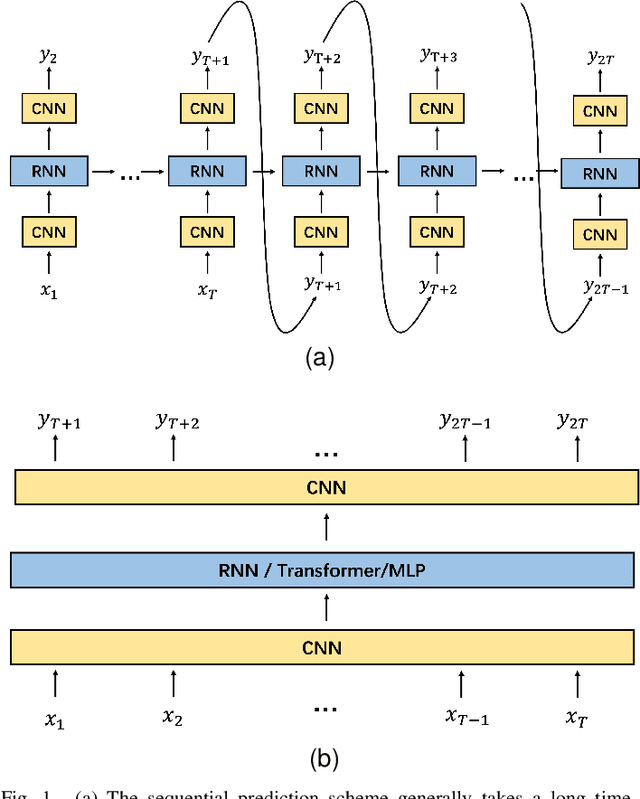
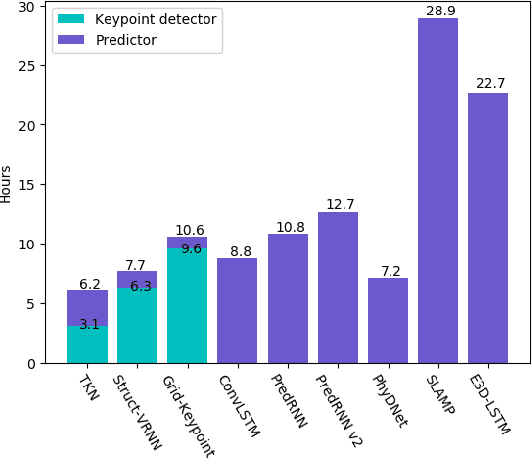
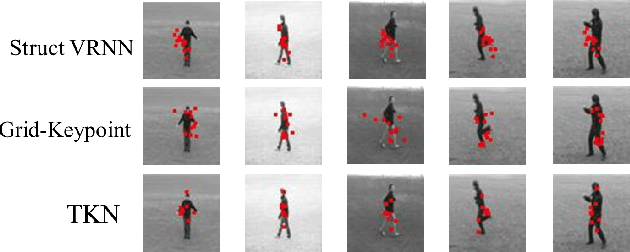
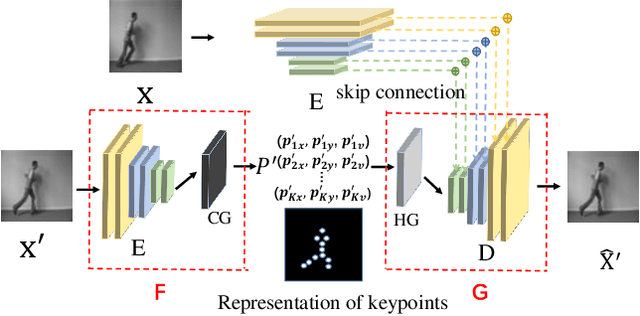
Video prediction is a complex time-series forecasting task with great potential in many use cases. However, conventional methods overemphasize accuracy while ignoring the slow prediction speed caused by complicated model structures that learn too much redundant information with excessive GPU memory consumption. Furthermore, conventional methods mostly predict frames sequentially (frame-by-frame) and thus are hard to accelerate. Consequently, valuable use cases such as real-time danger prediction and warning cannot achieve fast enough inference speed to be applicable in reality. Therefore, we propose a transformer-based keypoint prediction neural network (TKN), an unsupervised learning method that boost the prediction process via constrained information extraction and parallel prediction scheme. TKN is the first real-time video prediction solution to our best knowledge, while significantly reducing computation costs and maintaining other performance. Extensive experiments on KTH and Human3.6 datasets demonstrate that TKN predicts 11 times faster than existing methods while reducing memory consumption by 17.4% and achieving state-of-the-art prediction performance on average.
Mitigating Backdoors in Federated Learning with FLD
Mar 01, 2023
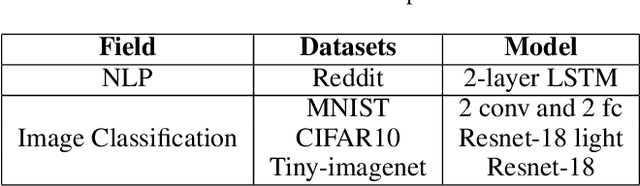
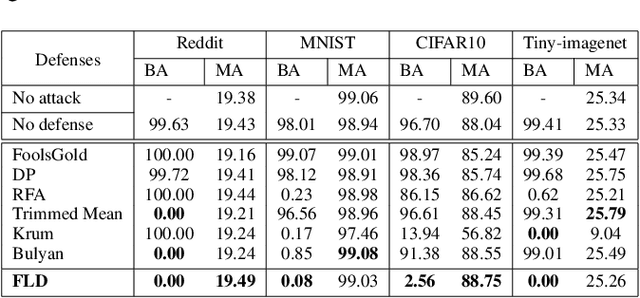
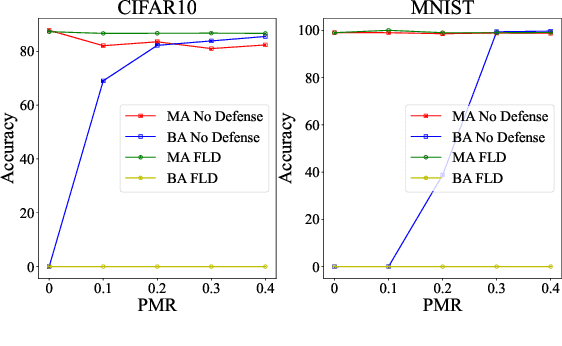
Federated learning allows clients to collaboratively train a global model without uploading raw data for privacy preservation. This feature, i.e., the inability to review participants' datasets, has recently been found responsible for federated learning's vulnerability in the face of backdoor attacks. Existing defense methods fall short from two perspectives: 1) they consider only very specific and limited attacker models and unable to cope with advanced backdoor attacks, such as distributed backdoor attacks, which break down the global trigger into multiple distributed triggers. 2) they conduct detection based on model granularity thus the performance gets impacted by the model dimension. To address these challenges, we propose Federated Layer Detection (FLD), a novel model filtering approach for effectively defending against backdoor attacks. FLD examines the models based on layer granularity to capture the complete model details and effectively detect potential backdoor models regardless of model dimension. We provide theoretical analysis and proof for the convergence of FLD. Extensive experiments demonstrate that FLD effectively mitigates state-of-the-art backdoor attacks with negligible impact on the accuracy of the primary task.