 Add to Chrome
 Add to Firefox
 Add to Edge
Every Packet Counts: Dispersing Information for Loss-Resilient Learned Image Compression
Aug 11, 2026
Learned image compression (LIC) has achieved impressive rate-distortion performance. However, existing methods remain highly vulnerable to packet loss, a common challenge in satellite and emergency communications. This vulnerability stems from non-uniform information distribution at the packetization stage and sequential decoding dependencies at the entropy coding stage. We propose an end-to-end loss-resilient image compression scheme that addresses both. Before packetization, we introduce an Inter-Channel Redistribution (ICR) mechanism to redistribute channel energy, preventing critical information concentrating in a small subset of channels. Then, an Interleaved Channel Grouping (ICG) strategy partitions latent channels in a strided manner to disperse information across packets, with each packet kept within constrained sizes. To limit cascading errors from lost packets, we adopt a two-layer dual-branch autoregressive structure to shorten the dependency chain. Extensive experiments demonstrate that our method consistently outperforms existing approaches in both reconstruction quality and stability. At 20% packet loss, it achieves an average PSNR gain of 1.84 dB over LossResilientLIC while reducing PSNR variance by an order of magnitude. Notably, trained under uniform random loss only, our model generalizes to bursty loss modeled by the Gilbert-Elliott channel, outperforming methods explicitly trained for such conditions.

Next-Frame Decoding for Ultra-Low-Bitrate Image Compression with Video Diffusion Priors
Mar 16, 2026We present a novel paradigm for ultra-low-bitrate image compression (ULB-IC) that exploits the ``temporal'' evolution in generative image compression. Specifically, we define an explicit intermediate state during decoding: a compact anchor frame, which preserves the scene geometry and semantic layout while discarding high-frequency details. We then reinterpret generative decoding as a virtual temporal transition from this anchor to the final reconstructed image.To model this progression, we leverage a pretrained video diffusion model (VDM) as temporal priors: the anchor frame serves as the initial frame and the original image as the target frame, transforming the decoding process into a next-frame prediction task.In contrast to image diffusion-based ULB-IC models, our decoding proceeds from a visible, semantically faithful anchor, which improves both fidelity and realism for perceptual image compression. Extensive experiments demonstrate that our method achieves superior objective and subjective performance. On the CLIC2020 test set, our method achieves over \textbf{50\% bitrate savings} across LPIPS, DISTS, FID, and KID compared to DiffC, while also delivering a significant decoding speedup of up to $\times$5. Code will be released later.
Free-GVC: Towards Training-Free Extreme Generative Video Compression with Temporal Coherence
Feb 10, 2026Building on recent advances in video generation, generative video compression has emerged as a new paradigm for achieving visually pleasing reconstructions. However, existing methods exhibit limited exploitation of temporal correlations, causing noticeable flicker and degraded temporal coherence at ultra-low bitrates. In this paper, we propose Free-GVC, a training-free generative video compression framework that reformulates video coding as latent trajectory compression guided by a video diffusion prior. Our method operates at the group-of-pictures (GOP) level, encoding video segments into a compact latent space and progressively compressing them along the diffusion trajectory. To ensure perceptually consistent reconstruction across GOPs, we introduce an Adaptive Quality Control module that dynamically constructs an online rate-perception surrogate model to predict the optimal diffusion step for each GOP. In addition, an Inter-GOP Alignment module establishes frame overlap and performs latent fusion between adjacent groups, thereby mitigating flicker and enhancing temporal coherence. Experiments show that Free-GVC achieves an average of 93.29% BD-Rate reduction in DISTS over the latest neural codec DCVC-RT, and a user study further confirms its superior perceptual quality and temporal coherence at ultra-low bitrates.
Dual-Representation Image Compression at Ultra-Low Bitrates via Explicit Semantics and Implicit Textures
Feb 05, 2026While recent neural codecs achieve strong performance at low bitrates when optimized for perceptual quality, their effectiveness deteriorates significantly under ultra-low bitrate conditions. To mitigate this, generative compression methods leveraging semantic priors from pretrained models have emerged as a promising paradigm. However, existing approaches are fundamentally constrained by a tradeoff between semantic faithfulness and perceptual realism. Methods based on explicit representations preserve content structure but often lack fine-grained textures, whereas implicit methods can synthesize visually plausible details at the cost of semantic drift. In this work, we propose a unified framework that bridges this gap by coherently integrating explicit and implicit representations in a training-free manner. Specifically, We condition a diffusion model on explicit high-level semantics while employing reverse-channel coding to implicitly convey fine-grained details. Moreover, we introduce a plug-in encoder that enables flexible control of the distortion-perception tradeoff by modulating the implicit information. Extensive experiments demonstrate that the proposed framework achieves state-of-the-art rate-perception performance, outperforming existing methods and surpassing DiffC by 29.92%, 19.33%, and 20.89% in DISTS BD-Rate on the Kodak, DIV2K, and CLIC2020 datasets, respectively.
Large Language Model for Lossless Image Compression with Visual Prompts
Feb 22, 2025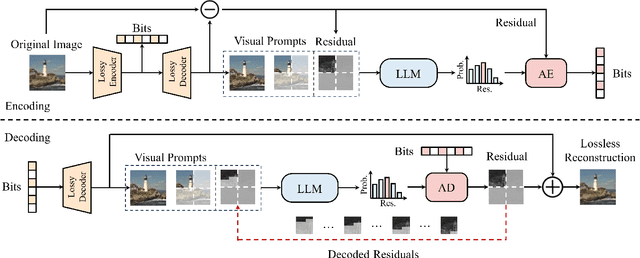
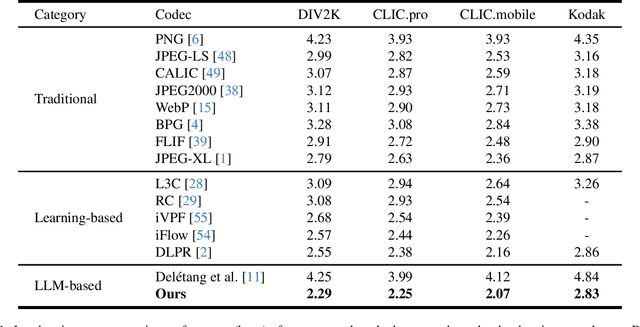
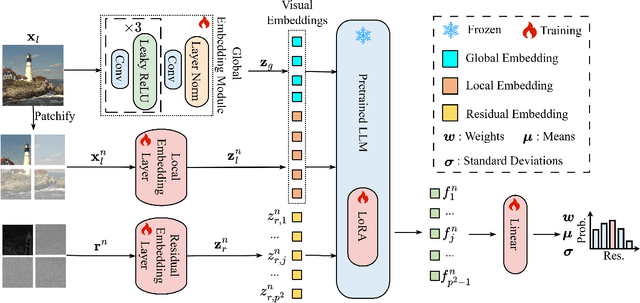
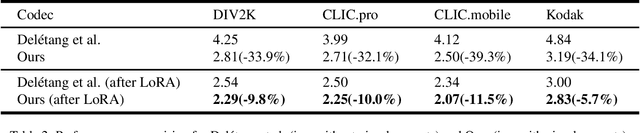
Recent advancements in deep learning have driven significant progress in lossless image compression. With the emergence of Large Language Models (LLMs), preliminary attempts have been made to leverage the extensive prior knowledge embedded in these pretrained models to enhance lossless image compression, particularly by improving the entropy model. However, a significant challenge remains in bridging the gap between the textual prior knowledge within LLMs and lossless image compression. To tackle this challenge and unlock the potential of LLMs, this paper introduces a novel paradigm for lossless image compression that incorporates LLMs with visual prompts. Specifically, we first generate a lossy reconstruction of the input image as visual prompts, from which we extract features to serve as visual embeddings for the LLM. The residual between the original image and the lossy reconstruction is then fed into the LLM along with these visual embeddings, enabling the LLM to function as an entropy model to predict the probability distribution of the residual. Extensive experiments on multiple benchmark datasets demonstrate our method achieves state-of-the-art compression performance, surpassing both traditional and learning-based lossless image codecs. Furthermore, our approach can be easily extended to images from other domains, such as medical and screen content images, achieving impressive performance. These results highlight the potential of LLMs for lossless image compression and may inspire further research in related directions.
Controllable Distortion-Perception Tradeoff Through Latent Diffusion for Neural Image Compression
Dec 16, 2024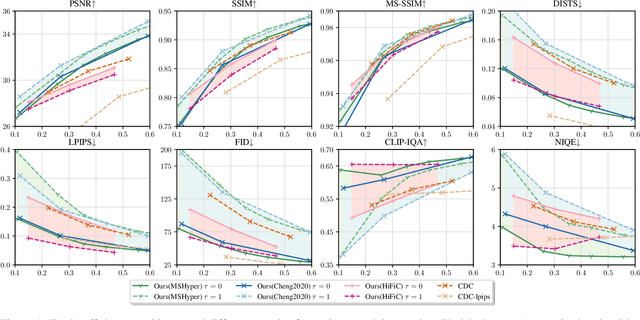
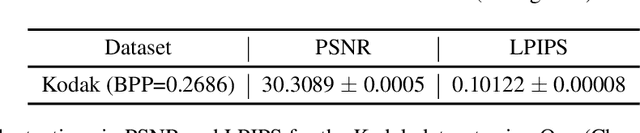
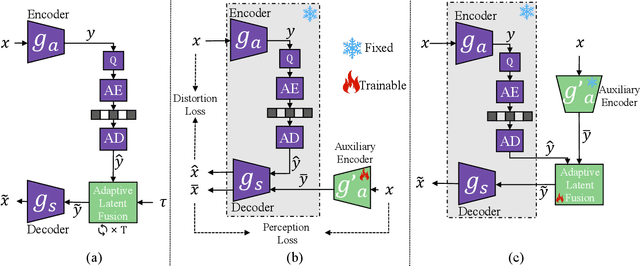
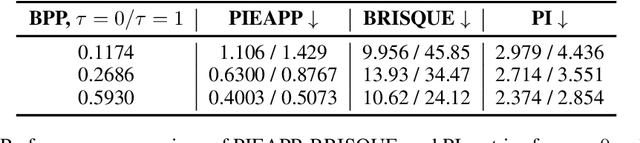
Neural image compression often faces a challenging trade-off among rate, distortion and perception. While most existing methods typically focus on either achieving high pixel-level fidelity or optimizing for perceptual metrics, we propose a novel approach that simultaneously addresses both aspects for a fixed neural image codec. Specifically, we introduce a plug-and-play module at the decoder side that leverages a latent diffusion process to transform the decoded features, enhancing either low distortion or high perceptual quality without altering the original image compression codec. Our approach facilitates fusion of original and transformed features without additional training, enabling users to flexibly adjust the balance between distortion and perception during inference. Extensive experimental results demonstrate that our method significantly enhances the pretrained codecs with a wide, adjustable distortion-perception range while maintaining their original compression capabilities. For instance, we can achieve more than 150% improvement in LPIPS-BDRate without sacrificing more than 1 dB in PSNR.