 Add to Chrome
 Add to Firefox
 Add to Edge
COCA: Classifier-Oriented Calibration for Source-Free Universal Domain Adaptation via Textual Prototype
Aug 21, 2023
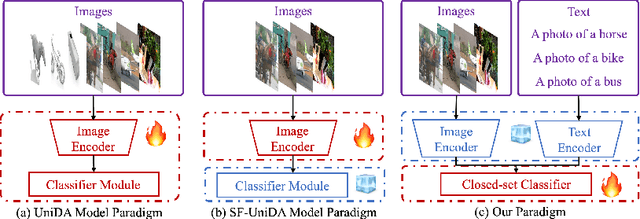
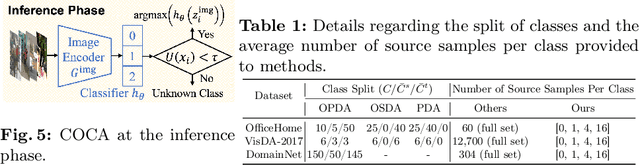
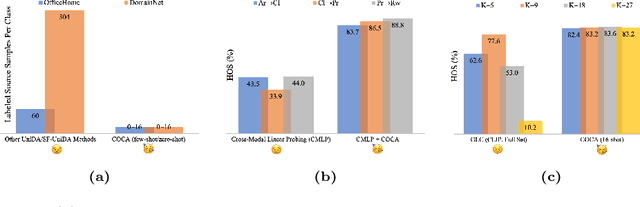
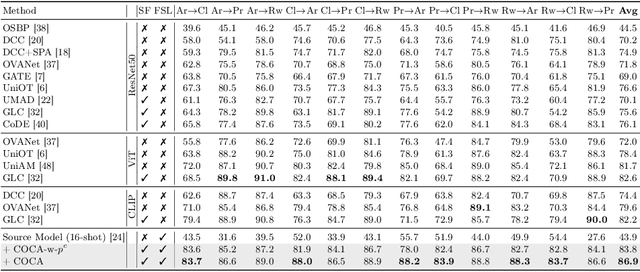
Universal Domain Adaptation (UniDA) aims to distinguish common and private classes between the source and target domains where domain shift exists. Recently, due to more stringent data restrictions, researchers have introduced Source-Free UniDA (SF-UniDA) in more realistic scenarios. SF-UniDA methods eliminate the need for direct access to source samples when performing adaptation to the target domain. However, existing SF-UniDA methods still require an extensive quantity of labeled source samples to train a source model, resulting in significant labeling costs. To tackle this issue, we present a novel Classifier-Oriented Calibration (COCA) method. This method, which leverages textual prototypes, is formulated for the source model based on few-shot learning. Specifically, we propose studying few-shot learning, usually explored for closed-set scenarios, to identify common and domain-private classes despite a significant domain shift between source and target domains. Essentially, we present a novel paradigm based on the vision-language model to learn SF-UniDA and hugely reduce the labeling costs on the source domain. Experimental results demonstrate that our approach outperforms state-of-the-art UniDA and SF-UniDA models.

Boosting Multi-modal Model Performance with Adaptive Gradient Modulation
Aug 15, 2023
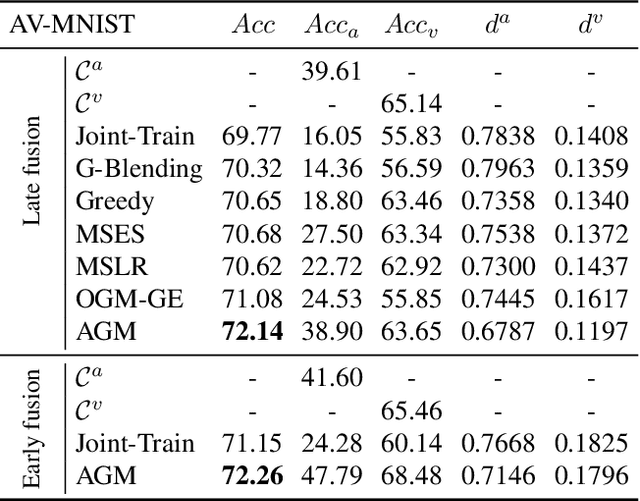
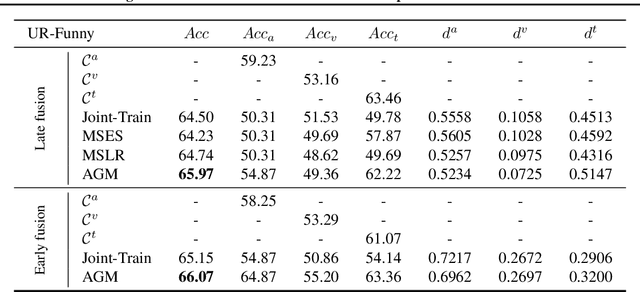
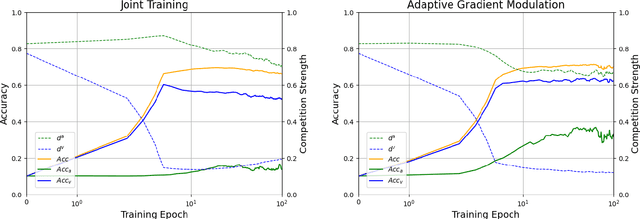
While the field of multi-modal learning keeps growing fast, the deficiency of the standard joint training paradigm has become clear through recent studies. They attribute the sub-optimal performance of the jointly trained model to the modality competition phenomenon. Existing works attempt to improve the jointly trained model by modulating the training process. Despite their effectiveness, those methods can only apply to late fusion models. More importantly, the mechanism of the modality competition remains unexplored. In this paper, we first propose an adaptive gradient modulation method that can boost the performance of multi-modal models with various fusion strategies. Extensive experiments show that our method surpasses all existing modulation methods. Furthermore, to have a quantitative understanding of the modality competition and the mechanism behind the effectiveness of our modulation method, we introduce a novel metric to measure the competition strength. This metric is built on the mono-modal concept, a function that is designed to represent the competition-less state of a modality. Through systematic investigation, our results confirm the intuition that the modulation encourages the model to rely on the more informative modality. In addition, we find that the jointly trained model typically has a preferred modality on which the competition is weaker than other modalities. However, this preferred modality need not dominate others. Our code will be available at https://github.com/lihong2303/AGM_ICCV2023.
Spatio-Temporal Calibration for Omni-Directional Vehicle-Mounted Event Cameras
Jul 19, 2023We present a solution to the problem of spatio-temporal calibration for event cameras mounted on an onmi-directional vehicle. Different from traditional methods that typically determine the camera's pose with respect to the vehicle's body frame using alignment of trajectories, our approach leverages the kinematic correlation of two sets of linear velocity estimates from event data and wheel odometers, respectively. The overall calibration task consists of estimating the underlying temporal offset between the two heterogeneous sensors, and furthermore, recovering the extrinsic rotation that defines the linear relationship between the two sets of velocity estimates. The first sub-problem is formulated as an optimization one, which looks for the optimal temporal offset that maximizes a correlation measurement invariant to arbitrary linear transformation. Once the temporal offset is compensated, the extrinsic rotation can be worked out with an iterative closed-form solver that incrementally registers associated linear velocity estimates. The proposed algorithm is proved effective on both synthetic data and real data, outperforming traditional methods based on alignment of trajectories.
A Fast Maximum $k$-Plex Algorithm Parameterized by the Degeneracy Gap
Jun 23, 2023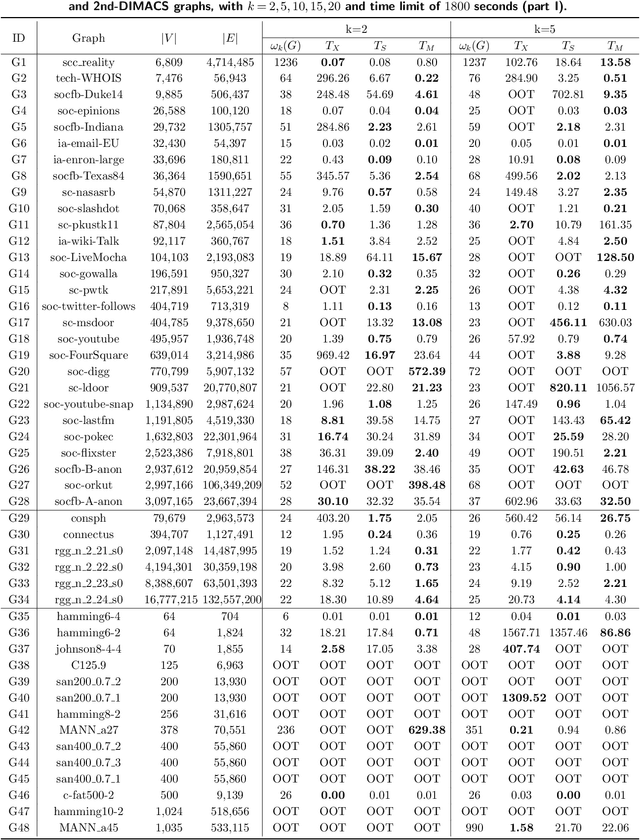
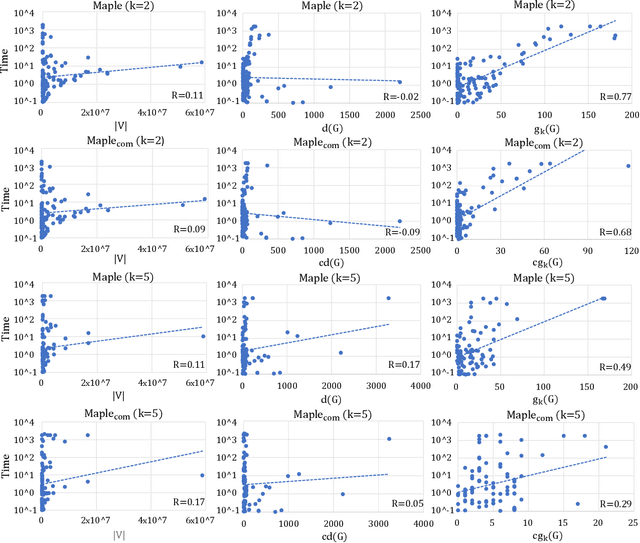
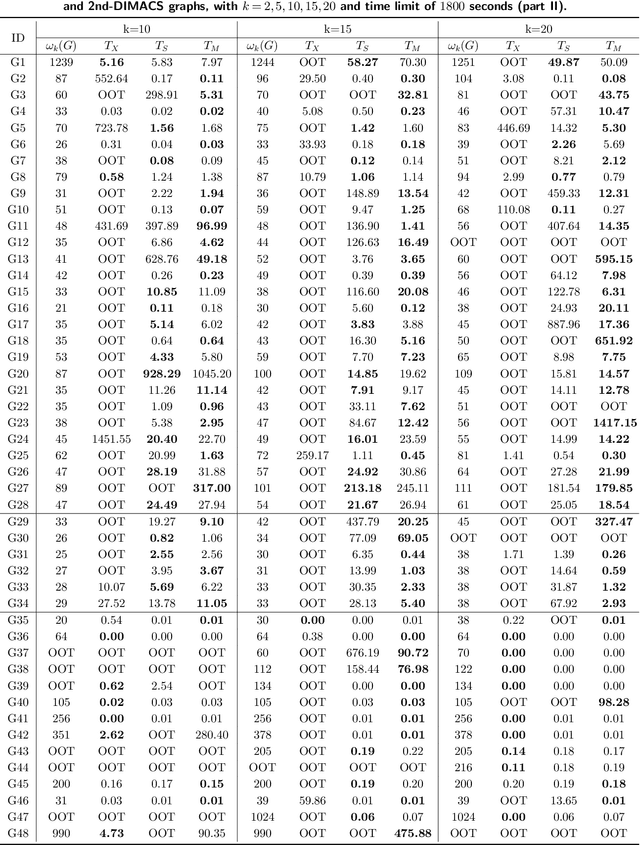
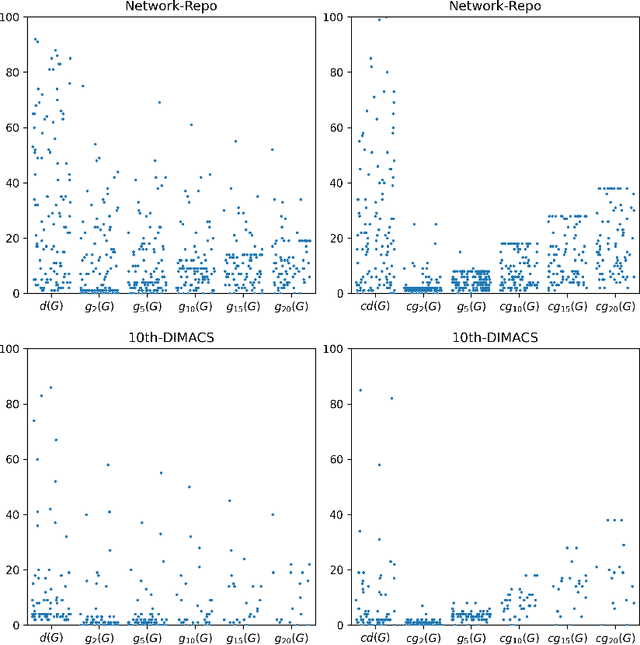
Given a graph, the $k$-plex is a vertex set in which each vertex is not adjacent to at most $k-1$ other vertices in the set. The maximum $k$-plex problem, which asks for the largest $k$-plex from a given graph, is an important but computationally challenging problem in applications like graph search and community detection. So far, there is a number of empirical algorithms without sufficient theoretical explanations on the efficiency. We try to bridge this gap by defining a novel parameter of the input instance, $g_k(G)$, the gap between the degeneracy bound and the size of maximum $k$-plex in the given graph, and presenting an exact algorithm parameterized by $g_k(G)$. In other words, we design an algorithm with running time polynomial in the size of input graph and exponential in $g_k(G)$ where $k$ is a constant. Usually, $g_k(G)$ is small and bounded by $O(\log{(|V|)})$ in real-world graphs, indicating that the algorithm runs in polynomial time. We also carry out massive experiments and show that the algorithm is competitive with the state-of-the-art solvers. Additionally, for large $k$ values such as $15$ and $20$, our algorithm has superior performance over existing algorithms.
Multi-Loss Convolutional Network with Time-Frequency Attention for Speech Enhancement
Jun 15, 2023
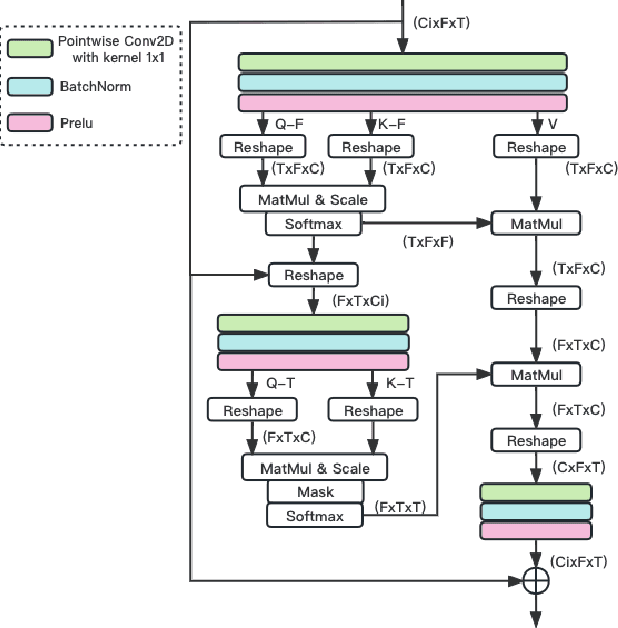
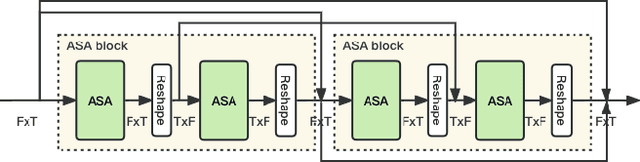
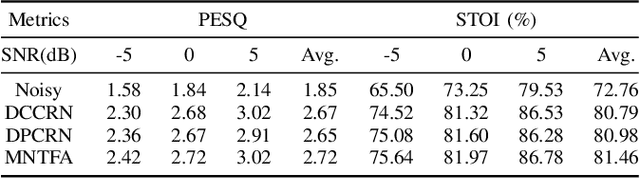
The Dual-Path Convolution Recurrent Network (DPCRN) was proposed to effectively exploit time-frequency domain information. By combining the DPRNN module with Convolution Recurrent Network (CRN), the DPCRN obtained a promising performance in speech separation with a limited model size. In this paper, we explore self-attention in the DPCRN module and design a model called Multi-Loss Convolutional Network with Time-Frequency Attention(MNTFA) for speech enhancement. We use self-attention modules to exploit the long-time information, where the intra-chunk self-attentions are used to model the spectrum pattern and the inter-chunk self-attention are used to model the dependence between consecutive frames. Compared to DPRNN, axial self-attention greatly reduces the need for memory and computation, which is more suitable for long sequences of speech signals. In addition, we propose a joint training method of a multi-resolution STFT loss and a WavLM loss using a pre-trained WavLM network. Experiments show that with only 0.23M parameters, the proposed model achieves a better performance than DPCRN.
Together We Make Sense -- Learning Meta-Sense Embeddings from Pretrained Static Sense Embeddings
May 30, 2023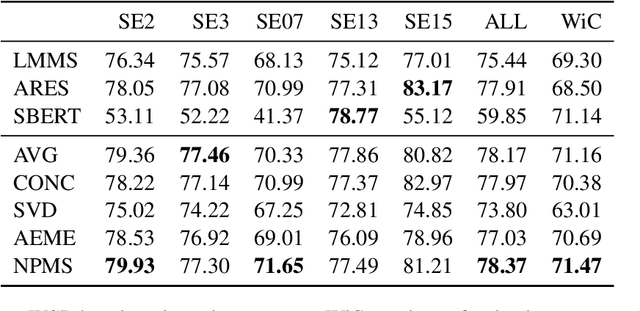
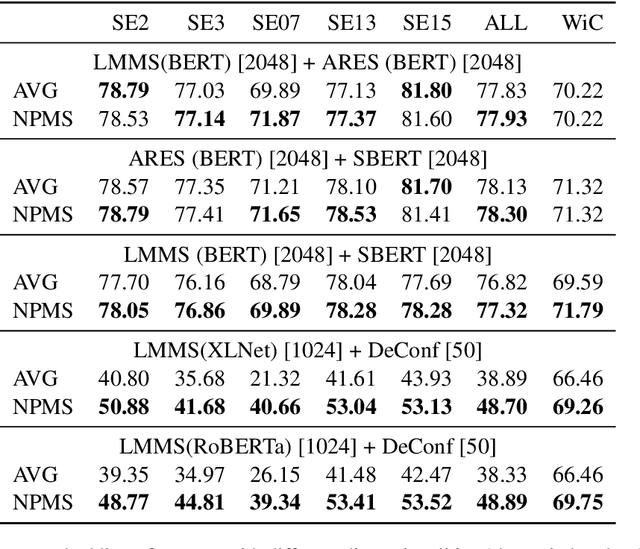
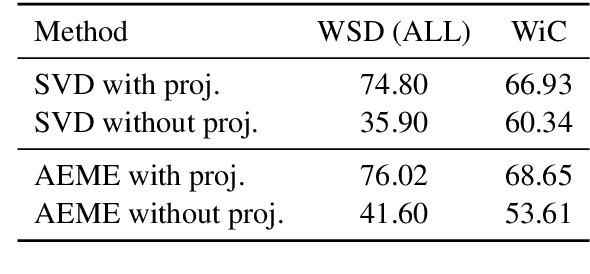
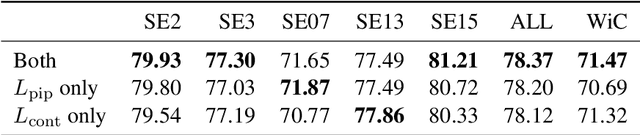
Sense embedding learning methods learn multiple vectors for a given ambiguous word, corresponding to its different word senses. For this purpose, different methods have been proposed in prior work on sense embedding learning that use different sense inventories, sense-tagged corpora and learning methods. However, not all existing sense embeddings cover all senses of ambiguous words equally well due to the discrepancies in their training resources. To address this problem, we propose the first-ever meta-sense embedding method -- Neighbour Preserving Meta-Sense Embeddings, which learns meta-sense embeddings by combining multiple independently trained source sense embeddings such that the sense neighbourhoods computed from the source embeddings are preserved in the meta-embedding space. Our proposed method can combine source sense embeddings that cover different sets of word senses. Experimental results on Word Sense Disambiguation (WSD) and Word-in-Context (WiC) tasks show that the proposed meta-sense embedding method consistently outperforms several competitive baselines.
An Efficient Multilingual Language Model Compression through Vocabulary Trimming
May 24, 2023Multilingual language model (LM) have become a powerful tool in NLP especially for non-English languages. Nevertheless, model parameters of multilingual LMs remain large due to the larger embedding matrix of the vocabulary covering tokens in different languages. On the contrary, monolingual LMs can be trained in a target language with the language-specific vocabulary only, but this requires a large budget and availability of reliable corpora to achieve a high-quality LM from scratch. In this paper, we propose vocabulary-trimming (VT), a method to reduce a multilingual LM vocabulary to a target language by deleting irrelevant tokens from its vocabulary. In theory, VT can compress any existing multilingual LM to build monolingual LMs in any language covered by the multilingual LM. In our experiments, we show that VT can retain the original performance of the multilingual LM, while being smaller in size (in general around 50% of the original vocabulary size is enough) than the original multilingual LM. The evaluation is performed over four NLP tasks (two generative and two classification tasks) among four widely used multilingual LMs in seven languages. Finally, we show that this methodology can keep the best of both monolingual and multilingual worlds by keeping a small size as monolingual models without the need for specifically retraining them, and even limiting potentially harmful social biases.
Solving Cosine Similarity Underestimation between High Frequency Words by L2 Norm Discounting
May 17, 2023Cosine similarity between two words, computed using their contextualised token embeddings obtained from masked language models (MLMs) such as BERT has shown to underestimate the actual similarity between those words (Zhou et al., 2022). This similarity underestimation problem is particularly severe for highly frequent words. Although this problem has been noted in prior work, no solution has been proposed thus far. We observe that the L2 norm of contextualised embeddings of a word correlates with its log-frequency in the pretraining corpus. Consequently, the larger L2 norms associated with the highly frequent words reduce the cosine similarity values measured between them, thus underestimating the similarity scores. To solve this issue, we propose a method to discount the L2 norm of a contextualised word embedding by the frequency of that word in a corpus when measuring the cosine similarities between words. We show that the so called stop words behave differently from the rest of the words, which require special consideration during their discounting process. Experimental results on a contextualised word similarity dataset show that our proposed discounting method accurately solves the similarity underestimation problem.
Accented Text-to-Speech Synthesis with Limited Data
May 08, 2023
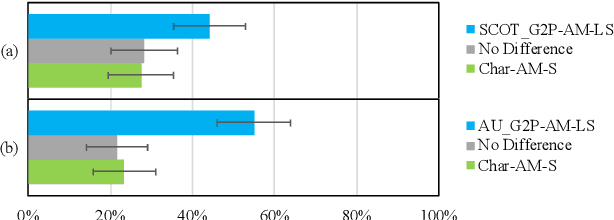
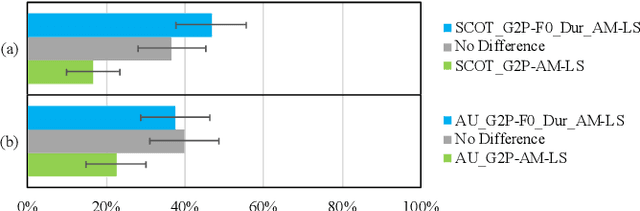
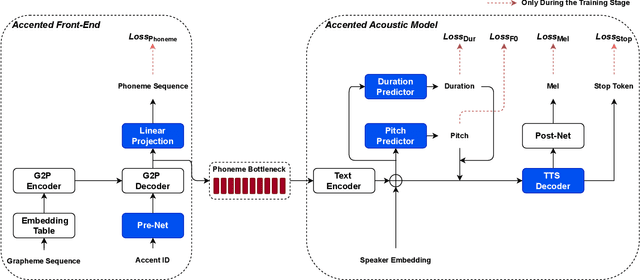
This paper presents an accented text-to-speech (TTS) synthesis framework with limited training data. We study two aspects concerning accent rendering: phonetic (phoneme difference) and prosodic (pitch pattern and phoneme duration) variations. The proposed accented TTS framework consists of two models: an accented front-end for grapheme-to-phoneme (G2P) conversion and an accented acoustic model with integrated pitch and duration predictors for phoneme-to-Mel-spectrogram prediction. The accented front-end directly models the phonetic variation, while the accented acoustic model explicitly controls the prosodic variation. Specifically, both models are first pre-trained on a large amount of data, then only the accent-related layers are fine-tuned on a limited amount of data for the target accent. In the experiments, speech data of three English accents, i.e., General American English, Irish English, and British English Received Pronunciation, are used for pre-training. The pre-trained models are then fine-tuned with Scottish and General Australian English accents, respectively. Both objective and subjective evaluation results show that the accented TTS front-end fine-tuned with a small accented phonetic lexicon (5k words) effectively handles the phonetic variation of accents, while the accented TTS acoustic model fine-tuned with a limited amount of accented speech data (approximately 3 minutes) effectively improves the prosodic rendering including pitch and duration. The overall accent modeling contributes to improved speech quality and accent similarity.
Dual Residual Attention Network for Image Denoising
May 07, 2023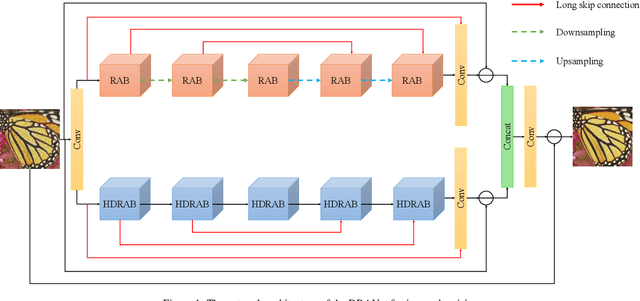
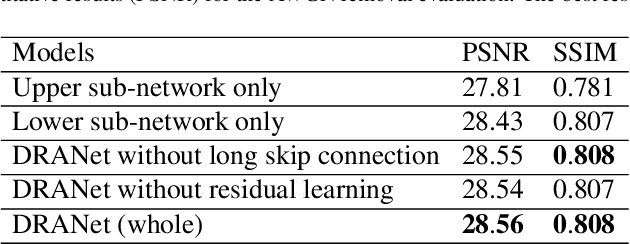

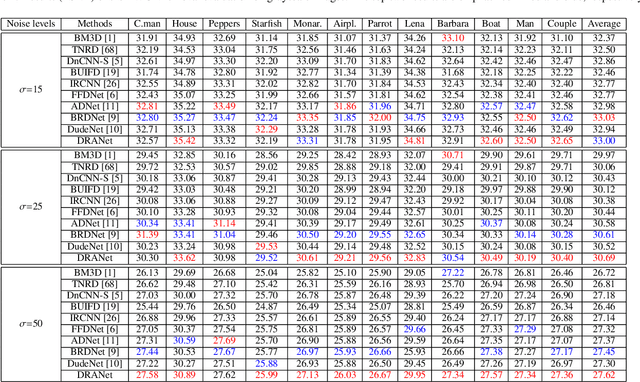
In image denoising, deep convolutional neural networks (CNNs) can obtain favorable performance on removing spatially invariant noise. However, many of these networks cannot perform well on removing the real noise (i.e. spatially variant noise) generated during image acquisition or transmission, which severely sets back their application in practical image denoising tasks. Instead of continuously increasing the network depth, many researchers have revealed that expanding the width of networks can also be a useful way to improve model performance. It also has been verified that feature filtering can promote the learning ability of the models. Therefore, in this paper, we propose a novel Dual-branch Residual Attention Network (DRANet) for image denoising, which has both the merits of a wide model architecture and attention-guided feature learning. The proposed DRANet includes two different parallel branches, which can capture complementary features to enhance the learning ability of the model. We designed a new residual attention block (RAB) and a novel hybrid dilated residual attention block (HDRAB) for the upper and the lower branches, respectively. The RAB and HDRAB can capture rich local features through multiple skip connections between different convolutional layers, and the unimportant features are dropped by the residual attention modules. Meanwhile, the long skip connections in each branch, and the global feature fusion between the two parallel branches can capture the global features as well. Moreover, the proposed DRANet uses downsampling operations and dilated convolutions to increase the size of the receptive field, which can enable DRANet to capture more image context information. Extensive experiments demonstrate that compared with other state-of-the-art denoising methods, our DRANet can produce competitive denoising performance both on synthetic and real-world noise removal.