 Add to Chrome
 Add to Firefox
 Add to Edge
TimeSage-EV: A Live Benchmark for Agentic Time Series Analysis in Evolving Environments
Aug 14, 2026
Time series analysis in high-stakes domains relies on recurring data releases, where new observations can alter the evidence base and the validity of later conclusions. Existing time series QA benchmarks mostly rely on fixed snapshots, leaving temporal validity and cutoff-aware evidence use unevaluated. We introduce TimeSage-EV, a live benchmark for agentic time series analysis in evolving environments. It tracks 60 real institutional scenarios across 6 domains, comprising 1,485 scenario-period QA pairs from Feb 2023 to May 2026 and spanning monthly, weekly, daily, and irregular release cadences. At each period, large language model (LLM) agents receive time series data and source reports, while the withheld target release provides ground truth. TimeSage-EV evaluates state identification, data summarization, and outlook reasoning. Experiments with frontier LLM agents and TimeSage-1.0, a novel self-evolving agent with a reusable analytical skill library, reveal significant performance gaps across model tiers and recurring failures in temporal validity, exogenous context use, and adaptation. We release TimeSage-EV as a research resource with monthly updates, code, a leaderboard, and failure-mode analyses.

TimeSage-MT: A Multi-Turn Benchmark for Evaluating Agentic Time Series Reasoning
May 31, 2026Time series data inform critical decisions across many real-world domains. While large language model (LLM) agents can analyze data through natural language and tools, it remains unclear whether they can conduct reliable time series analysis across multi-turn conversations. Existing benchmarks focus on single-step tasks such as forecasting and anomaly detection, overlooking practical workflows where user goals evolve, agents must build on prior analyses, and conclusions emerge from accumulated evidence. In this work, we introduce TimeSage-MT, a multi-turn benchmark for agentic time series reasoning with 240 tasks and 2,680 dialogue turns across 8 real-world domains, spanning basic exploration to decision-oriented analysis. TimeSage-MT is built through a reproducible pipeline that converts real-world time series data into multi-turn conversations with verifiable answers. It provides a unified evaluation protocol and public leaderboard for comparing time series agentic systems. To demonstrate the benchmark's utility, we evaluate frontier LLMs alongside TimeSage, a novel structured agent equipped with a comprehensive time series skill library. The results show sharp performance drops on decision-oriented tasks, driven by failures in memory, uncertainty handling, and domain-based decision making. TimeSage-MT exposes critical gaps in current agentic reasoning and provides a rigorous foundation for future development.
Evaluating LLMs in Finance Requires Explicit Bias Consideration
Feb 15, 2026Large Language Models (LLMs) are increasingly integrated into financial workflows, but evaluation practice has not kept up. Finance-specific biases can inflate performance, contaminate backtests, and make reported results useless for any deployment claim. We identify five recurring biases in financial LLM applications. They include look-ahead bias, survivorship bias, narrative bias, objective bias, and cost bias. These biases break financial tasks in distinct ways and they often compound to create an illusion of validity. We reviewed 164 papers from 2023 to 2025 and found that no single bias is discussed in more than 28 percent of studies. This position paper argues that bias in financial LLM systems requires explicit attention and that structural validity should be enforced before any result is used to support a deployment claim. We propose a Structural Validity Framework and an evaluation checklist with minimal requirements for bias diagnosis and future system design. The material is available at https://github.com/Eleanorkong/Awesome-Financial-LLM-Bias-Mitigation.
Fusing Narrative Semantics for Financial Volatility Forecasting
Oct 23, 2025We introduce M2VN: Multi-Modal Volatility Network, a novel deep learning-based framework for financial volatility forecasting that unifies time series features with unstructured news data. M2VN leverages the representational power of deep neural networks to address two key challenges in this domain: (i) aligning and fusing heterogeneous data modalities, numerical financial data and textual information, and (ii) mitigating look-ahead bias that can undermine the validity of financial models. To achieve this, M2VN combines open-source market features with news embeddings generated by Time Machine GPT, a recently introduced point-in-time LLM, ensuring temporal integrity. An auxiliary alignment loss is introduced to enhance the integration of structured and unstructured data within the deep learning architecture. Extensive experiments demonstrate that M2VN consistently outperforms existing baselines, underscoring its practical value for risk management and financial decision-making in dynamic markets.
Position: Empowering Time Series Reasoning with Multimodal LLMs
Feb 03, 2025


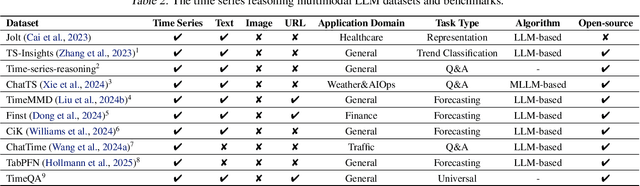
Understanding time series data is crucial for multiple real-world applications. While large language models (LLMs) show promise in time series tasks, current approaches often rely on numerical data alone, overlooking the multimodal nature of time-dependent information, such as textual descriptions, visual data, and audio signals. Moreover, these methods underutilize LLMs' reasoning capabilities, limiting the analysis to surface-level interpretations instead of deeper temporal and multimodal reasoning. In this position paper, we argue that multimodal LLMs (MLLMs) can enable more powerful and flexible reasoning for time series analysis, enhancing decision-making and real-world applications. We call on researchers and practitioners to leverage this potential by developing strategies that prioritize trust, interpretability, and robust reasoning in MLLMs. Lastly, we highlight key research directions, including novel reasoning paradigms, architectural innovations, and domain-specific applications, to advance time series reasoning with MLLMs.
Decision-informed Neural Networks with Large Language Model Integration for Portfolio Optimization
Feb 02, 2025This paper addresses the critical disconnect between prediction and decision quality in portfolio optimization by integrating Large Language Models (LLMs) with decision-focused learning. We demonstrate both theoretically and empirically that minimizing the prediction error alone leads to suboptimal portfolio decisions. We aim to exploit the representational power of LLMs for investment decisions. An attention mechanism processes asset relationships, temporal dependencies, and macro variables, which are then directly integrated into a portfolio optimization layer. This enables the model to capture complex market dynamics and align predictions with the decision objectives. Extensive experiments on S\&P100 and DOW30 datasets show that our model consistently outperforms state-of-the-art deep learning models. In addition, gradient-based analyses show that our model prioritizes the assets most crucial to decision making, thus mitigating the effects of prediction errors on portfolio performance. These findings underscore the value of integrating decision objectives into predictions for more robust and context-aware portfolio management.
Unlocking the Power of LSTM for Long Term Time Series Forecasting
Aug 19, 2024


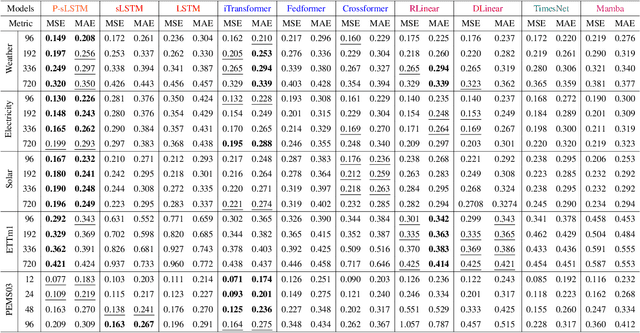
Traditional recurrent neural network architectures, such as long short-term memory neural networks (LSTM), have historically held a prominent role in time series forecasting (TSF) tasks. While the recently introduced sLSTM for Natural Language Processing (NLP) introduces exponential gating and memory mixing that are beneficial for long term sequential learning, its potential short memory issue is a barrier to applying sLSTM directly in TSF. To address this, we propose a simple yet efficient algorithm named P-sLSTM, which is built upon sLSTM by incorporating patching and channel independence. These modifications substantially enhance sLSTM's performance in TSF, achieving state-of-the-art results. Furthermore, we provide theoretical justifications for our design, and conduct extensive comparative and analytical experiments to fully validate the efficiency and superior performance of our model.