 Add to Chrome
 Add to Firefox
 Add to Edge
TimeSage-MT: A Multi-Turn Benchmark for Evaluating Agentic Time Series Reasoning
May 31, 2026
Time series data inform critical decisions across many real-world domains. While large language model (LLM) agents can analyze data through natural language and tools, it remains unclear whether they can conduct reliable time series analysis across multi-turn conversations. Existing benchmarks focus on single-step tasks such as forecasting and anomaly detection, overlooking practical workflows where user goals evolve, agents must build on prior analyses, and conclusions emerge from accumulated evidence. In this work, we introduce TimeSage-MT, a multi-turn benchmark for agentic time series reasoning with 240 tasks and 2,680 dialogue turns across 8 real-world domains, spanning basic exploration to decision-oriented analysis. TimeSage-MT is built through a reproducible pipeline that converts real-world time series data into multi-turn conversations with verifiable answers. It provides a unified evaluation protocol and public leaderboard for comparing time series agentic systems. To demonstrate the benchmark's utility, we evaluate frontier LLMs alongside TimeSage, a novel structured agent equipped with a comprehensive time series skill library. The results show sharp performance drops on decision-oriented tasks, driven by failures in memory, uncertainty handling, and domain-based decision making. TimeSage-MT exposes critical gaps in current agentic reasoning and provides a rigorous foundation for future development.

DeRegiME: Deep Regime Mixtures for Probabilistic Forecasting under Distribution Shift
May 19, 2026We introduce DeRegiME -- Deep Regime Mixture of Experts -- a direct multi-horizon probabilistic forecaster that separates latent uncertainty regimes from the underlying signal and softly assigns each forecast location to learned recurring regimes using a sparse variational Gaussian process (GP) whose nonstationary regime-mixing kernel and Student-t likelihood combine per-regime sub-kernels and noise processes via a shared gate. This yields a single sparse-GP posterior, not a mixture of GP experts. DeRegiME addresses a key limitation of neural forecasters: point forecasts discard residual uncertainty, and probabilistic heads -- whether single marginals, uninterpreted mixtures, quantile sets, or diffusion samples -- rarely expose the regime structure of the residual. Yet distribution shift in noisy heteroskedastic time series may be abrupt, gradual, or horizon-dependent and often appears in residual uncertainty rather than the conditional mean. DeRegiME yields an interpretable mean-residual-noise decomposition with a direct-sum feature-space representation that anchors regimes as clusters of residual similarity whose transitions surface as implicit changepoints. The effective number of regimes is pruned by the stick-breaking gate. We prove kernel validity and predictive-density propriety, and across ten benchmarks and three encoder grids DeRegiME improves negative log predictive density (NLPD) by 20.3% over the strongest encoder-matched baseline, a DeepAR/GluonTS-style dynamic Student-t head, with parallel gains on CRPS (3.0%) and MSE (4.7%). Improvements are consistent across all datasets, which span abrupt, gradual, and seasonal shifts.
Deep Learning for Financial Time Series: A Large-Scale Benchmark of Risk-Adjusted Performance
Mar 02, 2026We present a large scale benchmark of modern deep learning architectures for a financial time series prediction and position sizing task, with a primary focus on Sharpe ratio optimization. Evaluating linear models, recurrent networks, transformer based architectures, state space models, and recent sequence representation approaches, we assess out of sample performance on a daily futures dataset spanning commodities, equity indices, bonds, and FX spanning 2010 to 2025. Our evaluation goes beyond average returns and includes statistical significance, downside and tail risk measures, breakeven transaction cost analysis, robustness to random seed selection, and computational efficiency. We find that models explicitly designed to learn rich temporal representations consistently outperform linear benchmarks and generic deep learning models, which often lead the ranking in standard time series benchmarks. Hybrid models such as VSN with LSTM, a combination of Variable Selection Networks (VSN) and LSTMs, achieves the highest overall Sharpe ratio, while VSN with xLSTM and LSTM with PatchTST exhibit superior downside adjusted characteristics. xLSTM demonstrates the largest breakeven transaction cost buffer, indicating improved robustness to trading frictions.
Toward Expert Investment Teams:A Multi-Agent LLM System with Fine-Grained Trading Tasks
Feb 26, 2026The advancement of large language models (LLMs) has accelerated the development of autonomous financial trading systems. While mainstream approaches deploy multi-agent systems mimicking analyst and manager roles, they often rely on abstract instructions that overlook the intricacies of real-world workflows, which can lead to degraded inference performance and less transparent decision-making. Therefore, we propose a multi-agent LLM trading framework that explicitly decomposes investment analysis into fine-grained tasks, rather than providing coarse-grained instructions. We evaluate the proposed framework using Japanese stock data, including prices, financial statements, news, and macro information, under a leakage-controlled backtesting setting. Experimental results show that fine-grained task decomposition significantly improves risk-adjusted returns compared to conventional coarse-grained designs. Crucially, further analysis of intermediate agent outputs suggests that alignment between analytical outputs and downstream decision preferences is a critical driver of system performance. Moreover, we conduct standard portfolio optimization, exploiting low correlation with the stock index and the variance of each system's output. This approach achieves superior performance. These findings contribute to the design of agent structure and task configuration when applying LLM agents to trading systems in practical settings.
Evaluating LLMs in Finance Requires Explicit Bias Consideration
Feb 15, 2026Large Language Models (LLMs) are increasingly integrated into financial workflows, but evaluation practice has not kept up. Finance-specific biases can inflate performance, contaminate backtests, and make reported results useless for any deployment claim. We identify five recurring biases in financial LLM applications. They include look-ahead bias, survivorship bias, narrative bias, objective bias, and cost bias. These biases break financial tasks in distinct ways and they often compound to create an illusion of validity. We reviewed 164 papers from 2023 to 2025 and found that no single bias is discussed in more than 28 percent of studies. This position paper argues that bias in financial LLM systems requires explicit attention and that structural validity should be enforced before any result is used to support a deployment claim. We propose a Structural Validity Framework and an evaluation checklist with minimal requirements for bias diagnosis and future system design. The material is available at https://github.com/Eleanorkong/Awesome-Financial-LLM-Bias-Mitigation.
DeePM: Regime-Robust Deep Learning for Systematic Macro Portfolio Management
Jan 09, 2026We propose DeePM (Deep Portfolio Manager), a structured deep-learning macro portfolio manager trained end-to-end to maximize a robust, risk-adjusted utility. DeePM addresses three fundamental challenges in financial learning: (1) it resolves the asynchronous "ragged filtration" problem via a Directed Delay (Causal Sieve) mechanism that prioritizes causal impulse-response learning over information freshness; (2) it combats low signal-to-noise ratios via a Macroeconomic Graph Prior, regularizing cross-asset dependence according to economic first principles; and (3) it optimizes a distributionally robust objective where a smooth worst-window penalty serves as a differentiable proxy for Entropic Value-at-Risk (EVaR) - a window-robust utility encouraging strong performance in the most adverse historical subperiods. In large-scale backtests from 2010-2025 on 50 diversified futures with highly realistic transaction costs, DeePM attains net risk-adjusted returns that are roughly twice those of classical trend-following strategies and passive benchmarks, solely using daily closing prices. Furthermore, DeePM improves upon the state-of-the-art Momentum Transformer architecture by roughly fifty percent. The model demonstrates structural resilience across the 2010s "CTA (Commodity Trading Advisor) Winter" and the post-2020 volatility regime shift, maintaining consistent performance through the pandemic, inflation shocks, and the subsequent higher-for-longer environment. Ablation studies confirm that strictly lagged cross-sectional attention, graph prior, principled treatment of transaction costs, and robust minimax optimization are the primary drivers of this generalization capability.
Fusing Narrative Semantics for Financial Volatility Forecasting
Oct 23, 2025We introduce M2VN: Multi-Modal Volatility Network, a novel deep learning-based framework for financial volatility forecasting that unifies time series features with unstructured news data. M2VN leverages the representational power of deep neural networks to address two key challenges in this domain: (i) aligning and fusing heterogeneous data modalities, numerical financial data and textual information, and (ii) mitigating look-ahead bias that can undermine the validity of financial models. To achieve this, M2VN combines open-source market features with news embeddings generated by Time Machine GPT, a recently introduced point-in-time LLM, ensuring temporal integrity. An auxiliary alignment loss is introduced to enhance the integration of structured and unstructured data within the deep learning architecture. Extensive experiments demonstrate that M2VN consistently outperforms existing baselines, underscoring its practical value for risk management and financial decision-making in dynamic markets.
Stories that (are) Move(d by) Markets: A Causal Exploration of Market Shocks and Semantic Shifts across Different Partisan Groups
Feb 20, 2025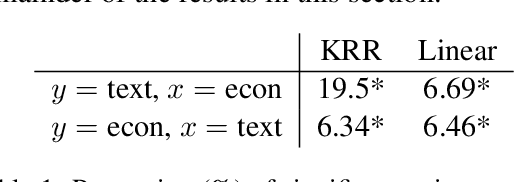
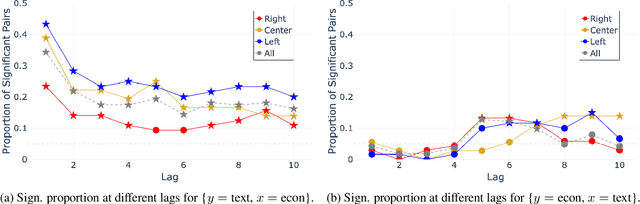
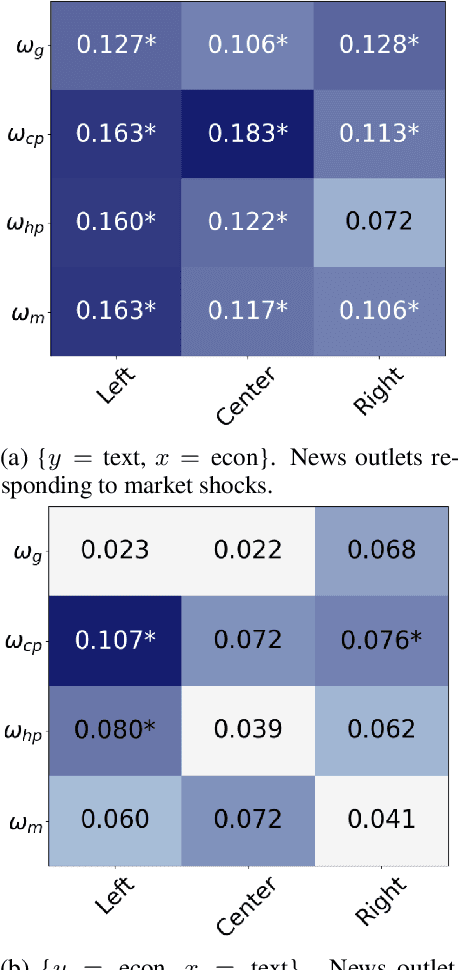
Macroeconomic fluctuations and the narratives that shape them form a mutually reinforcing cycle: public discourse can spur behavioural changes leading to economic shifts, which then result in changes in the stories that propagate. We show that shifts in semantic embedding space can be causally linked to financial market shocks -- deviations from the expected market behaviour. Furthermore, we show how partisanship can influence the predictive power of text for market fluctuations and shape reactions to those same shocks. We also provide some evidence that text-based signals are particularly salient during unexpected events such as COVID-19, highlighting the value of language data as an exogenous variable in economic forecasting. Our findings underscore the bidirectional relationship between news outlets and market shocks, offering a novel empirical approach to studying their effect on each other.
LOB-Bench: Benchmarking Generative AI for Finance - an Application to Limit Order Book Data
Feb 13, 2025While financial data presents one of the most challenging and interesting sequence modelling tasks due to high noise, heavy tails, and strategic interactions, progress in this area has been hindered by the lack of consensus on quantitative evaluation paradigms. To address this, we present LOB-Bench, a benchmark, implemented in python, designed to evaluate the quality and realism of generative message-by-order data for limit order books (LOB) in the LOBSTER format. Our framework measures distributional differences in conditional and unconditional statistics between generated and real LOB data, supporting flexible multivariate statistical evaluation. The benchmark also includes features commonly used LOB statistics such as spread, order book volumes, order imbalance, and message inter-arrival times, along with scores from a trained discriminator network. Lastly, LOB-Bench contains "market impact metrics", i.e. the cross-correlations and price response functions for specific events in the data. We benchmark generative autoregressive state-space models, a (C)GAN, as well as a parametric LOB model and find that the autoregressive GenAI approach beats traditional model classes.
When Dimensionality Hurts: The Role of LLM Embedding Compression for Noisy Regression Tasks
Feb 04, 2025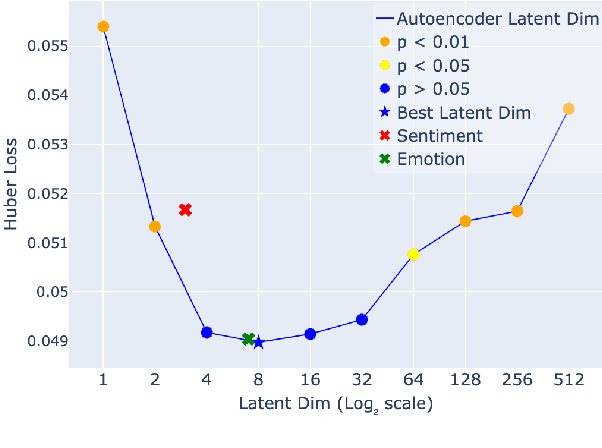
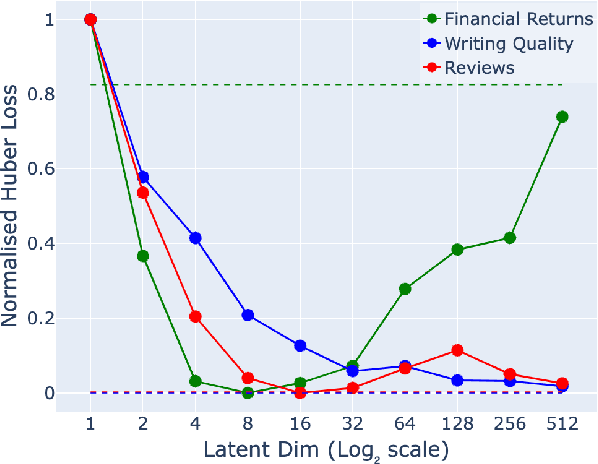
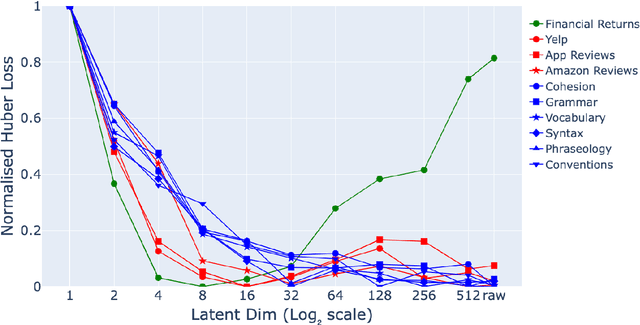
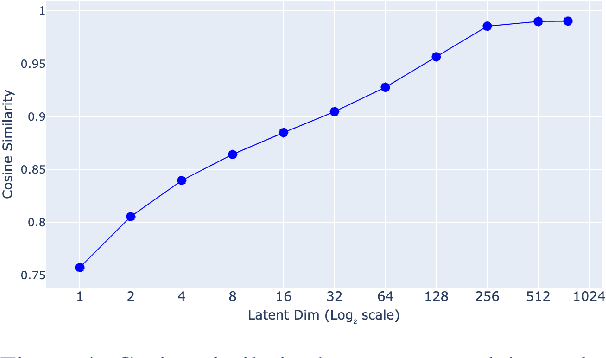
Large language models (LLMs) have shown remarkable success in language modelling due to scaling laws found in model size and the hidden dimension of the model's text representation. Yet, we demonstrate that compressed representations of text can yield better performance in LLM-based regression tasks. In this paper, we compare the relative performance of embedding compression in three different signal-to-noise contexts: financial return prediction, writing quality assessment and review scoring. Our results show that compressing embeddings, in a minimally supervised manner using an autoencoder's hidden representation, can mitigate overfitting and improve performance on noisy tasks, such as financial return prediction; but that compression reduces performance on tasks that have high causal dependencies between the input and target data. Our results suggest that the success of interpretable compressed representations such as sentiment may be due to a regularising effect.