 Add to Chrome
 Add to Firefox
 Add to Edge
LongRCA Bench: Diagnosing Responsible Roles and Root Causes in Long-Horizon Agent Failures
Aug 15, 2026
When a long-horizon agent execution fails, outcome-level evaluation reveals the unsuccessful result but not where the decisive error entered the trajectory. Developers must then inspect the full execution to identify the responsible role and localize the earliest decisive root-cause step. Existing failure-attribution benchmarks largely focus on shorter traces, leaving diagnosis across hundreds of recorded steps underexplored. We introduce LongRCA Bench, comprising 1,140 failed trajectories across five domains without injected errors. It provides independently scored human labels for the responsible role and earliest decisive root-cause step. The median trajectory contains 145 steps, and the strongest baseline reaches only 13.2% exact root-step accuracy. We further present Root-Cause Trajectory Attribution (RCTA), a training-free method that retrieves candidate error steps from segment summaries and traces them to available earlier handoff instructions. Using the same backbone, benchmark instances, and scoring protocol, RCTA reaches 51.1% responsible-role accuracy and 24.1% exact root-step accuracy. These results highlight the need to evaluate responsible-role attribution and exact root-step localization as separate targets in long-trajectory failure diagnosis.

Filter Learning for Subgraphs: Algebras and Performance Risk Bounds
Jul 23, 2026Graph signal processing tasks that leverage spectral information typically assume access to the complete graph topology, which is often unavailable in practice. We propose a systematic framework for subgraph filter learning (SFL), where subgraph-supported operators approximate ambient graph filters under partial observations. We formulate SFL as a statistical learning problem in which optimal subgraph operators are inherently data-dependent. To address the difficulty of directly estimating such operators, we develop a subgraph filter algebra based on distance-aware Laplacian constructions, defining a structured and controllable class of filters for effective approximation. We further establish performance risk bounds under the least squares loss, quantifying how well the learned operator approximates the restricted ambient mapping. Experiments real-world datasets show that, for SFL tasks, the proposed algebraic models consistently outperform polynomial filters, distribution-agnostic operators, and direct numerical filter learning baselines that attempt to recover the underlying structure from data.
Graph Distribution-valued Signals in Wasserstein Spaces: Theory and Applications
Jul 22, 2026We introduce a framework for graph signal processing (GSP) in which signals are represented as graph distribution-valued signals (GDSs), i.e., probability measures in a Wasserstein space. This perspective addresses fundamental limitations of classical vector-based GSP, including the requirement for complete synchronous observations across vertices and the need for strict temporal correspondence in observed filter input--output pairs. Furthermore, by modeling the graph structure as a distribution conditioned on signal realizations, we provide a principled approach to signal-dependent graph structures, which are common in real-world applications, while explicitly encoding uncertainty in graph topology. Our framework inherently captures uncertainty and stochasticity while strictly generalizing traditional graph signals, which can be interpreted as Dirac delta measures. We develop a systematic correspondence between foundational GSP concepts and their GDS analogs, showing that classical formulations emerge as special cases of our framework. We establish theoretical continuity results for GDS transforms, providing stability guarantees for input perturbations and distribution approximations. We demonstrate the utility of this approach through example applications, including graph filter learning and anomaly detection, and validate its effectiveness through empirical studies.
Semantic DLM+: Improving Diffusion Language Models through Bias-variance Trade-off in Transition Kernel Design
Jun 13, 2026Diffusion Language Models (DLMs) have demonstrated strong scaling capacity as alternatives to autoregressive language models. However, their performance is highly sensitive to the choice of transition kernels, and poorly designed kernels can lead to issues like training instability, slow convergence, and biased sampling. In this paper, we study this sensitivity through a principled analysis of generalization error and identify three critical factors: asymptotic bias (difficulty in approximating the posterior distribution), exposure bias (error propagation during sampling), and optimization variance induced by kernel dispersion. We further compare different transition kernels: masking diffusion yields sparse and easier posterior-approximation targets, while uniform diffusion provides stronger sampling-side repair but induces harder approximation. Motivated by this trade-off, we revisit a previously overlooked variant, semantic DLM (SemDLM), where the transition kernel corrupts tokens to neighborhoods that are semantically similar. Our theory suggests that SemDLM can serve as a plausible middle ground by reducing the posterior approximation difficulty of uniform diffusion while retaining repair ability. However, we find that SemDLM suffers from a semantic basin problem, where sampling repeatedly stays within a semantic region and produces low-diversity text. To address this, we propose SemDLM+, which adds a global transition and a semantic-frequency penalty during sampling. Experiments on LM1B and OpenWebText show that SemDLM+ improves training dynamics and achieves competitive language modeling and generation quality with satisfactory diversity.
Safe and Stylized Trajectory Planning for Autonomous Driving via Diffusion Model
Feb 04, 2026Achieving safe and stylized trajectory planning in complex real-world scenarios remains a critical challenge for autonomous driving systems. This paper proposes the SDD Planner, a diffusion-based framework designed to effectively reconcile safety constraints with driving styles in real time. The framework integrates two core modules: a Multi-Source Style-Aware Encoder, which employs distance-sensitive attention to fuse dynamic agent data and environmental contexts for heterogeneous safety-style perception; and a Style-Guided Dynamic Trajectory Generator, which adaptively modulates priority weights within the diffusion denoising process to generate user-preferred yet safe trajectories. Extensive experiments demonstrate that SDD Planner achieves state-of-the-art performance. On the StyleDrive benchmark, it improves the SM-PDMS metric by 3.9% over WoTE, the strongest baseline. Furthermore, on the NuPlan Test14 and Test14-hard benchmarks, SDD Planner ranks first with overall scores of 91.76 and 80.32, respectively, outperforming leading methods such as PLUTO. Real-vehicle closed-loop tests further confirm that SDD Planner maintains high safety standards while aligning with preset driving styles, validating its practical applicability for real-world deployment.
Uncertainty Principle for Vertex-Time Graph Signal Processing
Feb 03, 2026We present an uncertainty principle for graph signals in the vertex-time domain, unifying the classical time-frequency and graph uncertainty principles within a single framework. By defining vertex-time and spectral-frequency spreads, we quantify signal localization across these domains. Our framework identifies a class of signals that achieve maximum concentration in both the spatial and temporal domains. These signals serve as fundamental atoms for a new vertex-time dictionary, enhancing signal reconstruction under practical constraints, such as intermittent data commonly encountered in sensor and social networks. Furthermore, we introduce a novel graph topology inference method leveraging the uncertainty principle. Numerical experiments on synthetic and real datasets validate the effectiveness of our approach, demonstrating improved reconstruction accuracy, greater robustness to noise, and enhanced graph learning performance compared to existing methods.
Adaptive Multi-view Graph Contrastive Learning via Fractional-order Neural Diffusion Networks
Nov 09, 2025Graph contrastive learning (GCL) learns node and graph representations by contrasting multiple views of the same graph. Existing methods typically rely on fixed, handcrafted views-usually a local and a global perspective, which limits their ability to capture multi-scale structural patterns. We present an augmentation-free, multi-view GCL framework grounded in fractional-order continuous dynamics. By varying the fractional derivative order $α\in (0,1]$, our encoders produce a continuous spectrum of views: small $α$ yields localized features, while large $α$ induces broader, global aggregation. We treat $α$ as a learnable parameter so the model can adapt diffusion scales to the data and automatically discover informative views. This principled approach generates diverse, complementary representations without manual augmentations. Extensive experiments on standard benchmarks demonstrate that our method produces more robust and expressive embeddings and outperforms state-of-the-art GCL baselines.
Simple Graph Contrastive Learning via Fractional-order Neural Diffusion Networks
Apr 24, 2025Graph Contrastive Learning (GCL) has recently made progress as an unsupervised graph representation learning paradigm. GCL approaches can be categorized into augmentation-based and augmentation-free methods. The former relies on complex data augmentations, while the latter depends on encoders that can generate distinct views of the same input. Both approaches may require negative samples for training. In this paper, we introduce a novel augmentation-free GCL framework based on graph neural diffusion models. Specifically, we utilize learnable encoders governed by Fractional Differential Equations (FDE). Each FDE is characterized by an order parameter of the differential operator. We demonstrate that varying these parameters allows us to produce learnable encoders that generate diverse views, capturing either local or global information, for contrastive learning. Our model does not require negative samples for training and is applicable to both homophilic and heterophilic datasets. We demonstrate its effectiveness across various datasets, achieving state-of-the-art performance.
Efficient Training of Neural Fractional-Order Differential Equation via Adjoint Backpropagation
Mar 20, 2025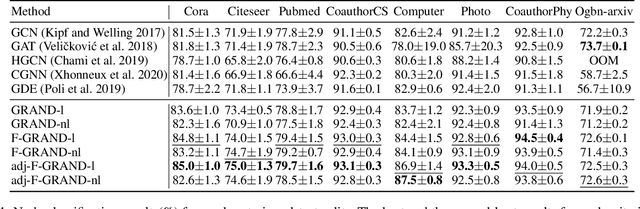
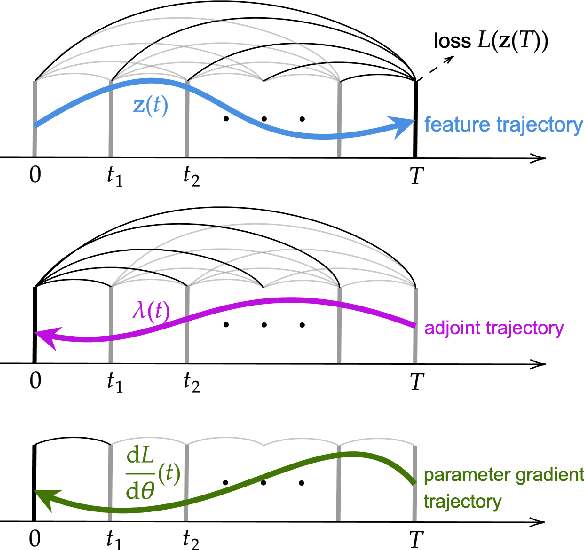

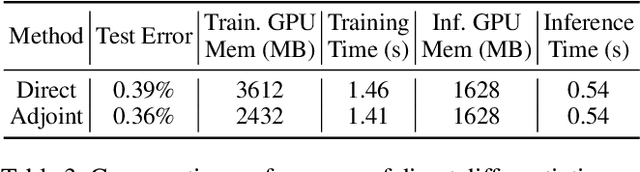
Fractional-order differential equations (FDEs) enhance traditional differential equations by extending the order of differential operators from integers to real numbers, offering greater flexibility in modeling complex dynamical systems with nonlocal characteristics. Recent progress at the intersection of FDEs and deep learning has catalyzed a new wave of innovative models, demonstrating the potential to address challenges such as graph representation learning. However, training neural FDEs has primarily relied on direct differentiation through forward-pass operations in FDE numerical solvers, leading to increased memory usage and computational complexity, particularly in large-scale applications. To address these challenges, we propose a scalable adjoint backpropagation method for training neural FDEs by solving an augmented FDE backward in time, which substantially reduces memory requirements. This approach provides a practical neural FDE toolbox and holds considerable promise for diverse applications. We demonstrate the effectiveness of our method in several tasks, achieving performance comparable to baseline models while significantly reducing computational overhead.
Distributed-Order Fractional Graph Operating Network
Nov 08, 2024
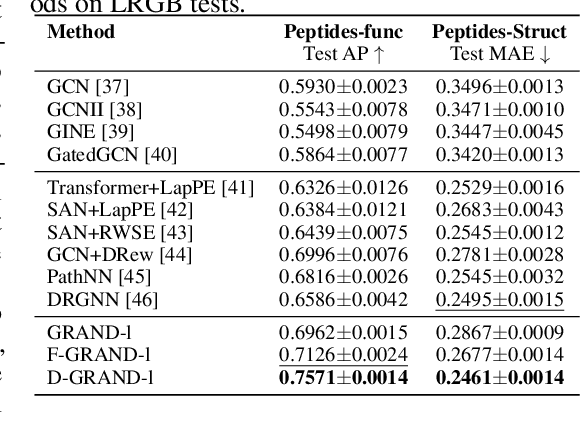
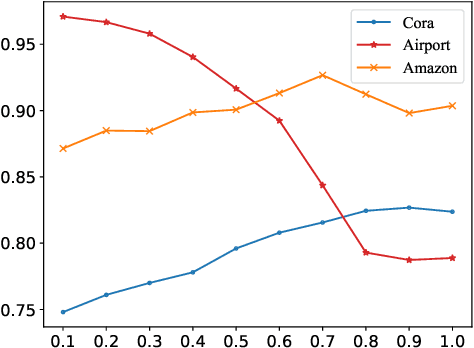
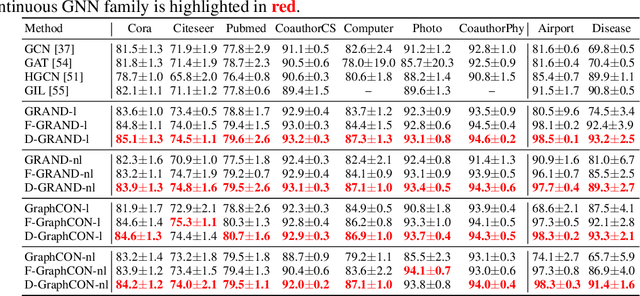
We introduce the Distributed-order fRActional Graph Operating Network (DRAGON), a novel continuous Graph Neural Network (GNN) framework that incorporates distributed-order fractional calculus. Unlike traditional continuous GNNs that utilize integer-order or single fractional-order differential equations, DRAGON uses a learnable probability distribution over a range of real numbers for the derivative orders. By allowing a flexible and learnable superposition of multiple derivative orders, our framework captures complex graph feature updating dynamics beyond the reach of conventional models. We provide a comprehensive interpretation of our framework's capability to capture intricate dynamics through the lens of a non-Markovian graph random walk with node feature updating driven by an anomalous diffusion process over the graph. Furthermore, to highlight the versatility of the DRAGON framework, we conduct empirical evaluations across a range of graph learning tasks. The results consistently demonstrate superior performance when compared to traditional continuous GNN models. The implementation code is available at \url{https://github.com/zknus/NeurIPS-2024-DRAGON}.