 Add to Chrome
 Add to Firefox
 Add to Edge
InsertFuse: A Unified Framework for Multi-Category Reference-Guided Image Insertion
Aug 06, 2026
We present InsertFuse, a unified framework for multi-category reference-guided image insertion. Its key idea is to decouple category-specific expertise learning from cross-category capability consolidation. InsertFuse first trains specialized experts for different insertion categories and then introduces Insertion On-Policy Distillation (IOPD) to consolidate their capabilities into a single student. By querying the matched expert at states visited by the student, IOPD preserves category-specific insertion behavior while mitigating the cross-category interference caused by direct joint training. To improve spatial control, we propose Token-Aligned Geometry Conditioning (TAGC), which maps mask-derived geometric cues to the visual token grid, and Region-Balanced Flow Matching, which separately normalizes prediction errors inside and outside the insertion region to prevent background-dominated and scale-dependent supervision. We further introduce Reference CFG to isolate and strengthen the guidance induced by the visual reference under fixed scene and geometry conditions, with IOPD transferring this enhanced supervision into the unified student. Extensive experiments on the public AnyInsertion benchmark and our multi-category test set demonstrate state-of-the-art performance on most metrics, showing strong reference fidelity and generation quality across diverse insertion categories.

REF-VLM: Triplet-Based Referring Paradigm for Unified Visual Decoding
Mar 10, 2025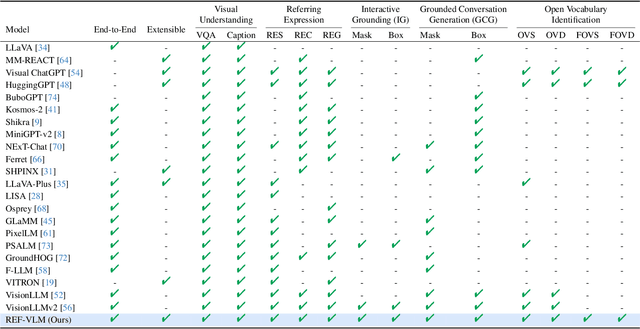
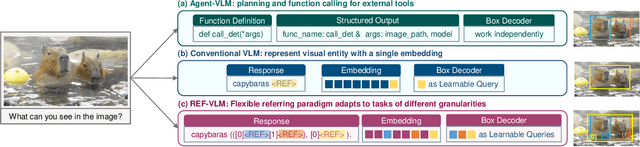
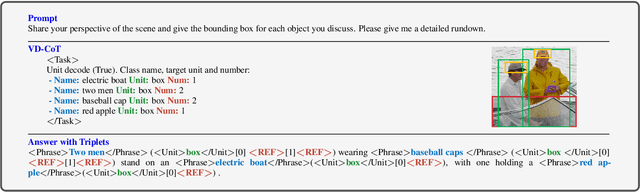
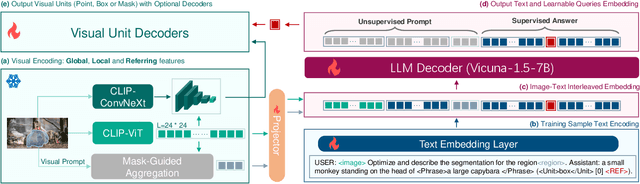
Multimodal Large Language Models (MLLMs) demonstrate robust zero-shot capabilities across diverse vision-language tasks after training on mega-scale datasets. However, dense prediction tasks, such as semantic segmentation and keypoint detection, pose significant challenges for MLLMs when represented solely as text outputs. Simultaneously, current MLLMs utilizing latent embeddings for visual task decoding generally demonstrate limited adaptability to both multi-task learning and multi-granularity scenarios. In this work, we present REF-VLM, an end-to-end framework for unified training of various visual decoding tasks. To address complex visual decoding scenarios, we introduce the Triplet-Based Referring Paradigm (TRP), which explicitly decouples three critical dimensions in visual decoding tasks through a triplet structure: concepts, decoding types, and targets. TRP employs symbolic delimiters to enforce structured representation learning, enhancing the parsability and interpretability of model outputs. Additionally, we construct Visual-Task Instruction Following Dataset (VTInstruct), a large-scale multi-task dataset containing over 100 million multimodal dialogue samples across 25 task types. Beyond text inputs and outputs, VT-Instruct incorporates various visual prompts such as point, box, scribble, and mask, and generates outputs composed of text and visual units like box, keypoint, depth and mask. The combination of different visual prompts and visual units generates a wide variety of task types, expanding the applicability of REF-VLM significantly. Both qualitative and quantitative experiments demonstrate that our REF-VLM outperforms other MLLMs across a variety of standard benchmarks. The code, dataset, and demo available at https://github.com/MacavityT/REF-VLM.
Link-Context Learning for Multimodal LLMs
Aug 15, 2023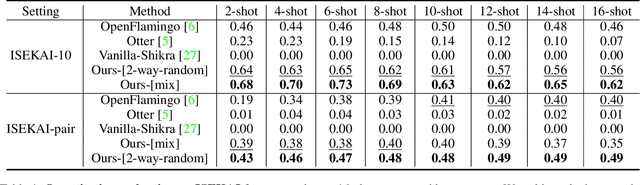

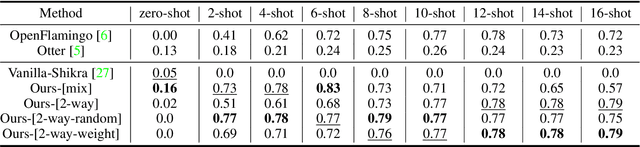
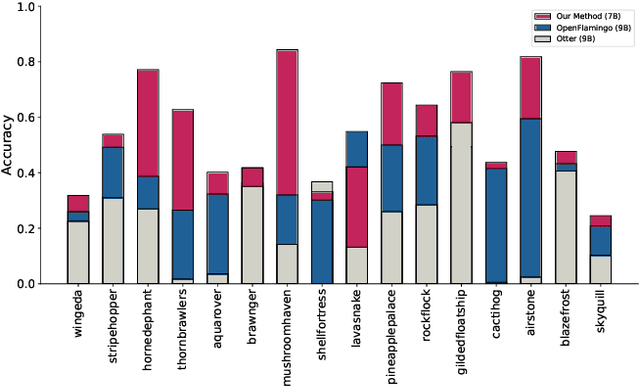
The ability to learn from context with novel concepts, and deliver appropriate responses are essential in human conversations. Despite current Multimodal Large Language Models (MLLMs) and Large Language Models (LLMs) being trained on mega-scale datasets, recognizing unseen images or understanding novel concepts in a training-free manner remains a challenge. In-Context Learning (ICL) explores training-free few-shot learning, where models are encouraged to ``learn to learn" from limited tasks and generalize to unseen tasks. In this work, we propose link-context learning (LCL), which emphasizes "reasoning from cause and effect" to augment the learning capabilities of MLLMs. LCL goes beyond traditional ICL by explicitly strengthening the causal relationship between the support set and the query set. By providing demonstrations with causal links, LCL guides the model to discern not only the analogy but also the underlying causal associations between data points, which empowers MLLMs to recognize unseen images and understand novel concepts more effectively. To facilitate the evaluation of this novel approach, we introduce the ISEKAI dataset, comprising exclusively of unseen generated image-label pairs designed for link-context learning. Extensive experiments show that our LCL-MLLM exhibits strong link-context learning capabilities to novel concepts over vanilla MLLMs. Code and data will be released at https://github.com/isekai-portal/Link-Context-Learning.