 Add to Chrome
 Add to Firefox
 Add to Edge
GPrune-LLM: Generalization-Aware Structured Pruning for Large Language Models
Mar 12, 2026
Structured pruning is widely used to compress large language models (LLMs), yet its effectiveness depends heavily on neuron importance estimation. Most existing methods estimate neuron importance from activation statistics on a single calibration dataset, which introduces calibration bias and degrades downstream cross-task generalization. We observe that neurons exhibit heterogeneous distribution sensitivity, with distribution-robust neurons maintaining consistent rankings across datasets and distribution-sensitive neurons showing high cross-dataset ranking variance. Based on this, we identify two structural limitations in existing methods. First, ranking all neurons within a shared space causes distribution-sensitive neurons that strongly activate on calibration inputs to dominate, crowding out distribution-robust neurons critical for out-of-distribution tasks. Second, applying activation-based importance metrics uniformly can be unreliable. Distribution-sensitive neurons that infrequently activate on calibration data receive insufficient activation signal for accurate local ranking. To address these limitations, we propose GPrune-LLM, a generalization-aware structured pruning framework that explicitly accounts for neuron differences in cross-distribution behavior. We first partition neurons into behavior-consistent modules to localize ranking competition, then evaluate activation-based metric reliability per module according to distribution sensitivity and score magnitude. For modules where activation-based scoring is unreliable, we switch to an activation-independent metric. Finally, we adaptively learn module-wise sparsity. Extensive experiments across multiple downstream tasks demonstrate GPrune-LLM's consistent improvements in post-compression generalization, particularly at high sparsity, and reduced dependence on importance metric choice.

REF-VLM: Triplet-Based Referring Paradigm for Unified Visual Decoding
Mar 10, 2025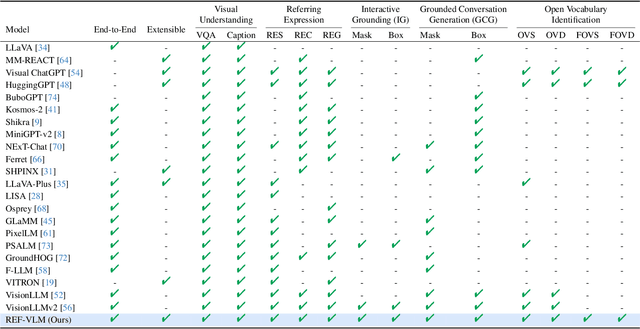
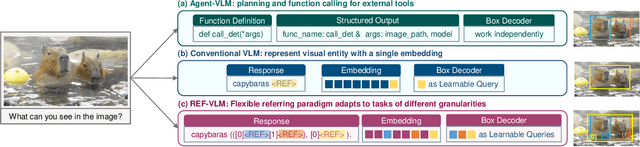
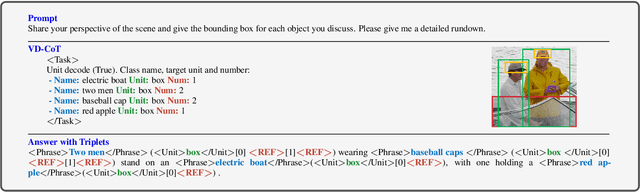
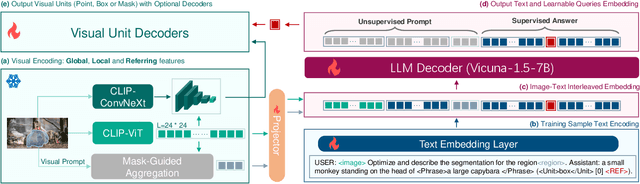
Multimodal Large Language Models (MLLMs) demonstrate robust zero-shot capabilities across diverse vision-language tasks after training on mega-scale datasets. However, dense prediction tasks, such as semantic segmentation and keypoint detection, pose significant challenges for MLLMs when represented solely as text outputs. Simultaneously, current MLLMs utilizing latent embeddings for visual task decoding generally demonstrate limited adaptability to both multi-task learning and multi-granularity scenarios. In this work, we present REF-VLM, an end-to-end framework for unified training of various visual decoding tasks. To address complex visual decoding scenarios, we introduce the Triplet-Based Referring Paradigm (TRP), which explicitly decouples three critical dimensions in visual decoding tasks through a triplet structure: concepts, decoding types, and targets. TRP employs symbolic delimiters to enforce structured representation learning, enhancing the parsability and interpretability of model outputs. Additionally, we construct Visual-Task Instruction Following Dataset (VTInstruct), a large-scale multi-task dataset containing over 100 million multimodal dialogue samples across 25 task types. Beyond text inputs and outputs, VT-Instruct incorporates various visual prompts such as point, box, scribble, and mask, and generates outputs composed of text and visual units like box, keypoint, depth and mask. The combination of different visual prompts and visual units generates a wide variety of task types, expanding the applicability of REF-VLM significantly. Both qualitative and quantitative experiments demonstrate that our REF-VLM outperforms other MLLMs across a variety of standard benchmarks. The code, dataset, and demo available at https://github.com/MacavityT/REF-VLM.
Metasurface-generated large and arbitrary analog convolution kernels for accelerated machine vision
Sep 27, 2024
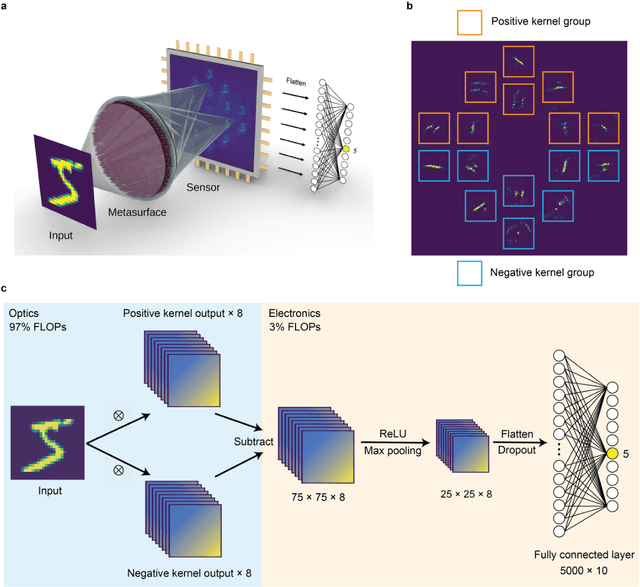
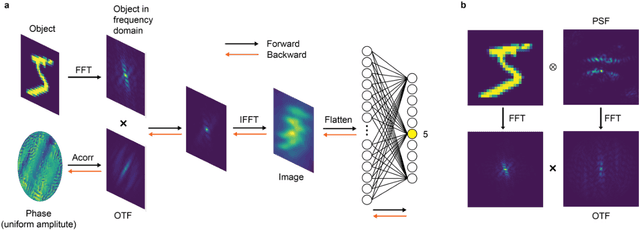

In the rapidly evolving field of artificial intelligence, convolutional neural networks are essential for tackling complex challenges such as machine vision and medical diagnosis. Recently, to address the challenges in processing speed and power consumption of conventional digital convolution operations, many optical components have been suggested to replace the digital convolution layer in the neural network, accelerating various machine vision tasks. Nonetheless, the analog nature of the optical convolution kernel has not been fully explored. Here, we develop a spatial frequency domain training method to create arbitrarily shaped analog convolution kernels using an optical metasurface as the convolution layer, with its receptive field largely surpassing digital convolution kernels. By employing spatial multiplexing, the multiple parallel convolution kernels with both positive and negative weights are generated under the incoherent illumination condition. We experimentally demonstrate a 98.59% classification accuracy on the MNIST dataset, with simulations showing 92.63% and 68.67% accuracy on the Fashion-MNIST and CIFAR-10 datasets with additional digital layers. This work underscores the unique advantage of analog optical convolution, offering a promising avenue to accelerate machine vision tasks, especially in edge devices.