 Add to Chrome
 Add to Firefox
 Add to Edge
Domain-Inspired Sharpness-Aware Minimization Under Domain Shifts
May 29, 2024
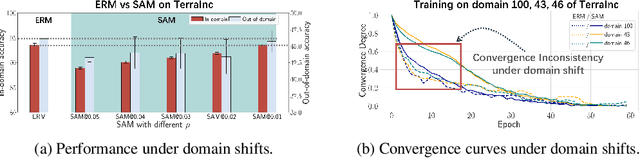
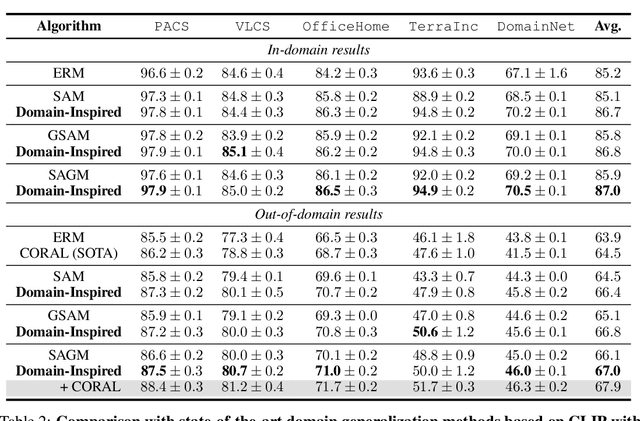
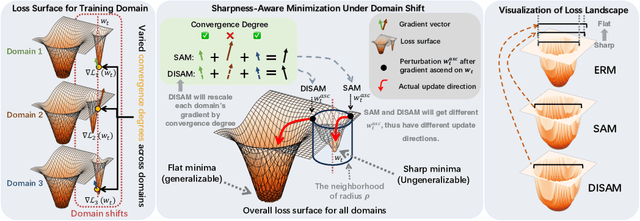
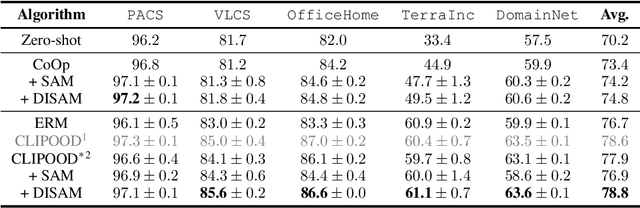
This paper presents a Domain-Inspired Sharpness-Aware Minimization (DISAM) algorithm for optimization under domain shifts. It is motivated by the inconsistent convergence degree of SAM across different domains, which induces optimization bias towards certain domains and thus impairs the overall convergence. To address this issue, we consider the domain-level convergence consistency in the sharpness estimation to prevent the overwhelming (deficient) perturbations for less (well) optimized domains. Specifically, DISAM introduces the constraint of minimizing variance in the domain loss, which allows the elastic gradient calibration in perturbation generation: when one domain is optimized above the averaging level \textit{w.r.t.} loss, the gradient perturbation towards that domain will be weakened automatically, and vice versa. Under this mechanism, we theoretically show that DISAM can achieve faster overall convergence and improved generalization in principle when inconsistent convergence emerges. Extensive experiments on various domain generalization benchmarks show the superiority of DISAM over a range of state-of-the-art methods. Furthermore, we show the superior efficiency of DISAM in parameter-efficient fine-tuning combined with the pretraining models. The source code is released at https://github.com/MediaBrain-SJTU/DISAM.

Federated Learning under Partially Class-Disjoint Data via Manifold Reshaping
May 29, 2024Statistical heterogeneity severely limits the performance of federated learning (FL), motivating several explorations e.g., FedProx, MOON and FedDyn, to alleviate this problem. Despite effectiveness, their considered scenario generally requires samples from almost all classes during the local training of each client, although some covariate shifts may exist among clients. In fact, the natural case of partially class-disjoint data (PCDD), where each client contributes a few classes (instead of all classes) of samples, is practical yet underexplored. Specifically, the unique collapse and invasion characteristics of PCDD can induce the biased optimization direction in local training, which prevents the efficiency of federated learning. To address this dilemma, we propose a manifold reshaping approach called FedMR to calibrate the feature space of local training. Our FedMR adds two interplaying losses to the vanilla federated learning: one is intra-class loss to decorrelate feature dimensions for anti-collapse; and the other one is inter-class loss to guarantee the proper margin among categories in the feature expansion. We conduct extensive experiments on a range of datasets to demonstrate that our FedMR achieves much higher accuracy and better communication efficiency. Source code is available at: https://github.com/MediaBrain-SJTU/FedMR.git.
Locally Estimated Global Perturbations are Better than Local Perturbations for Federated Sharpness-aware Minimization
May 29, 2024

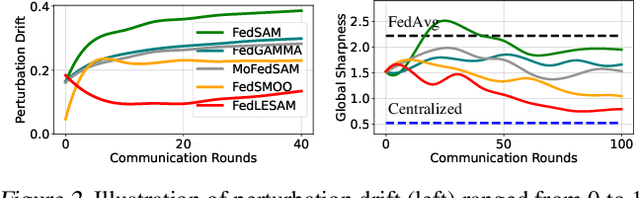

In federated learning (FL), the multi-step update and data heterogeneity among clients often lead to a loss landscape with sharper minima, degenerating the performance of the resulted global model. Prevalent federated approaches incorporate sharpness-aware minimization (SAM) into local training to mitigate this problem. However, the local loss landscapes may not accurately reflect the flatness of global loss landscape in heterogeneous environments; as a result, minimizing local sharpness and calculating perturbations on client data might not align the efficacy of SAM in FL with centralized training. To overcome this challenge, we propose FedLESAM, a novel algorithm that locally estimates the direction of global perturbation on client side as the difference between global models received in the previous active and current rounds. Besides the improved quality, FedLESAM also speed up federated SAM-based approaches since it only performs once backpropagation in each iteration. Theoretically, we prove a slightly tighter bound than its original FedSAM by ensuring consistent perturbation. Empirically, we conduct comprehensive experiments on four federated benchmark datasets under three partition strategies to demonstrate the superior performance and efficiency of FedLESAM.
HarmoDT: Harmony Multi-Task Decision Transformer for Offline Reinforcement Learning
May 28, 2024The purpose of offline multi-task reinforcement learning (MTRL) is to develop a unified policy applicable to diverse tasks without the need for online environmental interaction. Recent advancements approach this through sequence modeling, leveraging the Transformer architecture's scalability and the benefits of parameter sharing to exploit task similarities. However, variations in task content and complexity pose significant challenges in policy formulation, necessitating judicious parameter sharing and management of conflicting gradients for optimal policy performance. In this work, we introduce the Harmony Multi-Task Decision Transformer (HarmoDT), a novel solution designed to identify an optimal harmony subspace of parameters for each task. We approach this as a bi-level optimization problem, employing a meta-learning framework that leverages gradient-based techniques. The upper level of this framework is dedicated to learning a task-specific mask that delineates the harmony subspace, while the inner level focuses on updating parameters to enhance the overall performance of the unified policy. Empirical evaluations on a series of benchmarks demonstrate the superiority of HarmoDT, verifying the effectiveness of our approach.
Mitigating Noisy Correspondence by Geometrical Structure Consistency Learning
May 27, 2024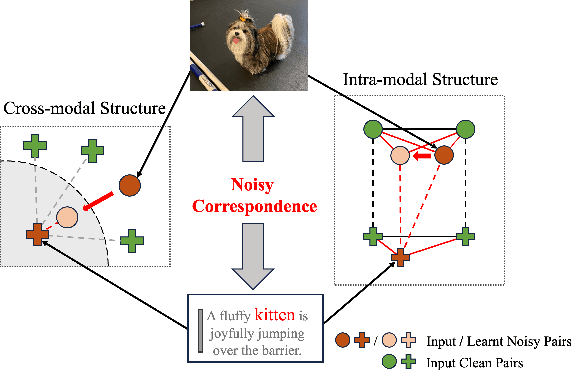
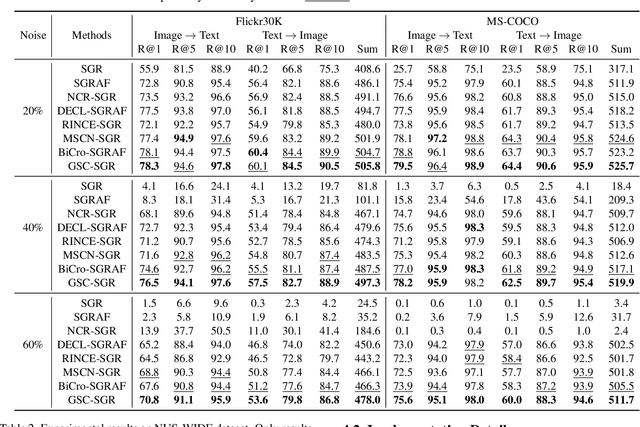
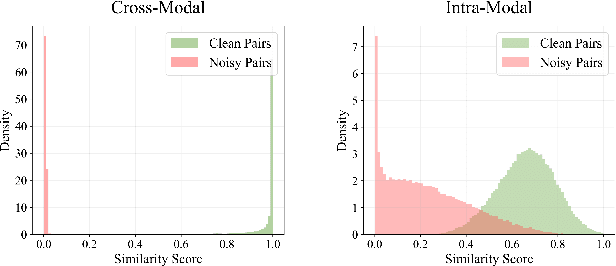
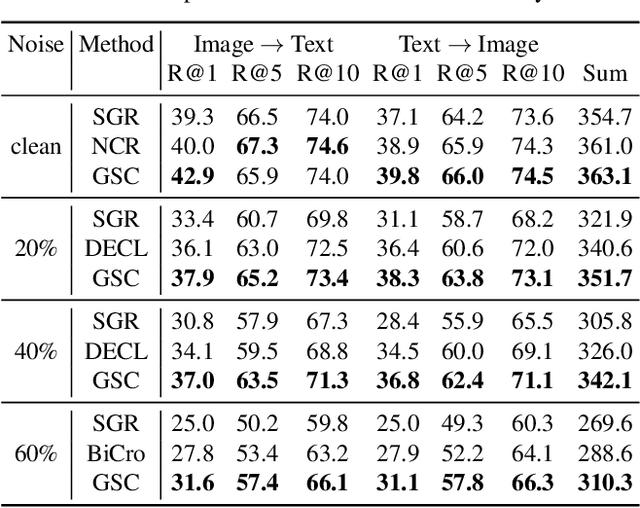
Noisy correspondence that refers to mismatches in cross-modal data pairs, is prevalent on human-annotated or web-crawled datasets. Prior approaches to leverage such data mainly consider the application of uni-modal noisy label learning without amending the impact on both cross-modal and intra-modal geometrical structures in multimodal learning. Actually, we find that both structures are effective to discriminate noisy correspondence through structural differences when being well-established. Inspired by this observation, we introduce a Geometrical Structure Consistency (GSC) method to infer the true correspondence. Specifically, GSC ensures the preservation of geometrical structures within and between modalities, allowing for the accurate discrimination of noisy samples based on structural differences. Utilizing these inferred true correspondence labels, GSC refines the learning of geometrical structures by filtering out the noisy samples. Experiments across four cross-modal datasets confirm that GSC effectively identifies noisy samples and significantly outperforms the current leading methods.
Q-value Regularized Transformer for Offline Reinforcement Learning
May 27, 2024Recent advancements in offline reinforcement learning (RL) have underscored the capabilities of Conditional Sequence Modeling (CSM), a paradigm that learns the action distribution based on history trajectory and target returns for each state. However, these methods often struggle with stitching together optimal trajectories from sub-optimal ones due to the inconsistency between the sampled returns within individual trajectories and the optimal returns across multiple trajectories. Fortunately, Dynamic Programming (DP) methods offer a solution by leveraging a value function to approximate optimal future returns for each state, while these techniques are prone to unstable learning behaviors, particularly in long-horizon and sparse-reward scenarios. Building upon these insights, we propose the Q-value regularized Transformer (QT), which combines the trajectory modeling ability of the Transformer with the predictability of optimal future returns from DP methods. QT learns an action-value function and integrates a term maximizing action-values into the training loss of CSM, which aims to seek optimal actions that align closely with the behavior policy. Empirical evaluations on D4RL benchmark datasets demonstrate the superiority of QT over traditional DP and CSM methods, highlighting the potential of QT to enhance the state-of-the-art in offline RL.
JointRF: End-to-End Joint Optimization for Dynamic Neural Radiance Field Representation and Compression
May 23, 2024Neural Radiance Field (NeRF) excels in photo-realistically static scenes, inspiring numerous efforts to facilitate volumetric videos. However, rendering dynamic and long-sequence radiance fields remains challenging due to the significant data required to represent volumetric videos. In this paper, we propose a novel end-to-end joint optimization scheme of dynamic NeRF representation and compression, called JointRF, thus achieving significantly improved quality and compression efficiency against the previous methods. Specifically, JointRF employs a compact residual feature grid and a coefficient feature grid to represent the dynamic NeRF. This representation handles large motions without compromising quality while concurrently diminishing temporal redundancy. We also introduce a sequential feature compression subnetwork to further reduce spatial-temporal redundancy. Finally, the representation and compression subnetworks are end-to-end trained combined within the JointRF. Extensive experiments demonstrate that JointRF can achieve superior compression performance across various datasets.
Learning Multi-Agent Communication from Graph Modeling Perspective
May 14, 2024In numerous artificial intelligence applications, the collaborative efforts of multiple intelligent agents are imperative for the successful attainment of target objectives. To enhance coordination among these agents, a distributed communication framework is often employed. However, information sharing among all agents proves to be resource-intensive, while the adoption of a manually pre-defined communication architecture imposes limitations on inter-agent communication, thereby constraining the potential for collaborative efforts. In this study, we introduce a novel approach wherein we conceptualize the communication architecture among agents as a learnable graph. We formulate this problem as the task of determining the communication graph while enabling the architecture parameters to update normally, thus necessitating a bi-level optimization process. Utilizing continuous relaxation of the graph representation and incorporating attention units, our proposed approach, CommFormer, efficiently optimizes the communication graph and concurrently refines architectural parameters through gradient descent in an end-to-end manner. Extensive experiments on a variety of cooperative tasks substantiate the robustness of our model across diverse cooperative scenarios, where agents are able to develop more coordinated and sophisticated strategies regardless of changes in the number of agents.
Low-Rank Knowledge Decomposition for Medical Foundation Models
Apr 26, 2024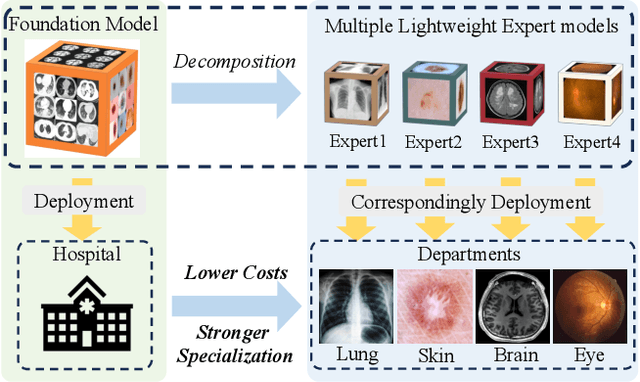
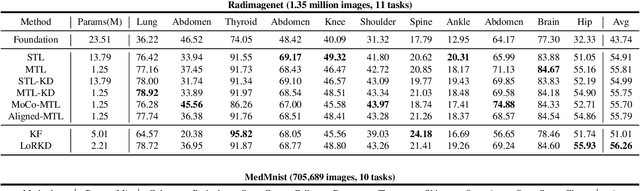
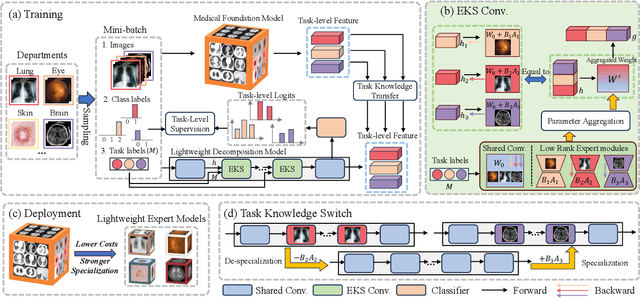
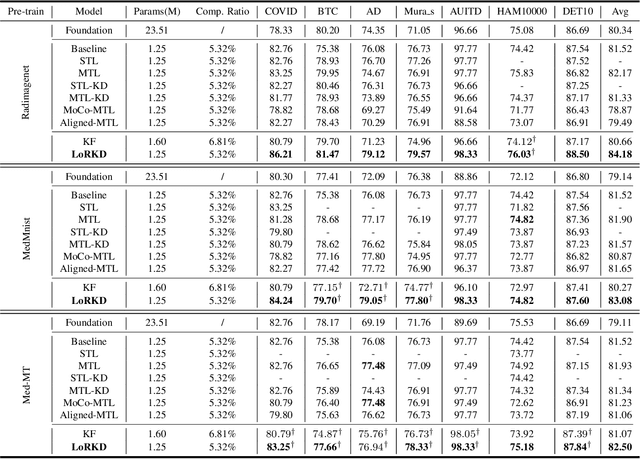
The popularity of large-scale pre-training has promoted the development of medical foundation models. However, some studies have shown that although foundation models exhibit strong general feature extraction capabilities, their performance on specific tasks is still inferior to task-specific methods. In this paper, we explore a new perspective called ``Knowledge Decomposition'' to improve the performance on specific medical tasks, which deconstruct the foundation model into multiple lightweight expert models, each dedicated to a particular task, with the goal of improving specialization while concurrently mitigating resource expenditure. To accomplish the above objective, we design a novel framework named Low-Rank Knowledge Decomposition (LoRKD), which explicitly separates graidents by incorporating low-rank expert modules and the efficient knowledge separation convolution. Extensive experimental results demonstrate that the decomposed models perform well in terms of performance and transferability, even surpassing the original foundation models.
RadGenome-Chest CT: A Grounded Vision-Language Dataset for Chest CT Analysis
Apr 25, 2024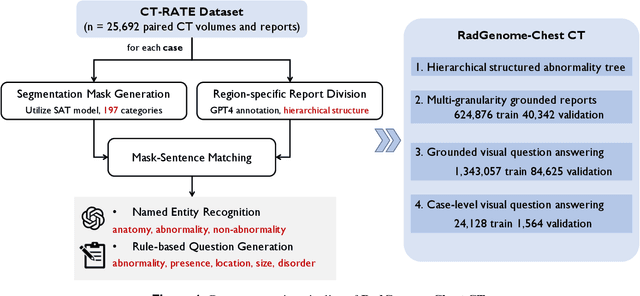

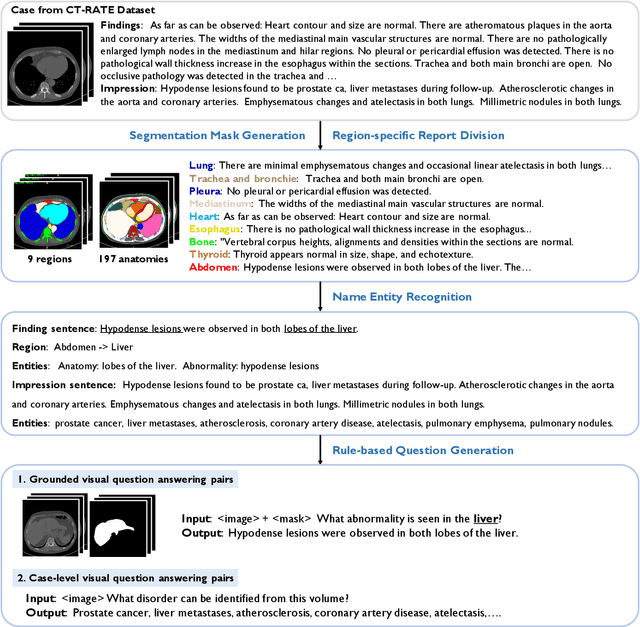
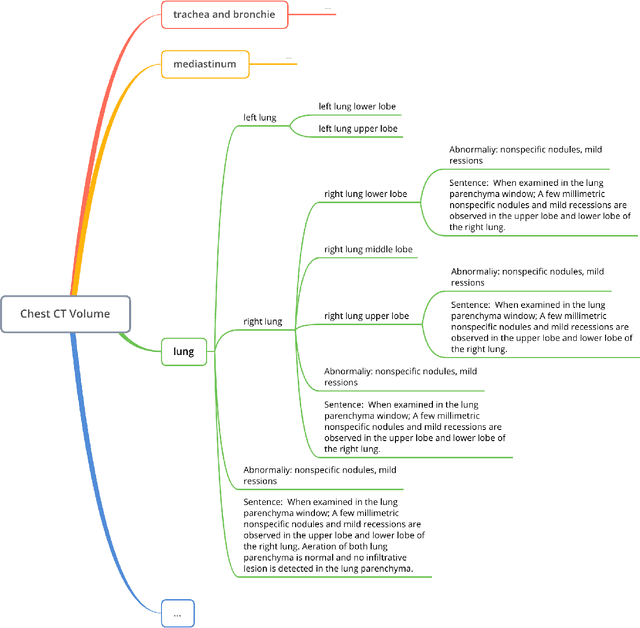
Developing generalist foundation model has recently attracted tremendous attention among researchers in the field of AI for Medicine (AI4Medicine). A pivotal insight in developing these models is their reliance on dataset scaling, which emphasizes the requirements on developing open-source medical image datasets that incorporate diverse supervision signals across various imaging modalities. In this paper, we introduce RadGenome-Chest CT, a comprehensive, large-scale, region-guided 3D chest CT interpretation dataset based on CT-RATE. Specifically, we leverage the latest powerful universal segmentation and large language models, to extend the original datasets (over 25,692 non-contrast 3D chest CT volume and reports from 20,000 patients) from the following aspects: (i) organ-level segmentation masks covering 197 categories, which provide intermediate reasoning visual clues for interpretation; (ii) 665 K multi-granularity grounded reports, where each sentence of the report is linked to the corresponding anatomical region of CT volume in the form of a segmentation mask; (iii) 1.3 M grounded VQA pairs, where questions and answers are all linked with reference segmentation masks, enabling models to associate visual evidence with textual explanations. All grounded reports and VQA pairs in the validation set have gone through manual verification to ensure dataset quality. We believe that RadGenome-Chest CT can significantly advance the development of multimodal medical foundation models, by training to generate texts based on given segmentation regions, which is unattainable with previous relevant datasets. We will release all segmentation masks, grounded reports, and VQA pairs to facilitate further research and development in this field.